SWAU-Net: Longitudinal Prediction of Geographic Atrophy via Sliding-Window Attention
Peter Racioppo, Ziyuan Chris Wang, SriniVas R. Sadda, Zhihong Jewel Hu

TL;DR
A new deep learning model called SWAU-Net improves the prediction of geographic atrophy progression in age-related macular degeneration, helping with clinical trials and patient monitoring.
Contribution
SWAU-Net introduces a novel hybrid architecture combining Transformer-based temporal modeling with U-Net spatial modeling, enhanced by consistency priors to improve prediction accuracy in low-data scenarios.
Findings
SWAU-Net achieved a Growth Mask Dice Similarity Coefficient (DSC) of 0.66, outperforming baseline models.
The model's structural constraints prevent overfitting to imaging noise, improving prediction robustness.
The framework supports more efficient clinical trial designs and personalized patient monitoring for geographic atrophy.
Abstract
Age-related macular degeneration (AMD) is the leading cause of central vision loss in aging populations. Geographic atrophy (GA) is the advanced, non-neovascular form of AMD. Predicting the longitudinal progression of GA remains a critical challenge in ophthalmic clinical practice and clinical trial design. Forecasting the trajectory of GA is complicated by highly variable growth rates and the inherent scarcity of long-term, high-quality imaging data. To address these challenges, we introduce the Sliding Window Attention U-Net (SWAU-Net), a hybrid architecture that integrates Transformer-based temporal modeling of GA growth with precise spatial modeling of GA location with a U-Net convolutional neural network (CNN). To ensure generalization in the low-data regime, SWAU-Net embeds explicit temporal and geometric consistency priors via a weight-shared Sliding Window Attention core and…
Genes, proteins, chemicals, diseases, species, mutations and cell lines named across the full text — each resolved to its canonical identifier and authoritative record.
Click any figure to enlarge with its caption.
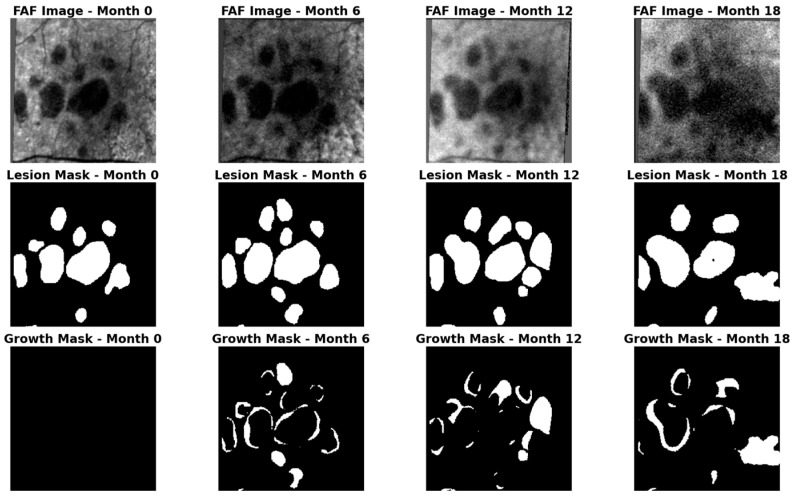 Figure 1
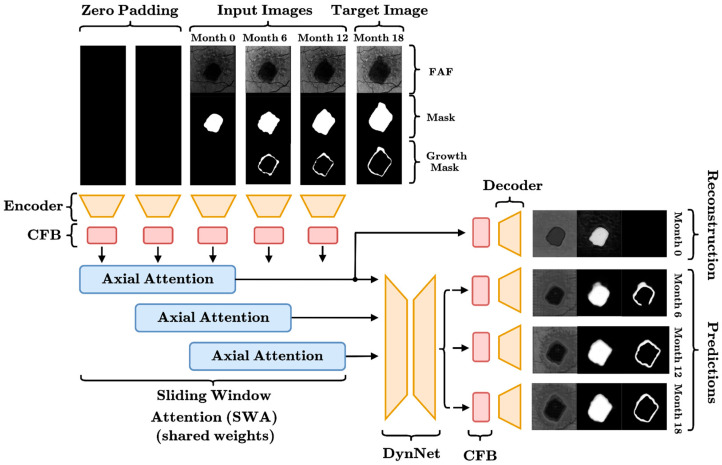 Figure 2
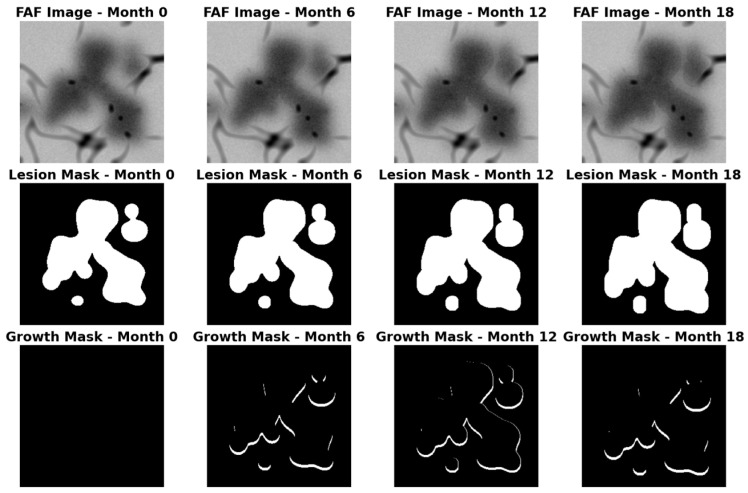 Figure 3
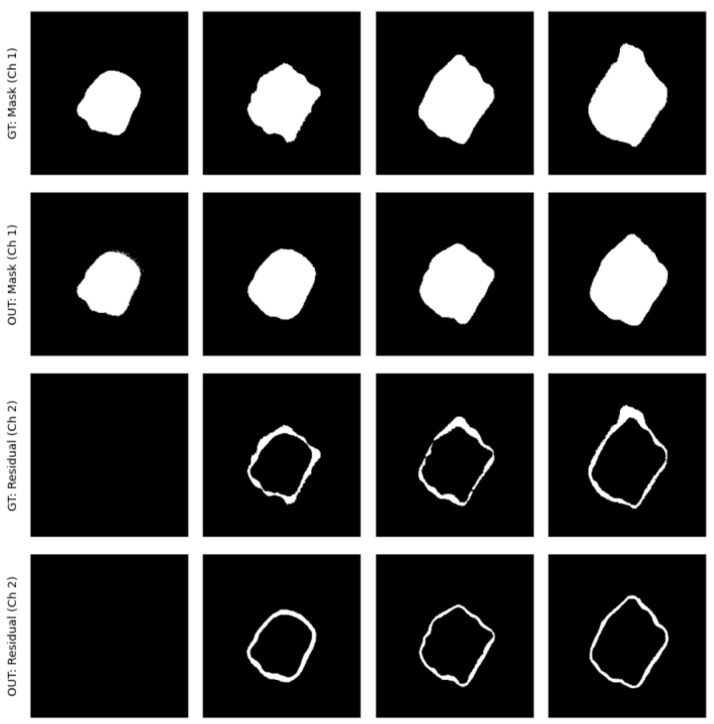 Figure 4
Peer Reviews
No public reviews on file for this paper yet. If you reviewed it on a platform where reviews are public (OpenReview, ICLR, NeurIPS, ICML), you can paste yours below so the community can read it here.
Videos
No videos yet. Explain this paper in a talk, walkthrough, or lecture? Add one.
Taxonomy
TopicsRetinal Imaging and Analysis · Retinal Diseases and Treatments · Ophthalmology and Visual Impairment Studies