HLA-DQ7 De Novo Donor-Specific Antibodies Are Associated with Increased Risk of Chronic Lung Allograft Dysfunction After Lung Transplantation
Maximilian Vorstandlechner, Julia Walter, Christian P. Schneider, Nicole Samm, Sebastian Michel, Paola Arnold, Roland Tomasi, Andrea Dick, Teresa Kauke

TL;DR
This study shows that HLA-DQ7 antibodies after lung transplants are linked to a higher risk of long-term lung failure and rejection-related deaths.
Contribution
The study identifies HLA-DQ7 as a specific antibody type strongly associated with chronic lung allograft dysfunction.
Findings
dnDSA occurred in 25.8% of lung transplant recipients, with class II being most common.
HLA-DQ dnDSA, especially DQ7, were strongly linked to chronic lung allograft dysfunction.
dnDSA-positive patients had higher rejection-attributed mortality compared to dnDSA-negative patients.
Abstract
Background/Objectives: Chronic lung allograft dysfunction (CLAD) remains the leading cause of late graft failure after lung transplantation (LuTX). De novo donor-specific anti-HLA antibodies (dnDSA), especially HLA-DQ, have been implicated; we assessed associations between dnDSA (class and specificity) and CLAD after LuTX. Methods: We retrospectively analyzed all LuTX recipients transplanted from 2005–2018 at a single center (n = 585). dnDSA were measured by Luminex single-antigen bead assays (MFI > 1000) at 1, 3, 6, and 12 months and at least annually thereafter. CLAD was defined by ISHLT criteria; time-to-event comparisons used log-rank testing. Results: dnDSA developed in 151/585 recipients (25.8%), predominantly class II (129/585; 22.1%); class I dnDSA occurred in 52/585 (8.9%). CLAD occurred more frequently in dnDSA-positive than dnDSA-negative recipients (64/151; 42.4% vs.…
Genes, proteins, chemicals, diseases, species, mutations and cell lines named across the full text — each resolved to its canonical identifier and authoritative record.
Click any figure to enlarge with its caption.
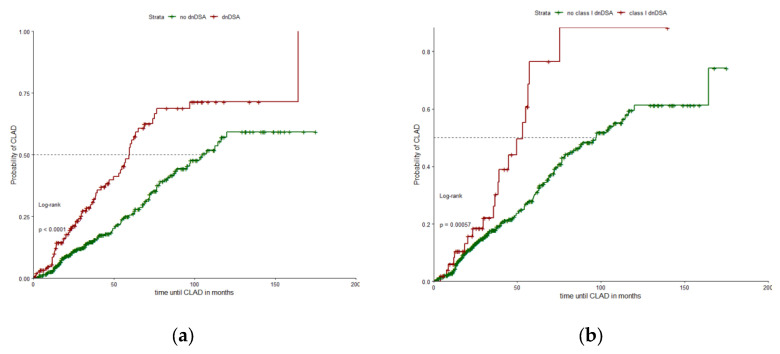 Figure 1
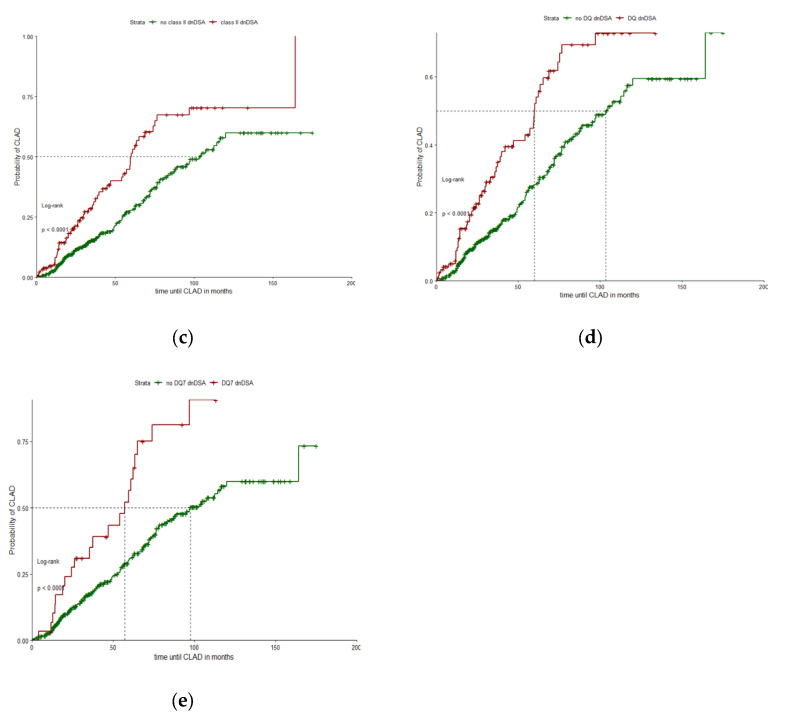 Figure 2
Peer Reviews
No public reviews on file for this paper yet. If you reviewed it on a platform where reviews are public (OpenReview, ICLR, NeurIPS, ICML), you can paste yours below so the community can read it here.
Videos
No videos yet. Explain this paper in a talk, walkthrough, or lecture? Add one.
Taxonomy
TopicsTransplantation: Methods and Outcomes · Renal Transplantation Outcomes and Treatments · Organ and Tissue Transplantation Research