Congenital Temporomandibular Joint Ankylosis: Investigating Potential Genetic Etiologies with Whole Exome Sequencing
Bożena Anna Marszałek-Kruk, Krzysztof Dowgierd, Mateusz Lejawa, Małgorzata Kulesa-Mrowiecka, Wojciech Wolański, Andrzej Myśliwiec, Anna Lipowicz

TL;DR
This study uses whole exome sequencing to identify genetic variants possibly linked to congenital temporomandibular joint ankylosis in a patient with facial asymmetry.
Contribution
The study reports the first case of congenital ankylosis with pathogenic variants in genes associated with craniofacial dysostosis syndromes.
Findings
Three pathogenic variants were identified in TCOF1, POLR1B, and DHODH genes.
Eight pathogenic variants were found in genes not previously linked to facial disorders.
WES proved effective in identifying genetic factors for congenital TMJ ankylosis.
Abstract
Background: Ankylosis of the temporomandibular joint (TMJ) is a rare developmental disorder that involves fibrous or bony fusion within the joint. It is a severe structural and functional disorder. Typically, the phenotype manifests as joint immobilization and results in facial deformity and trismus. To date, ankylosis is rarely diagnosed as congenital and its occurrence mechanism has not been thoroughly understood. We observed a female patient who as a newborn showed slight facial asymmetry and impaired mandibular retraction. In addition, non-uniform occlusal fissures were noted; the lower part of the left earlobe was slightly smaller than the right earlobe. The aim of the work was the identification of pathogenic variants in the genome related to ankylosis. Ankylosis has no known causative gene yet; thus, Whole Exome Sequencing (WES) was performed. Materials and Methods: We observed a…
Genes, proteins, chemicals, diseases, species, mutations and cell lines named across the full text — each resolved to its canonical identifier and authoritative record.
Click any figure to enlarge with its caption.
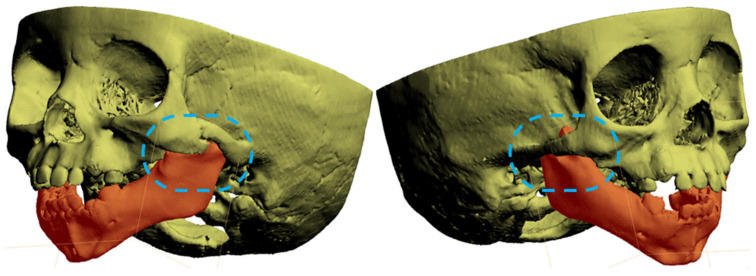 Figure 1
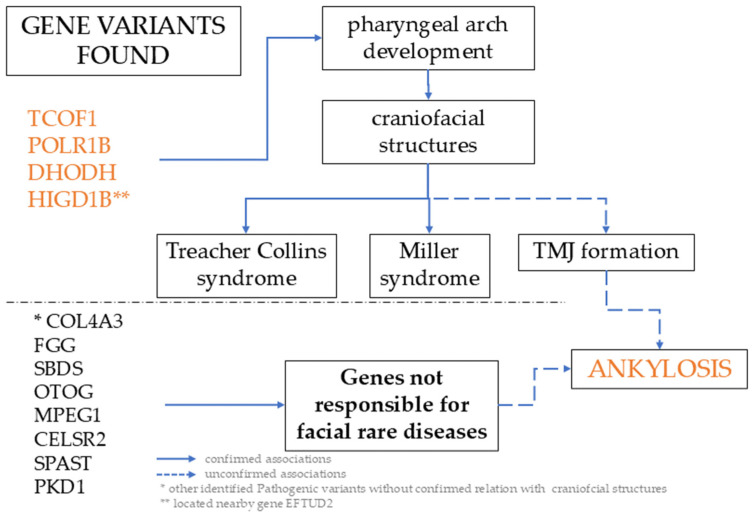 Figure 2
Peer Reviews
No public reviews on file for this paper yet. If you reviewed it on a platform where reviews are public (OpenReview, ICLR, NeurIPS, ICML), you can paste yours below so the community can read it here.
Videos
No videos yet. Explain this paper in a talk, walkthrough, or lecture? Add one.
Taxonomy
TopicsTemporomandibular Joint Disorders · Craniofacial Disorders and Treatments · dental development and anomalies