Alzheimer’s 2030: From Precision Genomics to Artificial Intelligence
Valeria D’Argenio, Rossella Tomaiuolo, Silvia Bargeri, Giulia Sancesario

TL;DR
This paper reviews how precision genomics and AI can improve Alzheimer's prevention, focusing on genetic and gender factors.
Contribution
The paper emphasizes integrating genetic risk scores and AI with sex and gender considerations for precision medicine in Alzheimer's.
Findings
Genetic factors contribute significantly to sporadic late-onset Alzheimer's disease.
Women are disproportionately affected due to biological and sociocultural factors.
AI and genetic risk scores offer potential for personalized prevention strategies.
Abstract
Alzheimer’s disease (AD) represents a critical global health challenge, with its prevalence and associated costs expected to double significantly by 2030 and 2050. While lifestyle interventions are crucial, sporadic late-onset AD has a substantial genetic component (40–80% heritability), though known variants limit the scope of traditional precision medicine. Crucially, sex and gender are significant risk determinants, with women accounting for two-thirds of cases due to a complex interplay of biological and sociocultural factors. This review focuses on the influence of genetic and gender-related factors, examining large-scale genome-wide association studies (GWASs) and their role in developing advanced genetic risk scores (GRS) for precision genomics. We also explore the potential of Artificial Intelligence (AI) for multimodal big data analysis and digital health tools to promote…
Genes, proteins, chemicals, diseases, species, mutations and cell lines named across the full text — each resolved to its canonical identifier and authoritative record.
Click any figure to enlarge with its caption.
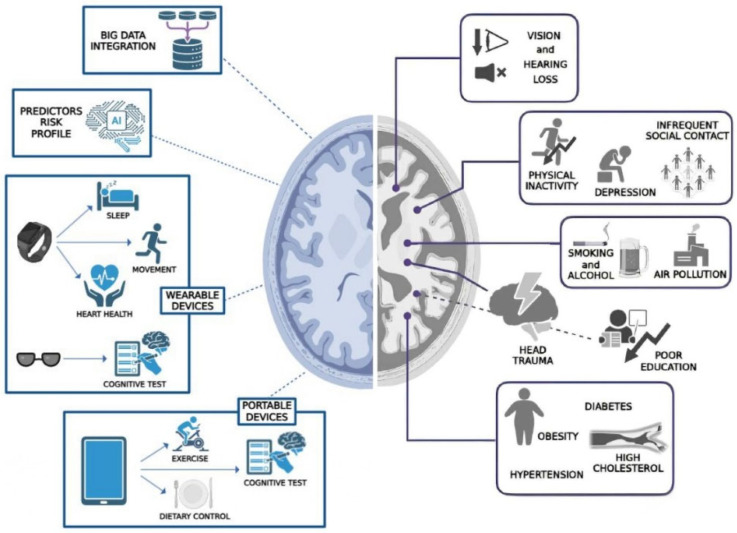 Figure 1
Peer Reviews
No public reviews on file for this paper yet. If you reviewed it on a platform where reviews are public (OpenReview, ICLR, NeurIPS, ICML), you can paste yours below so the community can read it here.
Videos
No videos yet. Explain this paper in a talk, walkthrough, or lecture? Add one.
Taxonomy
TopicsGenetic Associations and Epidemiology · Artificial Intelligence in Healthcare and Education · Machine Learning in Healthcare