Effects of Gender, Menopause, Vitamin D Status, and Tumor Parathyroid Cell Activity on Serum Phosphate Levels in a Large Cohort of Patients with Sporadic Hypercalcemic Primary Hyperparathyroidism
Matteo Corbetta, Silvia Carrara, Anna Dal Lago, Romina Mirsepanj, Elena Ruotolo, Chiara Sardella, Giacomo De Leo, Filomena Cetani, Sabrina Corbetta

TL;DR
This study finds that low phosphate levels are common in people with a parathyroid disorder called PHPT, with differences between men, women, and menopausal status.
Contribution
The study introduces sex- and age-specific reference ranges for phosphate and identifies distinct PHPT phenotypes based on phosphate, calcium, and PTH levels.
Findings
Moderate hypophosphatemia is more common in men than women with PHPT.
Postmenopausal women have lower phosphate levels than premenopausal women with PHPT.
Severe hypercalcemia and hypophosphatemia are linked to more bone and kidney complications.
Abstract
Diagnosis of primary hyperparathyroidism (PHPT) relies on the detection of hypercalcemia and increased circulating parathormone (PTH) levels. However, the disease induces a deep deregulation of phosphate metabolism. A total of 960 PHPT patients (848 females, 112 males) were retrospectively enrolled; biochemical and clinical data were collected at PHPT diagnosis. At variance with previous studies, hypophosphatemia was diagnosed using sex- and age-specific serum phosphate reference range. Reduced serum phosphate levels were detectable in 49% of PHPT males and 55% of PHPT females. Moderate hypophosphatemia (≤2.0 mg/dL) was more frequent in men than in women, and serum phosphate levels were lower in postmenopausal than premenopausal PHPT women. Vitamin D status did not alter the prevalence of hypophosphatemia. Serum phosphate levels negatively correlated with ionized calcium and PTH levels…
Genes, proteins, chemicals, diseases, species, mutations and cell lines named across the full text — each resolved to its canonical identifier and authoritative record.
Click any figure to enlarge with its caption.
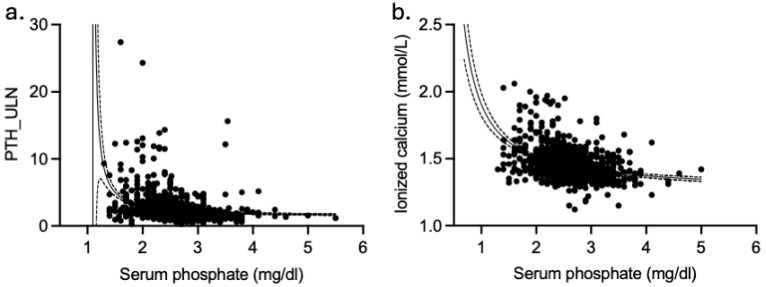 Figure 1
Peer Reviews
No public reviews on file for this paper yet. If you reviewed it on a platform where reviews are public (OpenReview, ICLR, NeurIPS, ICML), you can paste yours below so the community can read it here.
Videos
No videos yet. Explain this paper in a talk, walkthrough, or lecture? Add one.
Taxonomy
TopicsParathyroid Disorders and Treatments · Bone health and treatments · Vitamin D Research Studies