Genotypic Analysis of Enterobius vermicularis (Rhabditida: Oxyuridae, Linnaeus, 1758) Among Infected Individuals in Bulgaria: A First Phylogenetic Study
Eleonora Kaneva, Reneta Dimitrova, Nina Tsvetkova, Rumen Harizanov, Desislava Velcheva, Aleksandra Ivanova, Mihaela Videnova, Raina Borisova, Maria Pavlova, Diana Jordanova, Ivailo Alexiev

TL;DR
This study analyzes the genetic makeup of a common parasitic worm in Bulgaria, revealing low genetic diversity and a dominant strain.
Contribution
The first phylogenetic study of Enterobius vermicularis in Bulgaria, revealing low genetic diversity and a dominant haplotype.
Findings
All 128 Bulgarian isolates belong to genotype B and cluster with European and Asian sequences.
Genetic diversity is extremely low, with a dominant haplotype (Hap_1) accounting for 92.2% of samples.
A negative Tajima’s D suggests recent population expansion or purifying selection.
Abstract
Enterobiasis, caused by the nematode Enterobius vermicularis, remains a widespread public health issue, yet data regarding its genetic structure in Southeast Europe are scarce. This study presents the first molecular and phylogenetic characterization of E. vermicularis isolates from Bulgaria. Between 2022 and 2025, perianal tape test samples were collected from 128 individuals (92.2% of whom were children) with enterobiasis from 17 regions of the country. Molecular identification was performed via nested PCR targeting a 324 bp fragment of the mitochondrial cytochrome c oxidase subunit 1 (cox1) gene, followed by Sanger sequencing. Phylogenetic relationships were analyzed using Maximum Likelihood (IQ-TREE), and population genetic indices were calculated using DnaSP v6. Phylogenetic analysis revealed that all 128 Bulgarian isolates belong to genotype B, clustering closely with sequences…
Genes, proteins, chemicals, diseases, species, mutations and cell lines named across the full text — each resolved to its canonical identifier and authoritative record.
Click any figure to enlarge with its caption.
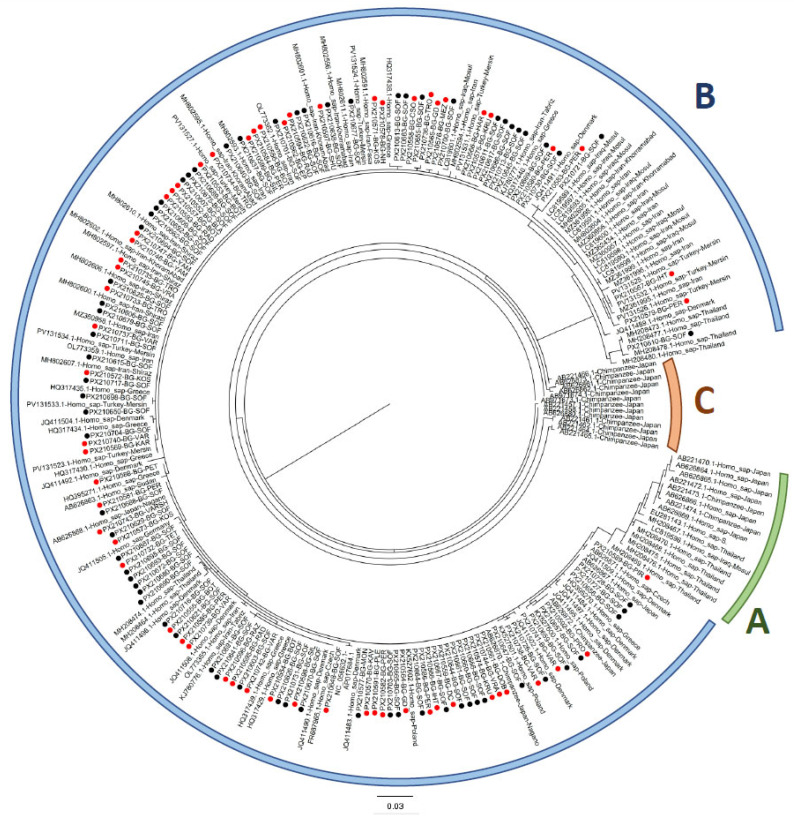 Figure 1
Peer Reviews
No public reviews on file for this paper yet. If you reviewed it on a platform where reviews are public (OpenReview, ICLR, NeurIPS, ICML), you can paste yours below so the community can read it here.
Videos
No videos yet. Explain this paper in a talk, walkthrough, or lecture? Add one.
Taxonomy
TopicsHelminth infection and control · Parasites and Host Interactions · Parasitic Diseases Research and Treatment