Application of Probabilistic Genotyping Software to Paternity Cases Involving Low-Template DNA
Alessia Riem, Elena Chierto, Federica Bertolotto, Marco Parnigoni, Serena Aneli, Carlo Robino

TL;DR
This paper evaluates how probabilistic genotyping software performs in paternity cases using low-quality DNA samples.
Contribution
The study compares probabilistic genotyping software with standard paternity tools for low-template DNA in kinship testing.
Findings
EFMrep produced significantly higher likelihood ratios in degraded DNA paternity cases.
Familias outperformed probabilistic genotyping in some scenarios with mild DNA degradation.
EFMrep maximized likelihood ratios in 60% of highly degraded trio cases.
Abstract
Background: Interpreting short tandem repeat (STR) profiles from low-template DNA (LT-DNA) requires consideration of the stochastic phenomena that can affect the reliability of genotypes. Although several probabilistic genotyping tools have been developed to model such uncertainties, most have only been used for direct comparisons between persons of interest and crime scene samples. Their application to kinship testing involving LT-DNA has received comparatively little attention. Methods: We evaluated the performance of two PGS, EuroForMix (EFM) and EFMrep, which support alternative hypotheses with relatedness, by comparing them with a standard paternity testing software (Familias) in 33 paternity cases involving LT-DNA samples categorised as ‘mildly’ (MD) or ‘highly’ (HD) degraded based on the quality of the STR profiles. The samples included formalin-fixed paraffin-embedded tissues,…
Genes, proteins, chemicals, diseases, species, mutations and cell lines named across the full text — each resolved to its canonical identifier and authoritative record.
Click any figure to enlarge with its caption.
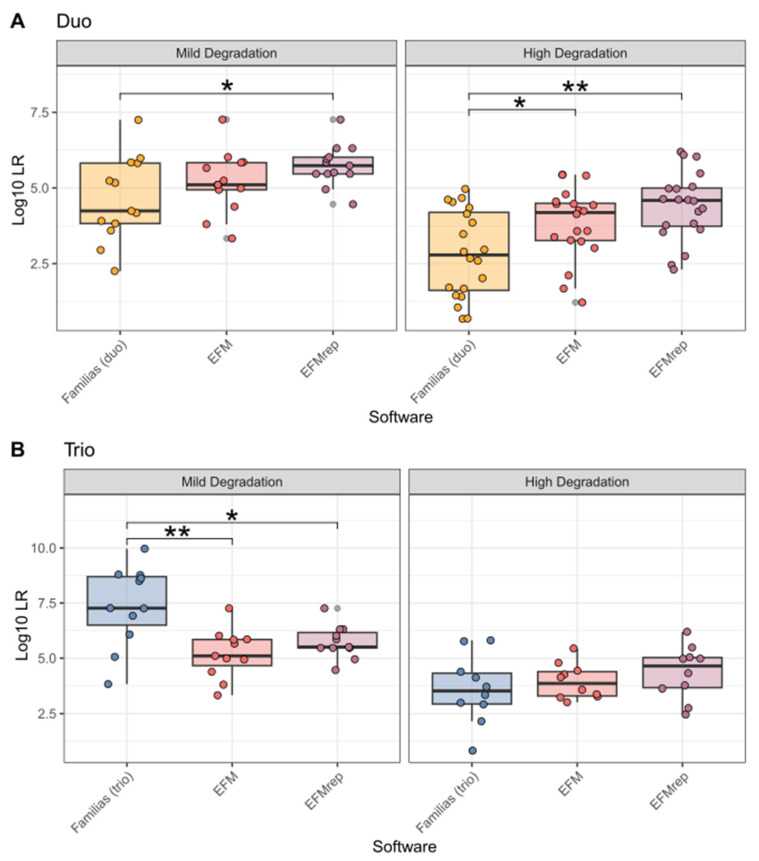 Figure 1
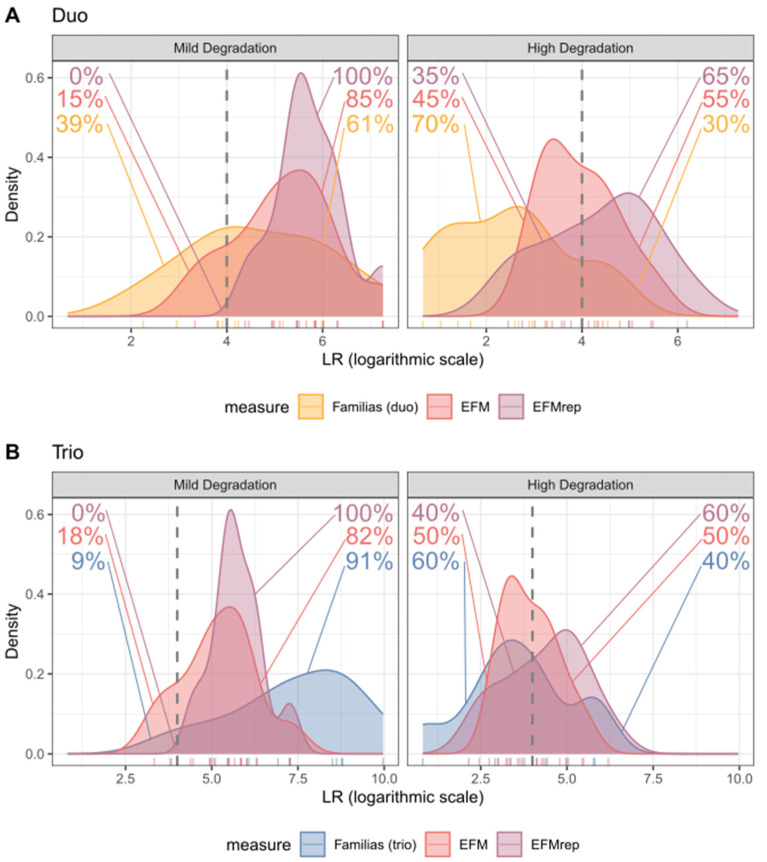 Figure 2
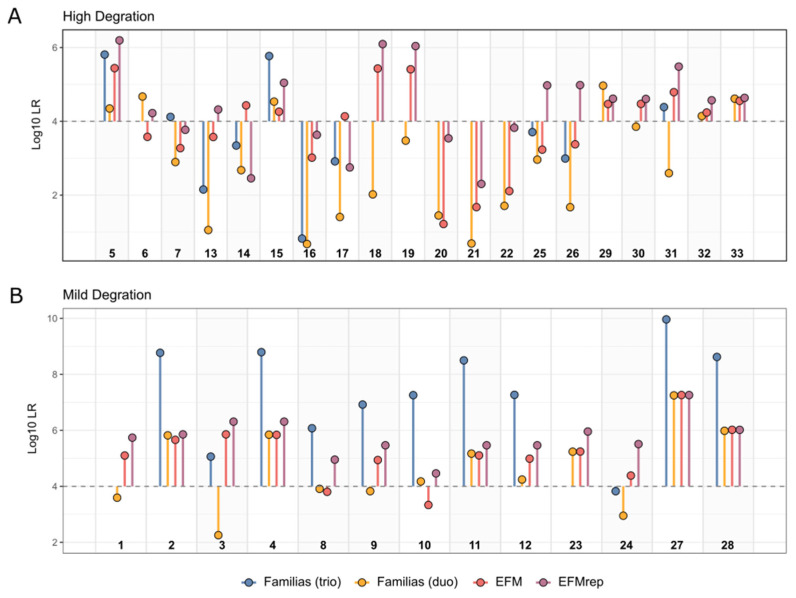 Figure 3
Peer Reviews
No public reviews on file for this paper yet. If you reviewed it on a platform where reviews are public (OpenReview, ICLR, NeurIPS, ICML), you can paste yours below so the community can read it here.
Videos
No videos yet. Explain this paper in a talk, walkthrough, or lecture? Add one.
Taxonomy
TopicsForensic and Genetic Research · Molecular Biology Techniques and Applications · Forensic Anthropology and Bioarchaeology Studies