Knowledge-Guided Framework for Synthesizing Contrast-Dependent Data from Multi-Sequence Non-Contrast MRI
Jinwei Dong, Yihua Chen, Nuoxi Li, Yaqiong Zheng, Guibin Lin, Xingtao Lin, Wangbin Ding

TL;DR
This paper introduces KGSynth, a new method to create contrast-enhanced MRI images from non-contrast scans, improving accuracy and avoiding the need for contrast agents.
Contribution
The novel KGSynth framework integrates knowledge guidance to enhance lesion detail preservation in synthesized MRI images.
Findings
KGSynth achieved an SSIM of 0.567 and PSNR of 19.48 dB for cardiac LGE synthesis.
For brain CBV synthesis, KGSynth yielded an SSIM of 0.697 and PSNR of 24.49 dB.
The method improved accuracy in delineating myocardial infarctions and tumor regions.
Abstract
Background: Contrast-enhanced magnetic resonance imaging (MRI), including late gadolinium enhancement (LGE) and cerebral blood volume (CBV) maps, is essential for characterizing pathologies such as myocardial scars and brain tumors. However, acquiring these images requires gadolinium-based contrast agents (GBCAs), which are contraindicated in certain patient populations. Although deep learning enables cross-modality image translation, current methods frequently fail to preserve lesion details, limiting their clinical utility. Methods: We propose KGSynth, a knowledge-guided framework designed to synthesize contrast-enhanced MRI from non-contrast sequences. This approach incorporates a knowledge estimator to extract lesion and anatomical features, paired with a style mapping network to capture contrast-specific visual characteristics. By explicitly modeling these distinct components, the…
Genes, proteins, chemicals, diseases, species, mutations and cell lines named across the full text — each resolved to its canonical identifier and authoritative record.
Click any figure to enlarge with its caption.
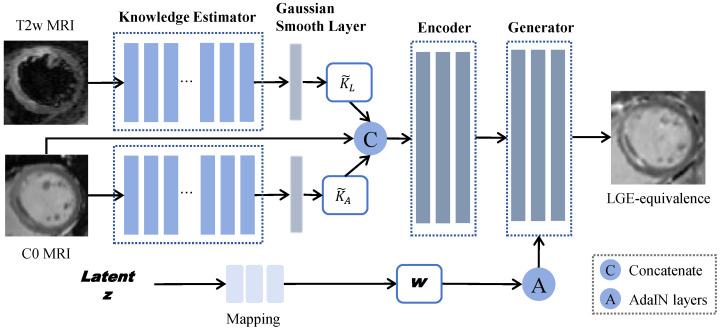 Figure 1
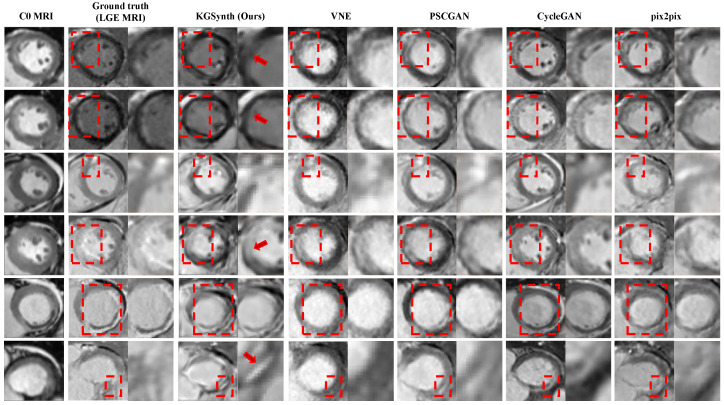 Figure 2
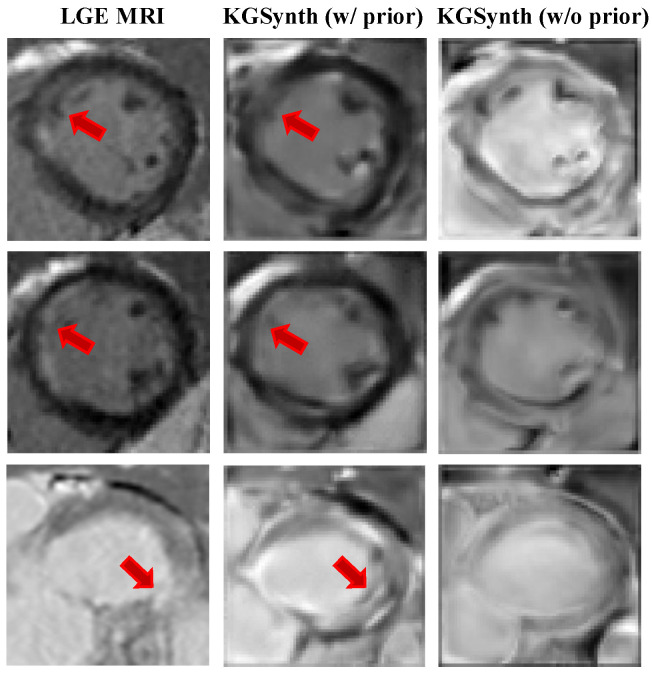 Figure 3
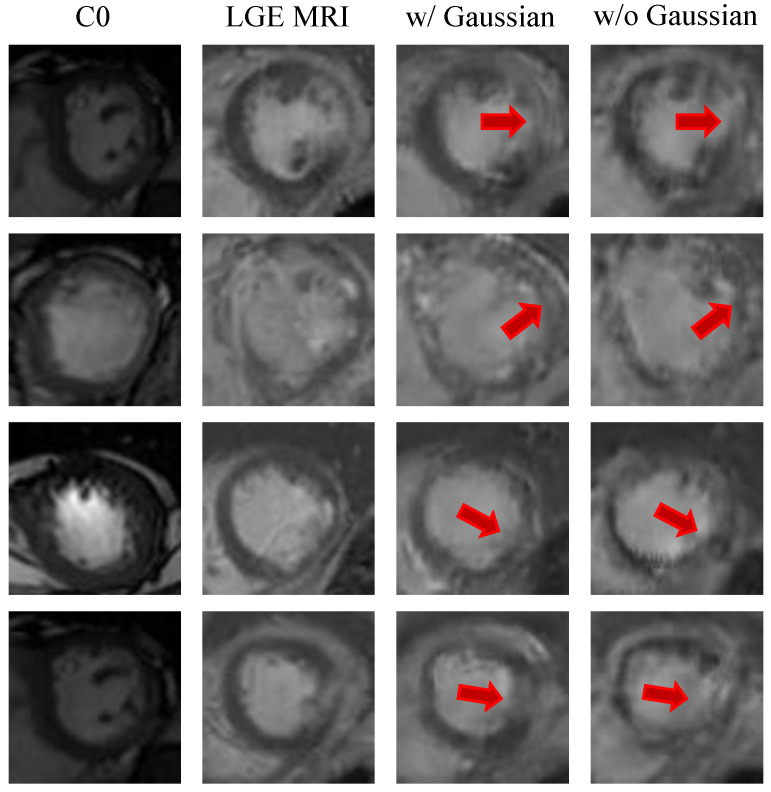 Figure 4
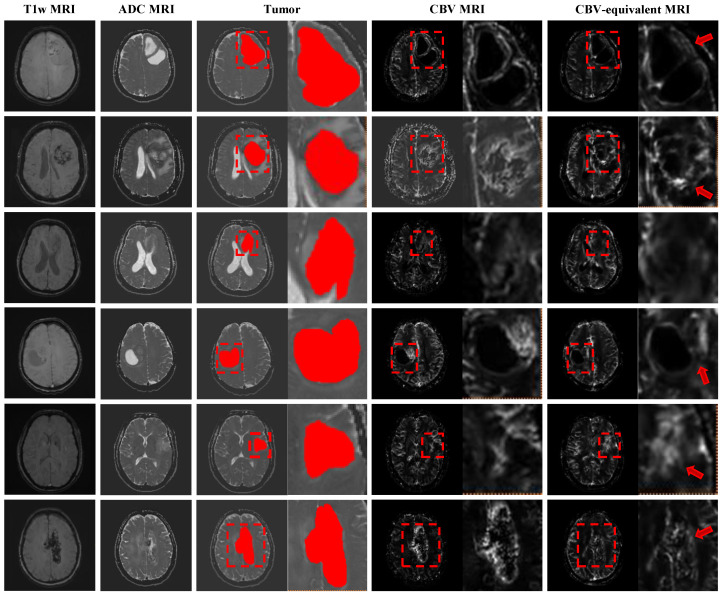 Figure 5
 Figure 6
Peer Reviews
No public reviews on file for this paper yet. If you reviewed it on a platform where reviews are public (OpenReview, ICLR, NeurIPS, ICML), you can paste yours below so the community can read it here.
Videos
No videos yet. Explain this paper in a talk, walkthrough, or lecture? Add one.
Taxonomy
TopicsMRI in cancer diagnosis · Advanced MRI Techniques and Applications · Lanthanide and Transition Metal Complexes