Brain Ketone Bodies in Health, Evolution and Disease
Pierre Bougnères

TL;DR
Ketone bodies are unique energy sources for the brain that can increase during fasting and may help the brain adapt to food shortages and diseases like Alzheimer's.
Contribution
The paper highlights the evolutionary and metabolic significance of ketone bodies and their potential therapeutic use in neurodegenerative diseases.
Findings
Ketone bodies can increase twenty-fold during fasting and provide energy to the brain.
Ketone bodies can modify proteins like histones, possibly acting as epigenetic messengers.
Ketogenic diets may help treat diseases like Alzheimer's by improving brain energy metabolism.
Abstract
Ketone bodies (KBs) are the only energy substrates oxidized by the brain, whose concentration in the circulation can greatly increase when a physiological situation requires it. For example, when an adult human fasts for two days, circulating KBs rise twenty-fold from ~0.1 to ~2 mM. As a fuel, KBs provide the brain with acetyl-CoA that produces ATP or glutamate, notably in certain brain regions. Remarkably, KBs activate the expression of their own cerebral transporters and KB-utilizing enzymes so that circulating levels determine cerebral utilization of KBs. Throughout evolution, the energetic role of KBs has been crucial for the metabolic homeostasis of humans endowed with a large brain and facing unpredictable periods of food shortage. Paradoxically, the brain of modern, regularly fed humans whose ordinary blood KBs are ~0.1 mM, has access to much fewer circulating sources of energy…
Genes, proteins, chemicals, diseases, species, mutations and cell lines named across the full text — each resolved to its canonical identifier and authoritative record.
Click any figure to enlarge with its caption.
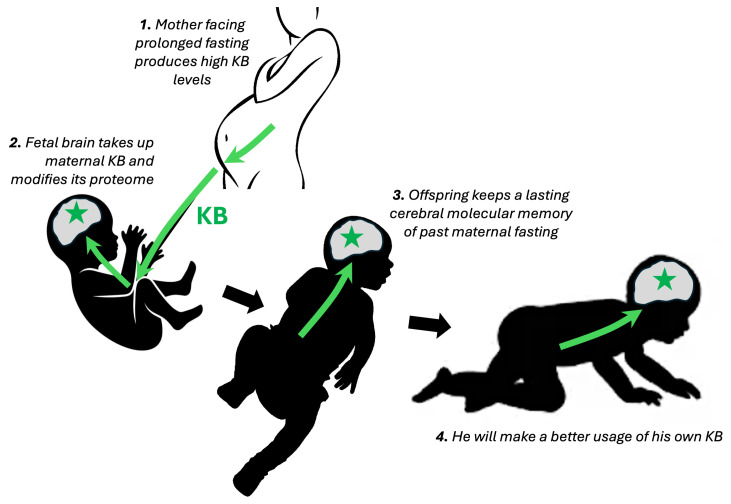 Figure 1
Peer Reviews
No public reviews on file for this paper yet. If you reviewed it on a platform where reviews are public (OpenReview, ICLR, NeurIPS, ICML), you can paste yours below so the community can read it here.
Videos
No videos yet. Explain this paper in a talk, walkthrough, or lecture? Add one.
Taxonomy
TopicsDiet and metabolism studies · Regulation of Appetite and Obesity · Epigenetics and DNA Methylation