Increasing the Response of Mismatch Repair Proficient Rectal Cancer to Immunotherapy with Particle Radiation and DNA Damage Response Inhibitors—Preclinical Evidence
Cristian J. Salazar-Vilches, Daniel K. Ebner, Jake A. Kloeber, Sonja Dragojevic, Jasvinder Singh, Michael Haddock, Yasamin Sharifzadeh, Alexander D. Sherry, Krishan R. Jethwa, Christopher L. Hallemeier, Kenneth W. Merrell, Robert W. Mutter, Zhenkun Lou, Cameron M. Callaghan

TL;DR
This paper reviews preclinical evidence showing that combining high-LET radiation and DNA damage response inhibitors can improve immunotherapy responses in mismatch repair proficient rectal cancer.
Contribution
The study provides a systematic review of preclinical evidence supporting the use of high-LET radiation and DDRi to enhance immunotherapy in pMMR rectal cancer.
Findings
High-LET radiation increases immunogenic cell death and tumor antigen presentation in pMMR models.
Combining DDRi with immunotherapy improves local control and systemic antitumor responses in preclinical studies.
High-LET therapies show manageable toxicity and excellent local control in murine models.
Abstract
Patients with mismatch repair deficient (dMMR) rectal adenocarcinomas demonstrate significant complete response rates to PD-1 inhibitor monotherapy, potentially allowing them to avoid chemotherapy, radiation, and surgery. However, >95% of patients are mismatch repair proficient (pMMR) and have so far not responded to immunotherapy in clinical trials. There is growing evidence that both high linear energy transfer (LET) particle radiation and DNA damage response inhibitors (DDRis) may increase the response of pMMR rectal cancer to immunotherapy and are ready for clinical translation. Background/Objectives: We performed a systematic review of preclinical literature on the use of high-LET particle therapy, DDRi, and/or immunotherapy specifically in pMMR colorectal cancer. Methods: A systematic review of the literature published between 2014 and 2025 was conducted across major databases.…
Genes, proteins, chemicals, diseases, species, mutations and cell lines named across the full text — each resolved to its canonical identifier and authoritative record.
Click any figure to enlarge with its caption.
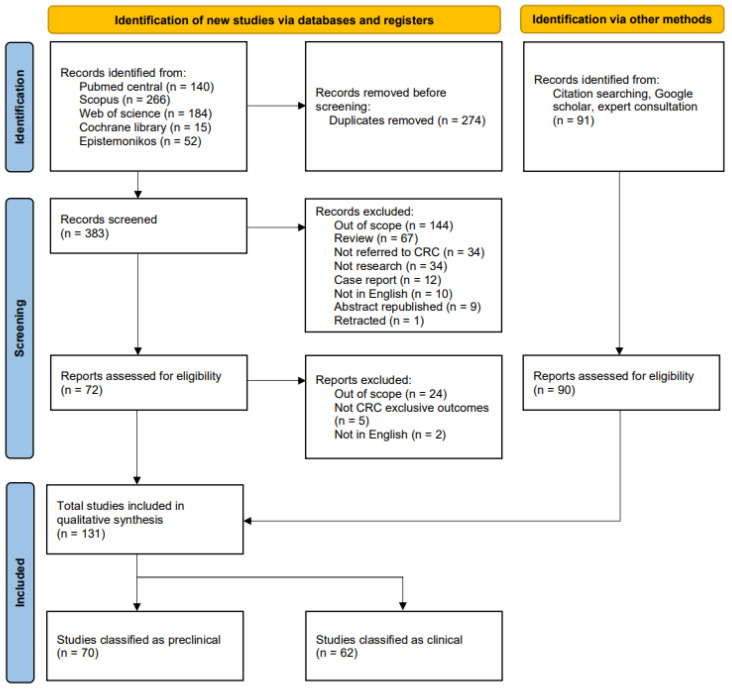 Figure 1
Peer Reviews
No public reviews on file for this paper yet. If you reviewed it on a platform where reviews are public (OpenReview, ICLR, NeurIPS, ICML), you can paste yours below so the community can read it here.
Videos
No videos yet. Explain this paper in a talk, walkthrough, or lecture? Add one.
Taxonomy
TopicsCancer Immunotherapy and Biomarkers · Colorectal and Anal Carcinomas · interferon and immune responses