3D Printing with Tragacanth-Gum-Based Bioinks: A New Frontier in Bioprinting Materials
Shivani Dogra, Bhupendra Koul, Ananta Prasad Arukha, Muhammad Fazle Rabbee

TL;DR
This paper reviews tragacanth gum as a promising bioink material for 3D bioprinting, highlighting its properties and potential for tissue engineering.
Contribution
The paper provides a critical review of recent advances in tragacanth gum-based bioinks and their performance in bioprinting.
Findings
Tragacanth gum exhibits shear-thinning behavior and gel-forming ability, improving bioink printability and stability.
TG-based bioinks show good cytocompatibility and can be used in composite formulations to enhance mechanical properties.
The review identifies challenges and future directions for clinical translation of TG-based bioinks.
Abstract
Extrusion-based bioprinting is widely used for fabricating cell-laden constructs; however, its success is highly dependent on the rheological and biological performance of the bioink. Natural polysaccharide gums have emerged as promising bioink components due to their biocompatibility and tunable properties. Among them, tragacanth gum (TG), a complex anionic heteropolysaccharide composed of tragacanthin and bassorin fractions, has gained increasing attention for extrusion bioprinting applications. TG exhibits pronounced shear-thinning behavior, high water uptake, and spontaneous gel-forming ability, which collectively enhance the printability, shape fidelity, and structural stability of bioinks. This review critically summarizes recent advances in TG-based hydrogels and bioinks, with emphasis on their molecular characteristics, rheological and physicochemical properties, and biological…
Genes, proteins, chemicals, diseases, species, mutations and cell lines named across the full text — each resolved to its canonical identifier and authoritative record.
Click any figure to enlarge with its caption.
 Figure 1
 Figure 2
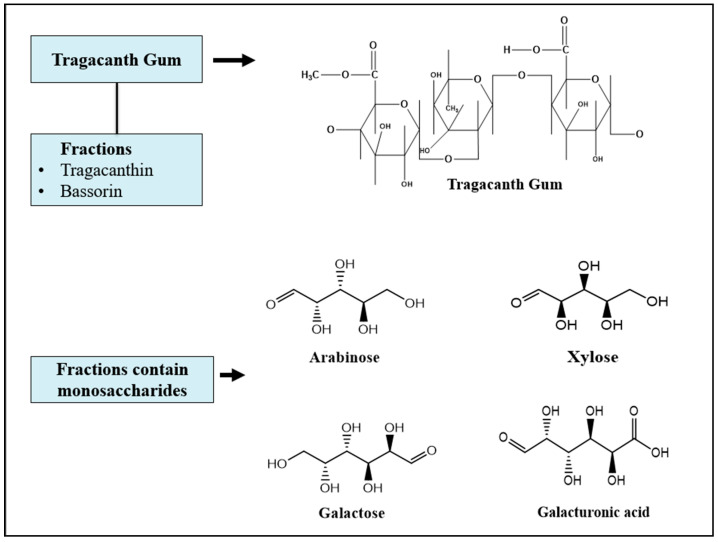 Figure 3
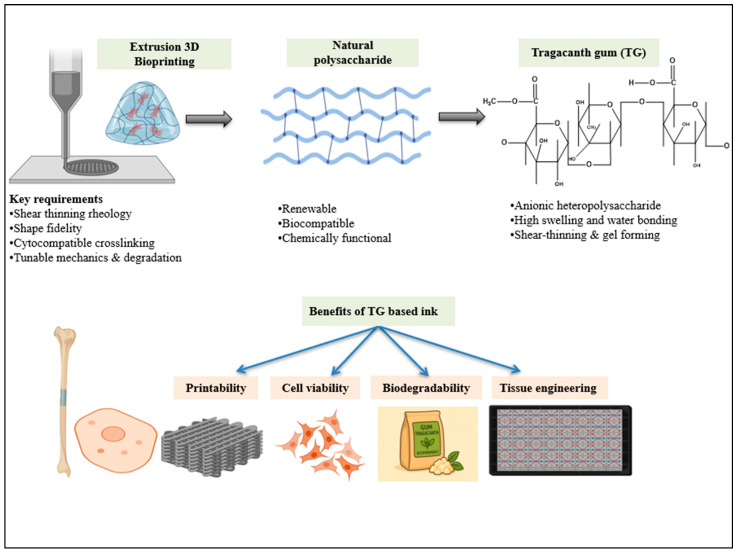 Figure 4
Peer Reviews
No public reviews on file for this paper yet. If you reviewed it on a platform where reviews are public (OpenReview, ICLR, NeurIPS, ICML), you can paste yours below so the community can read it here.
Videos
No videos yet. Explain this paper in a talk, walkthrough, or lecture? Add one.
Taxonomy
Topics3D Printing in Biomedical Research · Hydrogels: synthesis, properties, applications · Polymer Surface Interaction Studies