Multi-Entropy Feature Concatenation for Data-Efficient Cross-Subject Classification of Alzheimer’s Disease and Frontotemporal Dementia from Single-Channel EEG
Jiawen Li, Chen Ling, Weidong Zhang, Jujian Lv, Xianglei Hu, Kaihan Lin, Jun Yuan, Shuang Zhang, Rongjun Chen

TL;DR
This paper introduces a new method using EEG data to classify Alzheimer’s and frontotemporal dementia with limited data and single-channel inputs.
Contribution
The novel Multi-Entropy Feature Concatenation method enables data-efficient cross-subject classification of AD and FTD using single-channel EEG.
Findings
Using beta-rhythm with PCC, the method achieves 76.14% three-class accuracy on the AHEPA dataset.
Theta-rhythm with WC achieves 83.33% two-class accuracy on the Florida-Based dataset.
A MATLAB-based toolbox was developed to implement the proposed method.
Abstract
Alzheimer’s disease (AD) and frontotemporal dementia (FTD) are neurodegenerative disorders where early detection is vital. However, the need for long-term monitoring is incompatible with data-scarce settings, and methods trained on one subject often fail on another due to cross-subject variability. To address these limitations, this study proposes a cross-subject, single-channel electroencephalography (EEG)-based method that uses Multi-Entropy Feature Concatenation (MEFC) to classify AD and FTD. First, single-channel EEG is processed through the Discrete Wavelet Transform (DWT) to extract five rhythms: delta, theta, alpha, beta, and gamma. Subsequently, Permutation Entropy (PE), Singular Spectrum Entropy (SSE), and Sample Entropy (SE) are calculated for each rhythm and concatenated to form a combined MEFC to characterize the non-linear dynamic properties of EEG. Lastly, Dynamic Time…
Genes, proteins, chemicals, diseases, species, mutations and cell lines named across the full text — each resolved to its canonical identifier and authoritative record.
Click any figure to enlarge with its caption.
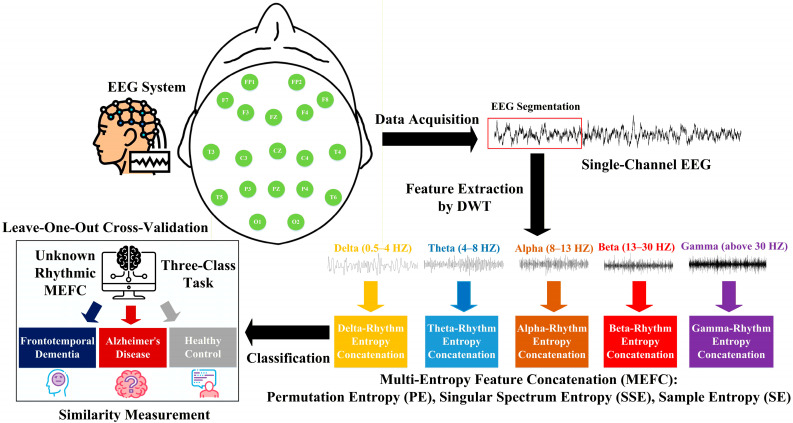 Figure 1
 Figure 2
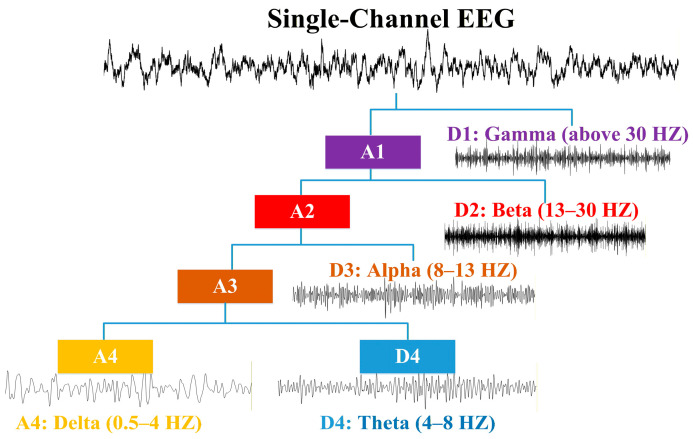 Figure 3
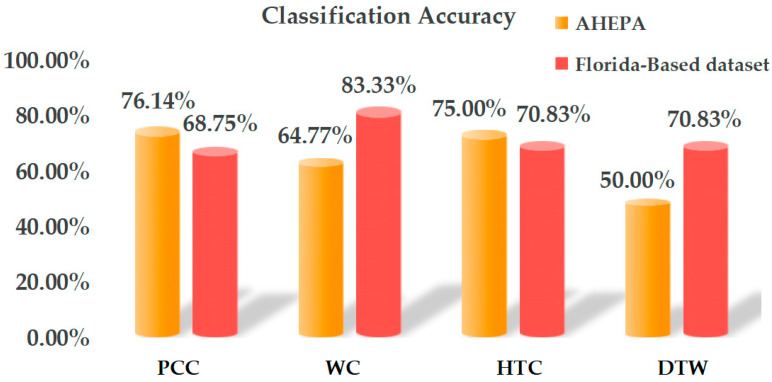 Figure 4
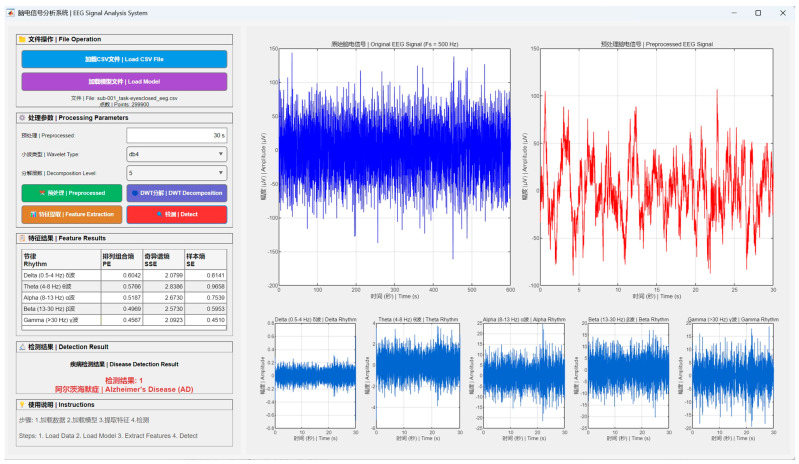 Figure 5
Peer Reviews
No public reviews on file for this paper yet. If you reviewed it on a platform where reviews are public (OpenReview, ICLR, NeurIPS, ICML), you can paste yours below so the community can read it here.
Videos
No videos yet. Explain this paper in a talk, walkthrough, or lecture? Add one.
Taxonomy
TopicsEEG and Brain-Computer Interfaces · Emotion and Mood Recognition · Functional Brain Connectivity Studies