Exploring Autosomal Dominant Non-Syndromic Monogenic Obesity: From Genes to Therapy
Giovanni Luppino, Mara Giordano, Francesca Franchina, Roberto Coco, Eleonora Inì, Carla Fazio, Debora Porri, Cecilia Lugarà, Domenico Corica, Tommaso Aversa, Malgorzata Wasniewska

TL;DR
This paper reviews autosomal dominant monogenic obesity, focusing on its genetic causes, clinical features, and current treatment challenges.
Contribution
The paper provides a comprehensive analysis of autosomal dominant non-syndromic monogenic obesity, emphasizing genetic and therapeutic insights.
Findings
Autosomal dominant mutations in genes like MC4R and SH2B1 are linked to non-syndromic monogenic obesity.
No targeted therapies are currently approved for autosomal dominant monogenic obesity.
Variants of uncertain significance complicate timely diagnosis and treatment.
Abstract
Genetic factors are key determinants in the pathophysiology of obesity, regulating energy homeostasis. Monogenic non-syndromic obesity accounts for 2–3% of obesity in both children and adults and is most often attributable to mutations in genes encoding components of the leptin–melanocortin pathway. Genetic testing is indicated in children with severe obesity before age 5, hyperphagia, a family history of obesity, and neurodevelopmental delay or organ dysfunction. Mutations associated with monogenic obesity follow autosomal recessive (LEP, LEPR, POMC, and PCSK1) or autosomal dominant (MC4R, SH2B1, SIM1, GNAS) modes of inheritance. Other gene mutations in heterozygous states (MRAP2, MC3R, SRC1, KSR2) are associated with obesity and may exhibit autosomal dominant inheritance; however, the clinical phenotype depends on the degree of genetic penetrance and interactions with other genetic…
Genes, proteins, chemicals, diseases, species, mutations and cell lines named across the full text — each resolved to its canonical identifier and authoritative record.
Click any figure to enlarge with its caption.
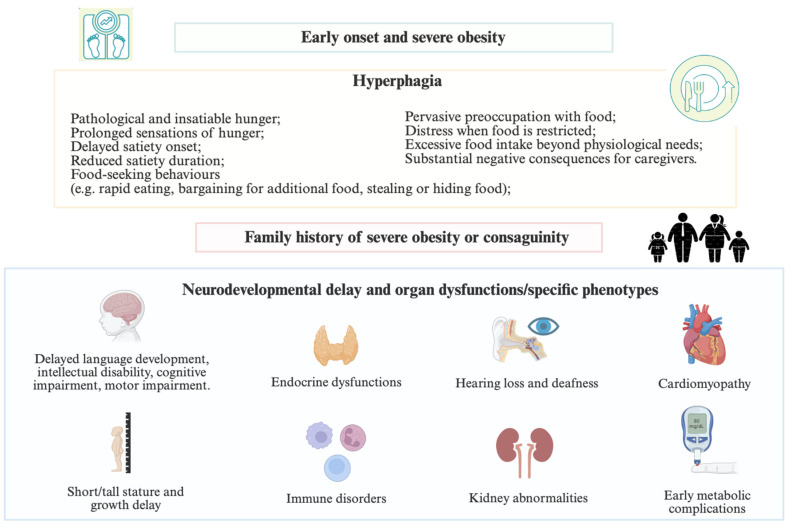 Figure 1
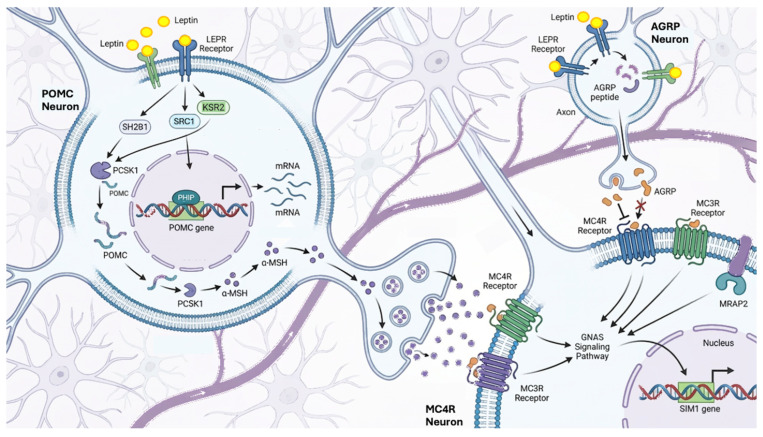 Figure 2
Peer Reviews
No public reviews on file for this paper yet. If you reviewed it on a platform where reviews are public (OpenReview, ICLR, NeurIPS, ICML), you can paste yours below so the community can read it here.
Videos
No videos yet. Explain this paper in a talk, walkthrough, or lecture? Add one.
Taxonomy
TopicsRegulation of Appetite and Obesity · Adipose Tissue and Metabolism · Adipokines, Inflammation, and Metabolic Diseases