Diagnosis of Tuberculous Meningitis: Integrating Clinical Assessment and Molecular Diagnostics
Jorge E. Leiva-Ordoñez, Beatriz Quintero

TL;DR
This paper reviews how to diagnose tuberculous meningitis by combining clinical signs and molecular tests to improve accuracy and early treatment.
Contribution
The paper integrates clinical and molecular diagnostic approaches to improve the accuracy of diagnosing tuberculous meningitis.
Findings
Molecular assays enable rapid detection of Mycobacterium tuberculosis but are influenced by factors like HIV status and disease stage.
Integrated diagnostic algorithms combining clinical and molecular methods improve diagnostic accuracy and treatment timing.
Challenges remain in accessing molecular diagnostics and standardizing pathways across different healthcare settings.
Abstract
Tuberculous meningitis is the most severe form of tuberculosis and remains associated with high mortality and substantial neurological disability, particularly among children and people living with HIV. Early diagnosis is challenging because of nonspecific clinical manifestations, the limited discriminatory value of cerebrospinal fluid cytochemical analysis, and the low sensitivity of conventional microbiological methods. This narrative review synthesizes contemporary evidence on the diagnostic approach to tuberculous meningitis, integrating clinical assessment, paraclinical cerebrospinal fluid findings, conventional microbiology, and molecular diagnostic tools. Clinical scoring systems, including the uniform case definition (Lancet consensus score), improve diagnostic stratification but do not replace microbiological confirmation. Molecular assays have transformed diagnostic pathways…
Genes, proteins, chemicals, diseases, species, mutations and cell lines named across the full text — each resolved to its canonical identifier and authoritative record.
Click any figure to enlarge with its caption.
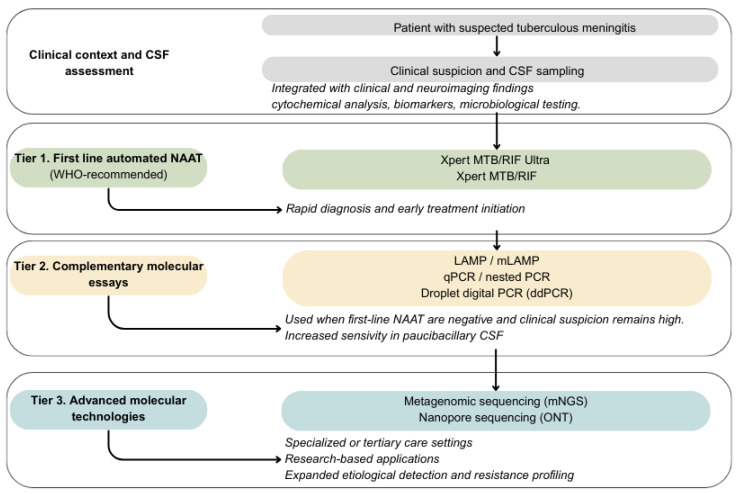 Figure 1
Peer Reviews
No public reviews on file for this paper yet. If you reviewed it on a platform where reviews are public (OpenReview, ICLR, NeurIPS, ICML), you can paste yours below so the community can read it here.
Videos
No videos yet. Explain this paper in a talk, walkthrough, or lecture? Add one.
Taxonomy
TopicsInfectious Diseases and Tuberculosis · Bacterial Infections and Vaccines · Sinusitis and nasal conditions