Symptom Monitoring in Ovarian Cancer Patients Treated with PARP Inhibitors: Agreement Between Physician- and Patient-Reported Toxicities Using PRO-CTCAE
Roberta Massobrio, Daniela Attianese, Alessandra Testi, Maria Pascotto, Beatrice Campigotto, Claudia Garulli, Luca Pace, Andrea Ricotti, Luca Fuso, Annamaria Ferrero

TL;DR
This study found poor agreement between doctors and patients on reported side effects of PARP inhibitors in ovarian cancer, highlighting the need for patient-reported outcomes.
Contribution
The study introduces a customized PRO-CTCAE questionnaire and reveals significant underestimation of toxicities by physicians compared to patient reports.
Findings
Physician-patient agreement on PARP inhibitor toxicities was poor (κ = 0–0.15) for all 12 symptoms assessed.
Fatigue, arthralgia, rash, and insomnia showed the lowest agreement and highest under-reporting by physicians.
Patient-reported outcomes are recommended for accurate toxicity monitoring in maintenance therapy settings.
Abstract
PARP inhibitors improve survival in ovarian cancer patients after first-line chemotherapy and platinum-sensitive relapse. As maintenance therapies are often prolonged, assessing treatment tolerability is crucial. This cohort study evaluated the agreement between physician- and patient-reported PARPi-related toxicities and identified underestimation rates for each symptom. A total of 77 patients receiving PARPis were enrolled, and a customized PRO-CTCAE questionnaire was used to collect patient-reported toxicities. Of the cohort, 39 received PARPis in first-line maintenance and 38 for recurrence. Agreement between patients and physicians was poor across all 12 toxicities (κ = 0–0.15), with the lowest agreement and highest under-reporting for fatigue, arthralgia, rash, and insomnia. These findings support the routine use of patient-reported outcomes to improve toxicity monitoring in…
Genes, proteins, chemicals, diseases, species, mutations and cell lines named across the full text — each resolved to its canonical identifier and authoritative record.
Click any figure to enlarge with its caption.
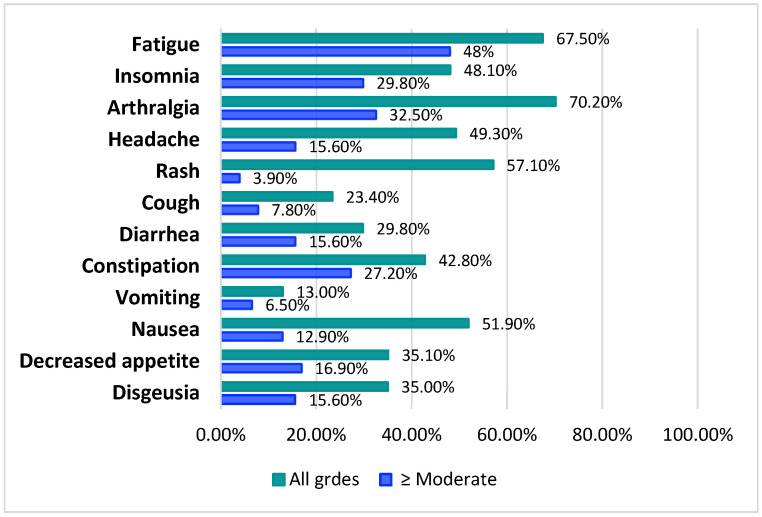 Figure 1
Peer Reviews
No public reviews on file for this paper yet. If you reviewed it on a platform where reviews are public (OpenReview, ICLR, NeurIPS, ICML), you can paste yours below so the community can read it here.
Videos
No videos yet. Explain this paper in a talk, walkthrough, or lecture? Add one.
Taxonomy
TopicsPARP inhibition in cancer therapy · Ovarian cancer diagnosis and treatment · Advanced Breast Cancer Therapies