Dynamical Casimir Effect Under the Action of Gravitational Waves
Gustavo de Oliveira, Thiago Henrique Moreira, Lucas Chibebe Céleri

TL;DR
This paper explores how gravitational waves can cause a quantum field to produce particles through the dynamical Casimir effect.
Contribution
The study identifies resonance conditions for exponential particle production via parametric amplification in a cavity affected by gravitational waves.
Findings
Gravitational waves induce oscillatory mirror motion in a cavity, leading to particle creation.
Resonance conditions enable exponential growth in particle numbers through parametric amplification.
Abstract
Several nontrivial phenomena emerge when a quantum field is subjected to dynamical perturbations, with prominent examples including the Hawking and Unruh effects, as well as the dynamical Casimir effect. In this work, we compute the number of particles produced via the dynamical Casimir effect in an ideal cavity, where one of the mirrors is allowed to move under the influence of a gravitational wave. Assuming an oscillatory mirror motion and a plane gravitational wave, we identify the resonance conditions that lead to an exponential increase in the number of created particles through parametric amplification.
Genes, proteins, chemicals, diseases, species, mutations and cell lines named across the full text — each resolved to its canonical identifier and authoritative record.
Click any figure to enlarge with its caption.
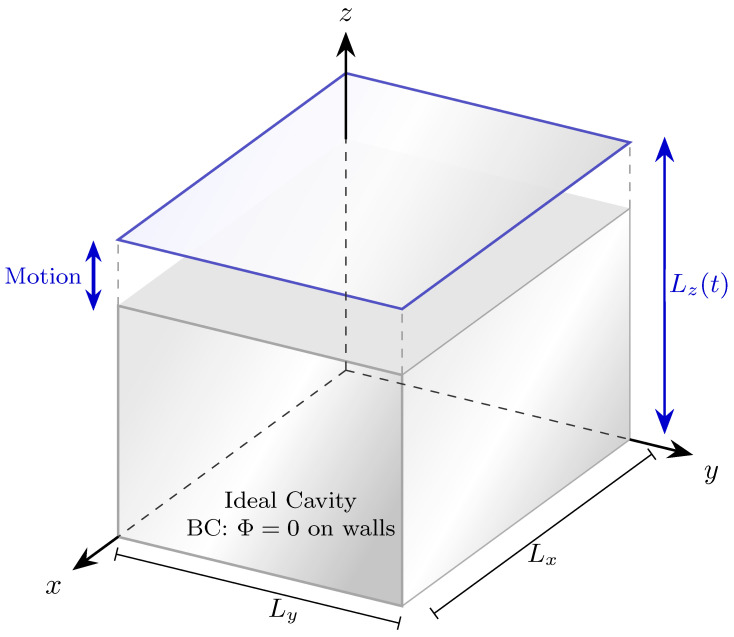 Figure 1
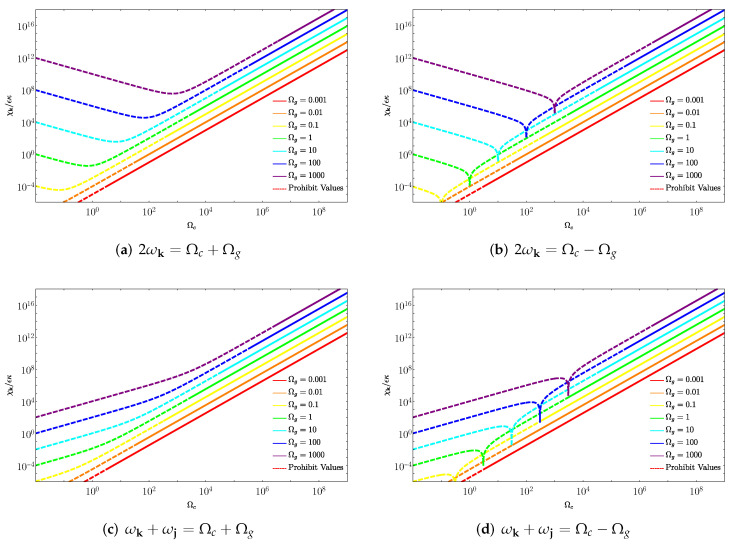 Figure 2
Peer Reviews
No public reviews on file for this paper yet. If you reviewed it on a platform where reviews are public (OpenReview, ICLR, NeurIPS, ICML), you can paste yours below so the community can read it here.
Videos
No videos yet. Explain this paper in a talk, walkthrough, or lecture? Add one.
Taxonomy
TopicsQuantum Electrodynamics and Casimir Effect · Advanced Mathematical Theories and Applications · Quantum and Classical Electrodynamics