Differentiating Late Awakeners from Non-Awakeners in Comatose Cardiac Arrest Survivors: Diagnostic Value of Multimodal Monitoring in Patients with Indeterminate Prognosis
Hyo Joon Kim, Sang Hoon Oh, Jee Yong Lim

TL;DR
This study identifies markers to distinguish patients who later awaken after cardiac arrest from those with poor outcomes, to avoid premature withdrawal of life support.
Contribution
A multimodal model combining NSE levels and brainstem reflexes improves identification of late awakeners with good outcomes.
Findings
9.4% of comatose patients at 72 hours became late awakeners with favorable outcomes.
Preserved corneal reflexes and NSE < 90 ng/mL predicted late awakening with high specificity.
Multimodal model achieved an optimism-corrected AUC of 0.896 for predicting recovery.
Abstract
Background: Current guidelines recommend prognostication at 72 h after cardiac arrest, yet a subset of patients (Late Awakeners) recover consciousness after this window. This study investigated diagnostic markers to distinguish Late Awakeners from those with permanent poor outcomes (Non-Awakeners) to prevent premature withdrawal of life-sustaining therapy. Methods: We analyzed adult OHCA patients treated with TTM from 2009 to 2019 who remained comatose (Glasgow Coma Scale Motor score < 6) at 72 h. Patients were categorized as Late Awakeners (obeyed commands > 72 h) or Non-Awakeners. The diagnostic performance of maximal Neuron-Specific Enolase (NSE) levels within 72 h and brainstem reflexes was assessed using receiver operating characteristic (ROC) analysis. Model calibration was evaluated using the Hosmer–Lemeshow test, and internal validation was performed using bootstrap resampling.…
Genes, proteins, chemicals, diseases, species, mutations and cell lines named across the full text — each resolved to its canonical identifier and authoritative record.
Click any figure to enlarge with its caption.
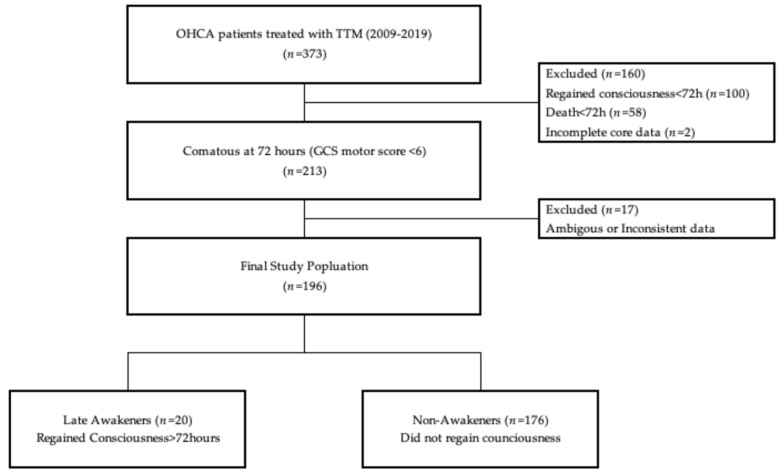 Figure 1
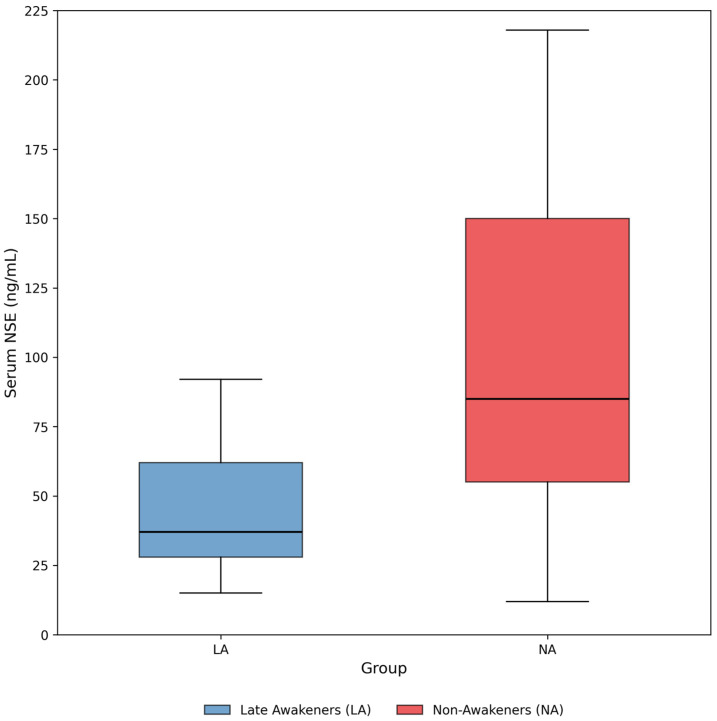 Figure 2
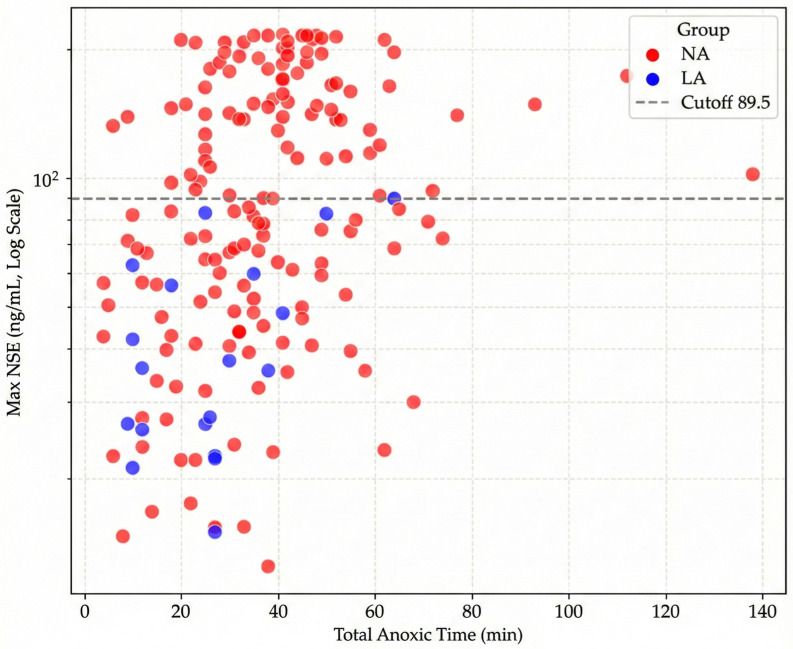 Figure 3
Peer Reviews
No public reviews on file for this paper yet. If you reviewed it on a platform where reviews are public (OpenReview, ICLR, NeurIPS, ICML), you can paste yours below so the community can read it here.
Videos
No videos yet. Explain this paper in a talk, walkthrough, or lecture? Add one.
Taxonomy
TopicsCardiac Arrest and Resuscitation · Traumatic Brain Injury and Neurovascular Disturbances · Traumatic Brain Injury Research