Radiotherapy De-Escalation in Younger Patients with Breast Cancer: Are We There Yet?
Ioannis Georgakopoulos, Georgios Nikiforos Ntoumas, Pantelis Skarlos, Alexia Sidiropoulou, Georgia Lymperopoulou, Ioanna Kollarou, Konstantina Perdikari, Flora Zagouri, Maria Tolia

TL;DR
This paper reviews whether reducing radiotherapy is safe for younger breast cancer patients, finding that only moderate reductions are supported by evidence.
Contribution
The paper systematically reviews the evidence for radiotherapy de-escalation in younger breast cancer patients, highlighting gaps in current data.
Findings
Moderate hypofractionation is supported by evidence and can be safely applied regardless of age.
Ultra-hypofractionation and partial breast irradiation lack strong evidence in younger patients.
Younger patients have more aggressive tumors and higher recurrence risks, complicating de-escalation.
Abstract
Radiotherapy de-escalation is an important approach in the management of early breast cancer, with the goal of limiting treatment burden, without compromising oncologic outcomes. However, implementation of such strategies in younger patients remains precarious, not only due to their underrepresentation in relative studies but also due to the more aggressive tumor biology, higher recurrence risk and worse survival observed in younger individuals. This review summarizes existing data on radiotherapy de-escalation strategies specifically in younger women with early breast cancer. The evidence supports that moderate radiotherapy hypo-fractionation can be safely applicated irrespective of age, as opposed to ultra-hypofractionation, partial breast irradiation and omission of radiotherapy, for which data remain uncertain. Future trials with adequate representation of younger patients are…
Genes, proteins, chemicals, diseases, species, mutations and cell lines named across the full text — each resolved to its canonical identifier and authoritative record.
Click any figure to enlarge with its caption.
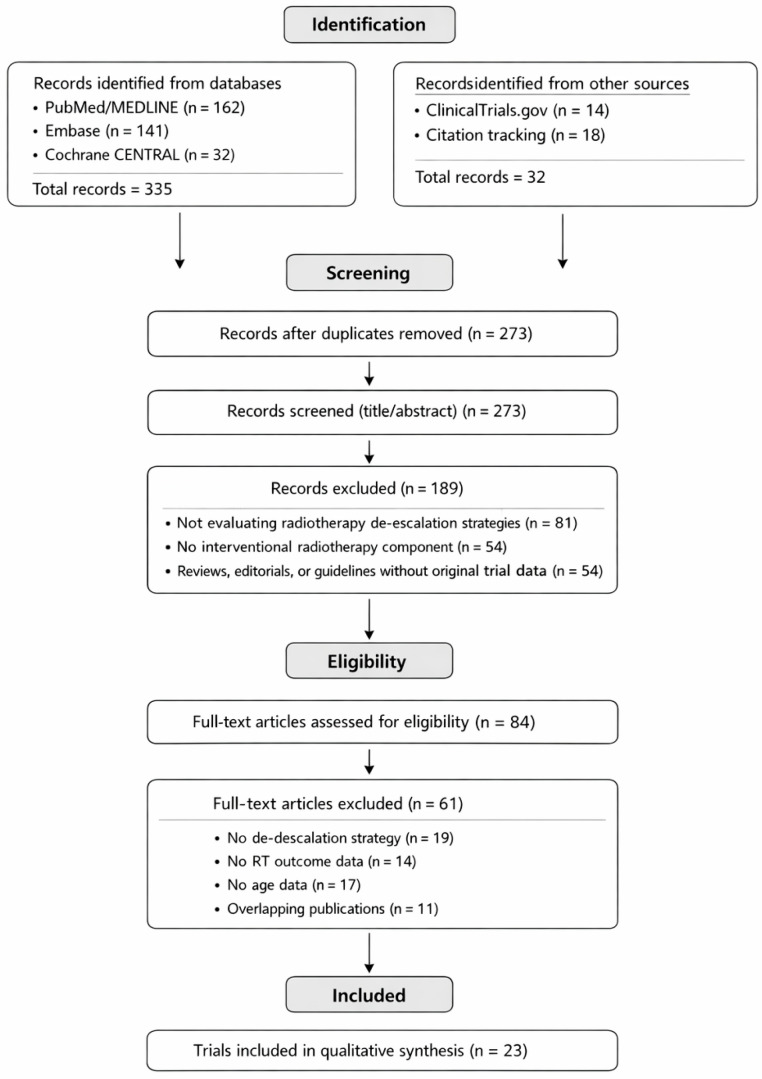 Figure 1
Peer Reviews
No public reviews on file for this paper yet. If you reviewed it on a platform where reviews are public (OpenReview, ICLR, NeurIPS, ICML), you can paste yours below so the community can read it here.
Videos
No videos yet. Explain this paper in a talk, walkthrough, or lecture? Add one.
Taxonomy
TopicsBreast Cancer Treatment Studies · Breast Lesions and Carcinomas · Cancer Risks and Factors