A Survey of Lattice-Based Physical-Layer Security for Wireless Systems with p-Modular Lattice Constructions
Hassan Khodaiemehr, Khadijeh Bagheri, Amin Mohajer, Chen Feng, Daniel Panario, Victor C. M. Leung

TL;DR
This paper surveys lattice-based methods for securing wireless communications, focusing on algebraic constructions and new p-modular lattices.
Contribution
The paper introduces a new family of p-modular lattices and analyzes their properties for physical-layer security.
Findings
p-modular lattices from cyclotomic fields Q(ζp) for primes p≡1(mod4) are characterized and analyzed.
A non-existence theorem shows these lattices cannot be extended to prime-power cyclotomic fields.
Indefinite theta series and modular completions are integrated to support secrecy metrics in mixed-signature lattices.
Abstract
Physical-layer security (PLS) provides an information-theoretic framework for securing wireless communications by exploiting channel and signal-structure asymmetries, thereby avoiding reliance on computational hardness assumptions. Within this setting, lattice codes and their algebraic constructions play a central role in achieving secrecy over Gaussian and fading wiretap channels. This article offers a comprehensive survey of lattice-based wiretap coding, covering foundational concepts in algebraic number theory, Construction A over number fields, and the structure of modular and unimodular lattice families. We review key secrecy metrics, including secrecy gain, flatness factor, and equivocation, and consolidate classical and recent results to provide a unified perspective that links wireless-channel models with their underlying algebraic lattice structures. In addition, we review a…
Genes, proteins, chemicals, diseases, species, mutations and cell lines named across the full text — each resolved to its canonical identifier and authoritative record.
Click any figure to enlarge with its caption.
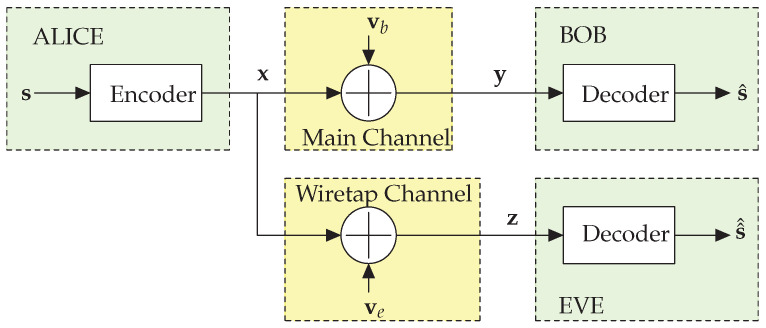 Figure 1
Peer Reviews
No public reviews on file for this paper yet. If you reviewed it on a platform where reviews are public (OpenReview, ICLR, NeurIPS, ICML), you can paste yours below so the community can read it here.
Videos
No videos yet. Explain this paper in a talk, walkthrough, or lecture? Add one.
Taxonomy
TopicsWireless Communication Security Techniques · Coding theory and cryptography · Cryptography and Data Security