Comparative Analysis of Methodological Aspects of the Study of Extracellular Vesicles and Extracellular Mitochondria: From Isolation to Internalization
Natalia Yunusova, Dmitry Svarovsky, Evgenya Kaigorodova, Alexey Dobrodeev, Virab Sisakian, Svetlana Tamkovich

TL;DR
This paper reviews methods for isolating and studying mitochondria-rich extracellular vesicles and their internalization mechanisms.
Contribution
The paper provides a comparative analysis of methodologies for studying extracellular mitochondria and mitochondria-rich EVs.
Findings
MitoEVs and extracellular mitochondria contain a characteristic set of mitochondrial nucleic acids, primarily mtDNA.
EV internalization mechanisms include clathrin-dependent endocytosis, caveolin-dependent endocytosis, raft-mediated endocytosis, and macropinocytosis.
Stem cells, platelet concentrate, and peripheral blood mononuclear cells are main sources for mitochondria-rich EVs for therapeutic use.
Abstract
Mitochondrial transfer in mammals has been proven to occur both under physiological conditions and during pathological conditions. It has been shown that neighboring cells can exchange mitochondria via nanotunnel tubes. However, there is evidence that free mitochondria, as well as whole mitochondria and individual mitochondrial fragments, can be transported between cells within extracellular vesicles (EVs). This review discusses the methodological aspects of isolation and a minimal set of methods for characterizing mitochondria-rich EVs (mitoEVs), as well as methodological approaches for studying the nucleic acid, protein, and lipid composition. It has been shown that mitoEVs, as well as extracellular mitochondria, contain a characteristic set of nucleic acids of mitochondrial origin. First and foremost, the dominant fraction of mitochondrial nucleic acids is mitochondrial DNA (mtDNA),…
Genes, proteins, chemicals, diseases, species, mutations and cell lines named across the full text — each resolved to its canonical identifier and authoritative record.
Click any figure to enlarge with its caption.
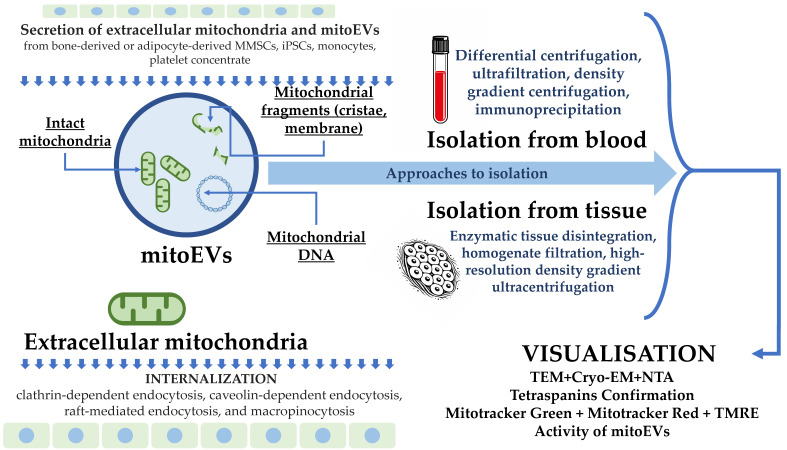 Figure 1
Peer Reviews
No public reviews on file for this paper yet. If you reviewed it on a platform where reviews are public (OpenReview, ICLR, NeurIPS, ICML), you can paste yours below so the community can read it here.
Videos
No videos yet. Explain this paper in a talk, walkthrough, or lecture? Add one.
Taxonomy
TopicsExtracellular vesicles in disease · Mitochondrial Function and Pathology · Caveolin-1 and cellular processes