Rumen Fluid Transplantation from Allium mongolicum Regel-Fed Donors Enhances Lamb Meat Quality and Reduces 4-Alkyl Branched-Chain Fatty Acids
Xiaoyuan Wang, Guoli Han, Khas Erdene, Chen Bai, Qina Cao, Yankai Zheng, Terigele Li, Lahan Hai, Yande Fan, Yuqi Zhao, Xinyi Liu, Changjin Ao

TL;DR
Transplanting rumen fluid from lambs fed Allium mongolicum Regel reduces lamb meat taint and improves quality by lowering specific fatty acids.
Contribution
This study shows that rumen fluid transplantation can mimic the meat quality benefits of feeding Allium mongolicum Regel to lambs.
Findings
Rumen fluid transplantation reduced 4-alkyl branched-chain fatty acids (KBCFAs) by 49-64% in lamb meat.
Transplanted rumen fluid improved meat quality by lowering drip and cooking loss while increasing protein and essential amino acids.
The results suggest rumen microbes mediate the flavor benefits of Allium mongolicum Regel in lamb meat.
Abstract
The extent of consumer approval for lamb is intimately connected to meat quality standards. Within this context, the distinctive ‘mutton taint’ serves as a critical benchmark for assessment, a characteristic that is largely governed by the concentrations of three fundamental branched-chain fatty acids (KBCFA), specifically 4-methyloctanoic acid (MOA), 4-ethyloctanoic acid (EOA), and 4-methylnonanoic acid (MNA). While Allium mongolicum Regel (AMR)—an Allium species prevalent in arid Asian regions known for its abundant bioactive constituents—is known to improve meat quality and mitigate these off-flavors, the potential mediating role of the rumen fluid in this process remains unclear. This study investigated whether rumen fluid transplantation (RFT) from AMR-fed donors could mimic the impacts of directly adding AMR to the diet on KBCFA accumulation and meat attributes. Thirty male lambs…
Genes, proteins, chemicals, diseases, species, mutations and cell lines named across the full text — each resolved to its canonical identifier and authoritative record.
Click any figure to enlarge with its caption.
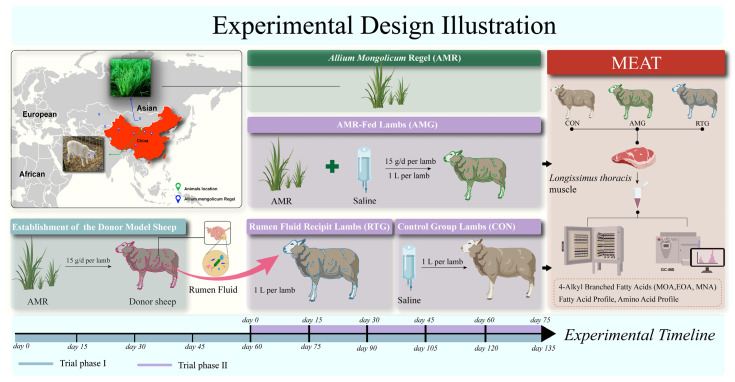 Figure 1
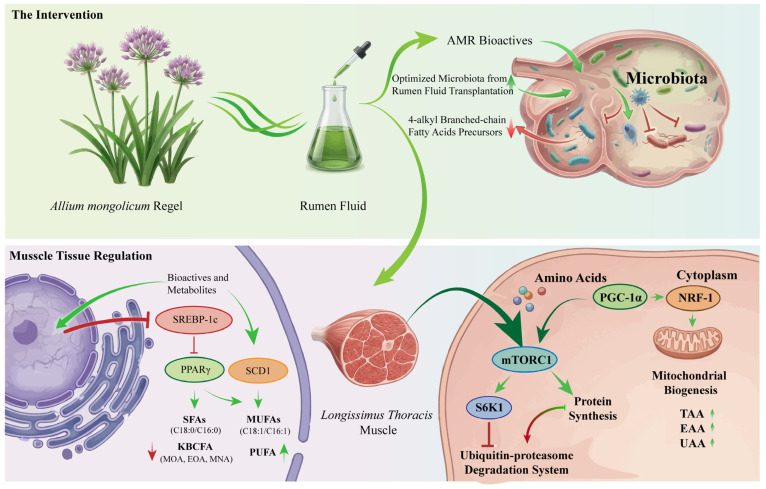 Figure 2
Peer Reviews
No public reviews on file for this paper yet. If you reviewed it on a platform where reviews are public (OpenReview, ICLR, NeurIPS, ICML), you can paste yours below so the community can read it here.
Videos
No videos yet. Explain this paper in a talk, walkthrough, or lecture? Add one.
Taxonomy
TopicsRuminant Nutrition and Digestive Physiology · Garlic and Onion Studies · Milk Quality and Mastitis in Dairy Cows