Dynamic Mode Decomposition-Based Clustered Pattern Projection for Reliable Alzheimer’s Disease Detection from EEG
Jong-Hyeon Seo, Hunseok Kang, Jacob Kang, Aymen I. Zreikat

TL;DR
This paper introduces a new method for detecting Alzheimer’s disease from EEG data using a Dynamic Mode Decomposition-based framework that improves classification reliability.
Contribution
The novel DMD-based Clustered Pattern Projection (DMD-CPP) framework enhances AD detection from eyes-open EEG by encoding data with cosine-similarity prototypes.
Findings
DMD-CPP achieved competitive classification accuracy with improved margin-based reliability in AD detection.
The model showed wider and more asymmetric decision margins in distinguishing AD from healthy controls.
Clustering-based pattern projection stabilized EEG dynamics and provided interpretable feature representations.
Abstract
Background/Objectives: Detecting Alzheimer’s disease (AD) from normal aging using eyes-open (EO) EEG is challenging due to stimulus-driven nonstationarity and fragmented oscillatory responses. This study aims to determine whether prototype-based representations derived from Dynamic Mode Decomposition (DMD) can improve AD detection from EO photostimulation EEG. Methods: We propose a DMD-based framework termed DMD-based Clustered Pattern Projection (DMD-CPP). Segment-wise DMD representations were clustered to learn class-specific medoid prototypes, and each EEG epoch was encoded as a vector of cosine-similarity coordinates with respect to these prototypes. A linear SVM classifier was trained on the resulting DMD-CPP features and evaluated under strict leave-one-subject-out validation. Results: The DMD-CPP model achieved competitive classification accuracy and, importantly, enhanced…
Genes, proteins, chemicals, diseases, species, mutations and cell lines named across the full text — each resolved to its canonical identifier and authoritative record.
Click any figure to enlarge with its caption.
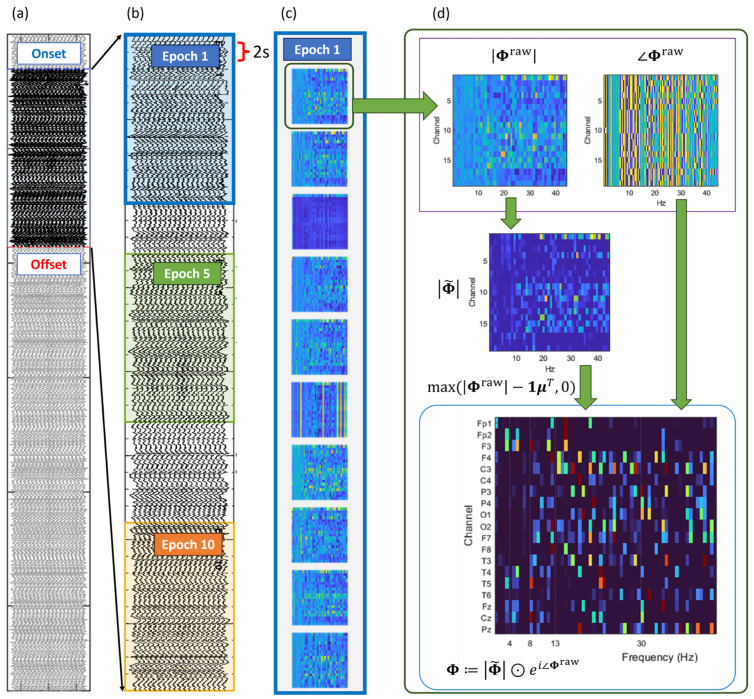 Figure 1
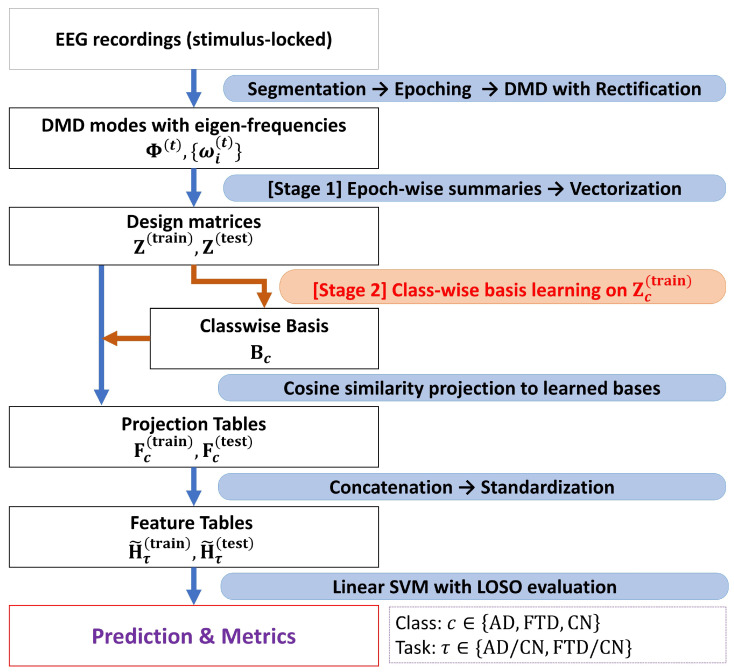 Figure 2
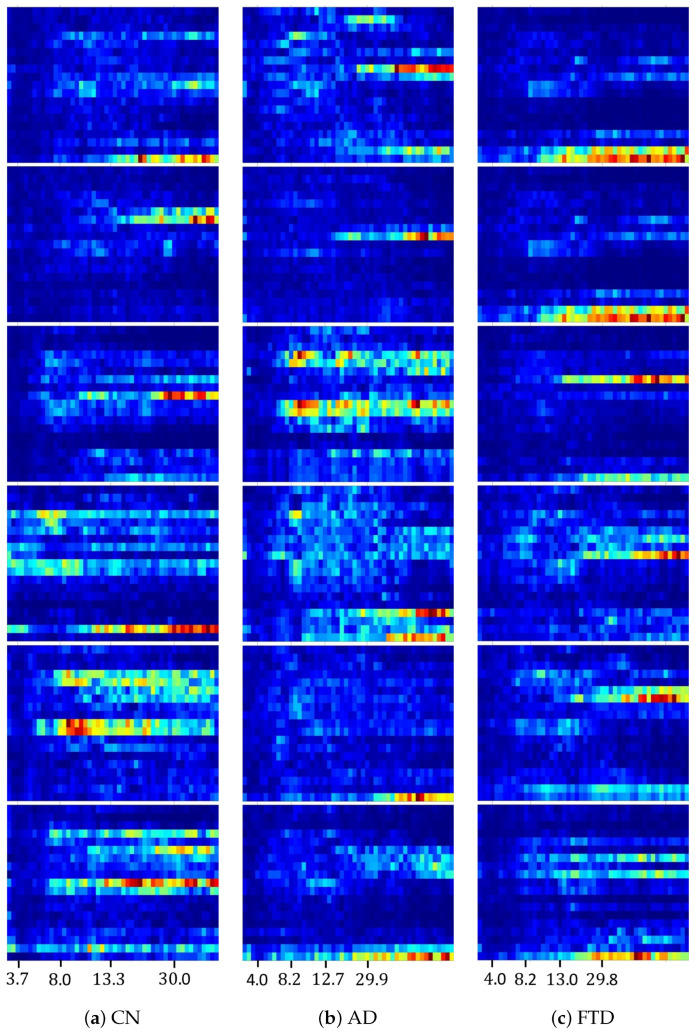 Figure 3
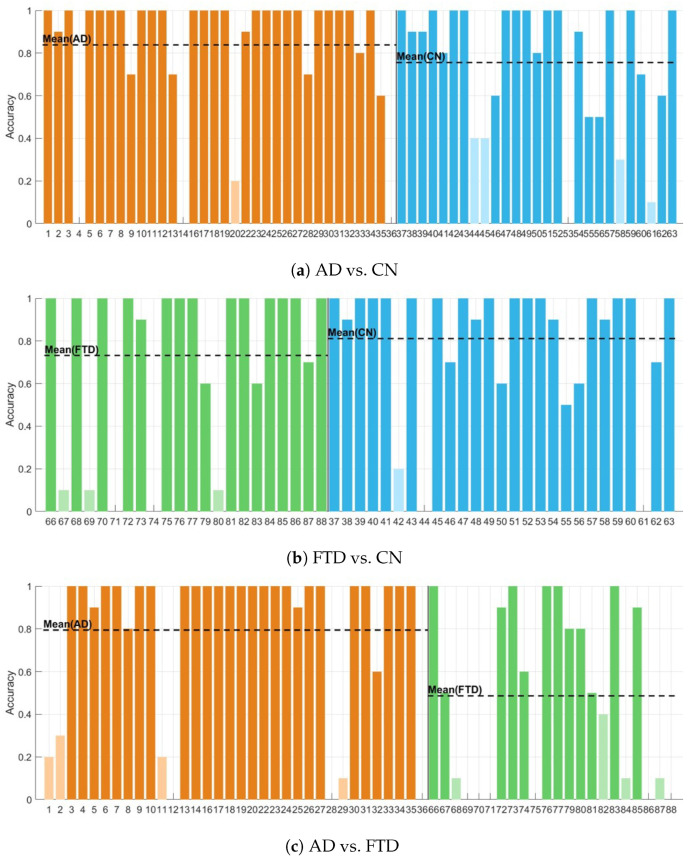 Figure 4
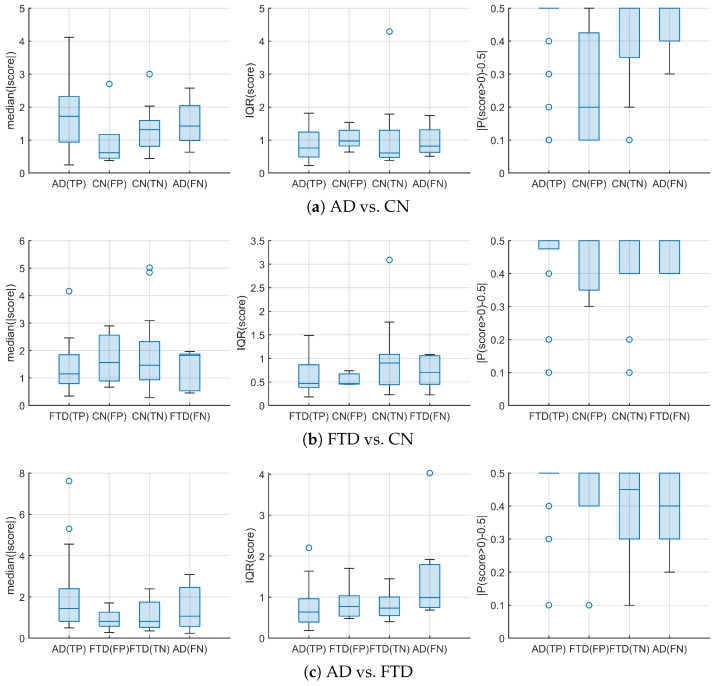 Figure 5
Peer Reviews
No public reviews on file for this paper yet. If you reviewed it on a platform where reviews are public (OpenReview, ICLR, NeurIPS, ICML), you can paste yours below so the community can read it here.
Videos
No videos yet. Explain this paper in a talk, walkthrough, or lecture? Add one.
Taxonomy
TopicsEEG and Brain-Computer Interfaces · Functional Brain Connectivity Studies · Emotion and Mood Recognition