The Diagnostic Evolution of Haematological Neoplasms: A Narrative Review of the Road to Two Genetically Focused Classification Systems Through a Resource-Limited Perspective
Caryn Benjamin, Zivanai Cuthbert Chapanduka, Nadine Rapiti

TL;DR
This review discusses how the classification of blood cancers has evolved to include advanced genetic testing, but warns that this may increase diagnostic disparities between low/middle and high-income countries.
Contribution
The paper highlights the impact of genetically focused classification systems on diagnostic disparities in resource-limited settings.
Findings
The WHO-HAEM5 and ICC classifications integrate advanced genetic technologies.
Diagnostic disparities between LMICs and HICs are expected to widen due to reliance on costly genetic testing.
Advocacy for accessible and affordable diagnostics in LMICs is urgently needed.
Abstract
Introduction: Classification of haematological malignancies has evolved over centuries from multiple morphology-based classifications to a single consensus classification, the World Health Organisation (WHO) classification of tumours in 2001, which included clinical history and immunophenotype. The next two decades saw a revised WHO classification, incorporating immunophenotyping, cytogenetics, molecular genetics, morphology, and clinical features. In 2022, the WHO classification of Haematolymphoid Tumours fifth edition (WHO-HAEM5) and International Consensus Classification (ICC) integrated advanced genetic technologies. Navigating two classifications has caused uncertainty for pathologists and clinicians globally. However, there is added concern for low and middle income countries (LMICs), where diagnostic disparities compared to high income countries (HICs) already exist. The…
Genes, proteins, chemicals, diseases, species, mutations and cell lines named across the full text — each resolved to its canonical identifier and authoritative record.
Click any figure to enlarge with its caption.
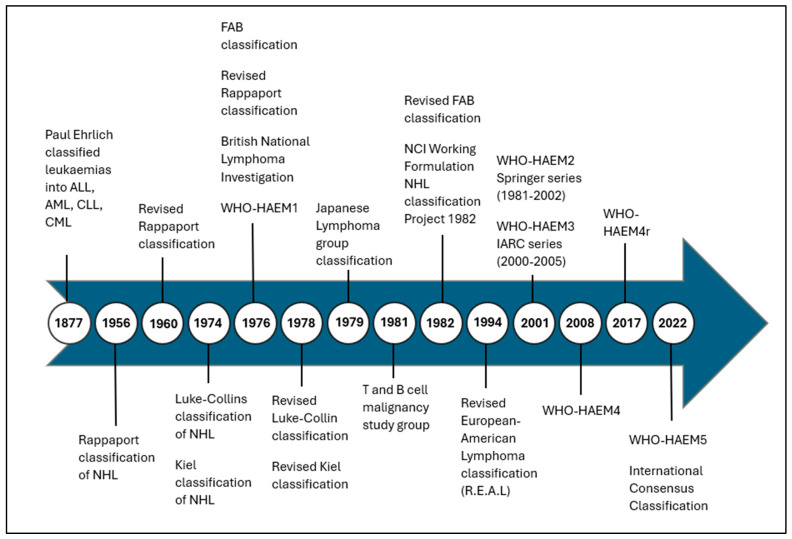 Figure 1
Peer Reviews
No public reviews on file for this paper yet. If you reviewed it on a platform where reviews are public (OpenReview, ICLR, NeurIPS, ICML), you can paste yours below so the community can read it here.
Videos
No videos yet. Explain this paper in a talk, walkthrough, or lecture? Add one.
Taxonomy
TopicsMyeloproliferative Neoplasms: Diagnosis and Treatment · Acute Myeloid Leukemia Research · Acute Lymphoblastic Leukemia research