Hypertriglyceridaemia-Associated Acute Pancreatitis: Risk Stratification, Drivers, and Prevention of Recurrence
Federica Fogacci, Arrigo F. G. Cicero

TL;DR
This paper reviews how high triglycerides cause acute pancreatitis, how to manage it, and new treatments to prevent recurrence.
Contribution
The paper provides updated insights into risk factors, management strategies, and emerging therapies for hypertriglyceridaemia-induced pancreatitis.
Findings
Acute pancreatitis risk increases sharply when triglycerides exceed 10 mmol/L.
Emerging RNA-targeted therapies show promise in preventing pancreatitis recurrence in high-risk patients.
Abstract
Hypertriglyceridaemia is the third most common aetiology of acute pancreatitis and a leading cause of recurrence in specialized lipid clinics. The risk of acute pancreatitis rises steeply once triglycerides exceed approximately 10 mmol/L (≈885 mg/dL). Still, clinically meaningful risk may occur at lower levels in the presence of chylomicronaemia, metabolic stress, or pregnancy. This mini-review synthesizes contemporary evidence on epidemiology, mechanistic links between triglyceride-rich lipoproteins and pancreatic injury, and the practical distinction between secondary (acquired) and genetic drivers of severe hypertriglyceridaemia. We summarize acute management strategies aimed at rapid triglyceride reduction (including insulin-based approaches and therapeutic plasma exchange in selected scenarios) and focus on long-term prevention of recurrence through lifestyle interventions,…
Genes, proteins, chemicals, diseases, species, mutations and cell lines named across the full text — each resolved to its canonical identifier and authoritative record.
Click any figure to enlarge with its caption.
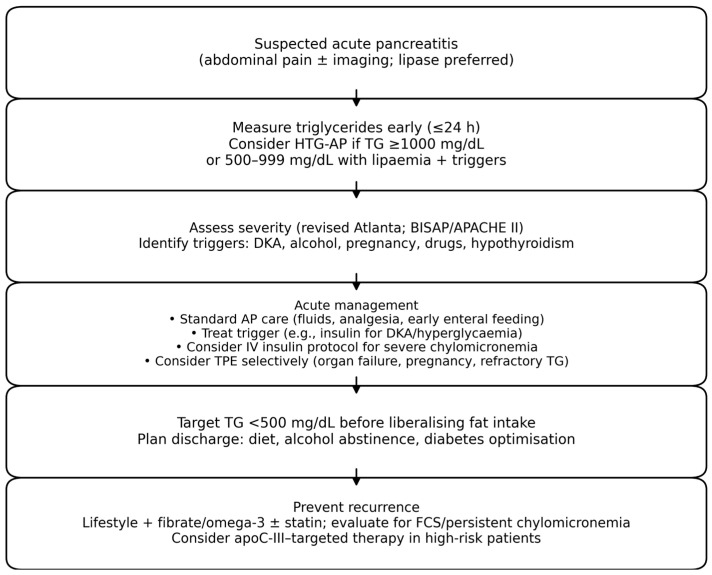 Figure 1
Peer Reviews
No public reviews on file for this paper yet. If you reviewed it on a platform where reviews are public (OpenReview, ICLR, NeurIPS, ICML), you can paste yours below so the community can read it here.
Videos
No videos yet. Explain this paper in a talk, walkthrough, or lecture? Add one.
Taxonomy
TopicsLipid metabolism and disorders · Pancreatitis Pathology and Treatment · Caveolin-1 and cellular processes