Reconstruction Versus Hemiarthroplasty in Comminuted (Three- and Four-Part) Proximal Humerus Fractures: A Retrospective Functional Outcome Analysis at 6 Months
Alexandru Lisias Dimitriu, Monica Georgiana Roman, Elisa Georgiana Popescu, Eduard Cătălin Georgescu, Dragoș Ene, Răzvan Ene

TL;DR
This study compares two surgical treatments for complex shoulder fractures in elderly patients and finds similar early outcomes between reconstruction and hemiarthroplasty.
Contribution
The study provides new comparative evidence on functional outcomes of ORIF versus hemiarthroplasty for comminuted proximal humerus fractures in elderly patients.
Findings
ORIF and hemiarthroplasty showed comparable 6-month functional outcomes in Constant–Murley and DASH scores.
Complication rates were similar between the two surgical approaches.
Stable anatomic reduction and tuberosity management were emphasized as more critical than implant choice.
Abstract
Background: The optimal management of comminuted proximal humerus fractures in the elderly remains controversial. Although hemiarthroplasty is widely used for complex fracture patterns, its functional superiority over reconstruction is not consistently demonstrated. The aim of this study was to compare early functional outcomes following open reduction and internal fixation (ORIF) versus hemiarthroplasty in elderly patients with three- and four-part proximal humerus fractures. Methods: This retrospective single-center study included elderly patients with comminuted proximal humerus fractures treated between 2020 and 2024 by either ORIF or hemiarthroplasty. Functional outcomes were assessed at 6 months using the Constant–Murley and DASH scores. Secondary outcomes included complication rates, range of motion, and early reintervention. Results: At 6 months, the ORIF group showed a mean…
Genes, proteins, chemicals, diseases, species, mutations and cell lines named across the full text — each resolved to its canonical identifier and authoritative record.
Click any figure to enlarge with its caption.
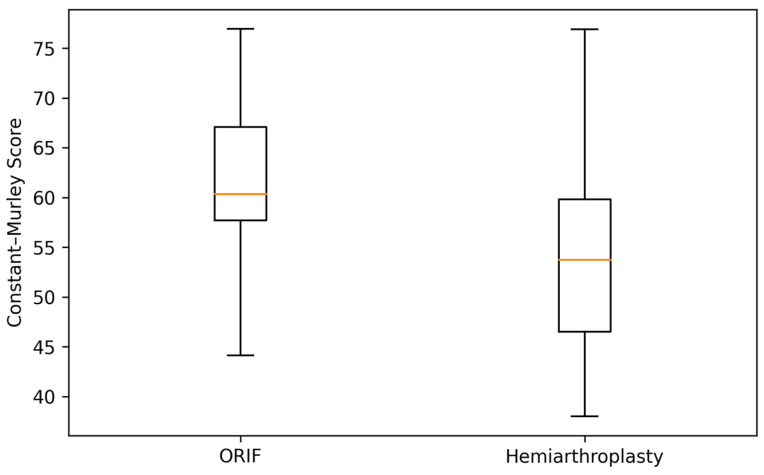 Figure 1
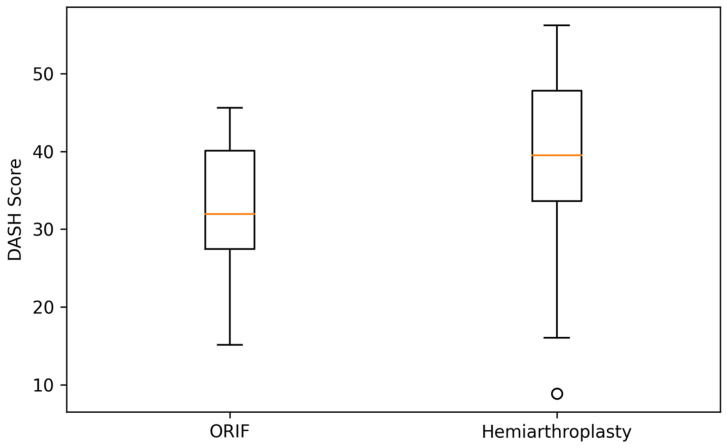 Figure 2
Peer Reviews
No public reviews on file for this paper yet. If you reviewed it on a platform where reviews are public (OpenReview, ICLR, NeurIPS, ICML), you can paste yours below so the community can read it here.
Videos
No videos yet. Explain this paper in a talk, walkthrough, or lecture? Add one.
Taxonomy
TopicsShoulder Injury and Treatment · Shoulder and Clavicle Injuries · Elbow and Forearm Trauma Treatment