An Audit of Accessibility and Actionability of Molecular Profiling for Patients with Cancer of Unknown Primary at a Tertiary Care Centre
Khaled Abdulalem, Jonah Teich, Erika Martinez, Samuel D. Saibil

TL;DR
This study examines how often cancer patients with unknown primary tumors receive molecular testing and finds that it is rarely used early enough to change their treatment.
Contribution
The study reveals low accessibility and late use of molecular profiling in CUP treatment, suggesting a need for earlier integration into clinical practice.
Findings
82% of patients received NGS analysis, but only after their disease had progressed.
Only 13% of patients had their treatment modified based on molecular profiling.
Molecular profiling was accessed through clinical trials, charitable programs, or private sources, not standard hospital services.
Abstract
Background/Objectives: Cancer of unknown primary (CUP) remains a significant challenge in the field of oncology. Despite advances elsewhere in the field, there have been few advances in the treatment of CUP and correspondingly no improvements in patient survival. Recent studies utilizing molecular profiling, including next-generation sequencing (NGS), and molecularly targeted treatment of CUP have shown some promising initial results, but have yet to be integrated into the standard of care in most jurisdictions. This study aimed to assess the use of molecular characterization and targeted treatment of patients with CUP treated at Princess Margaret Cancer Centre (PMCC). Methods: This study is a retrospective audit of patients with CUP treated between January 2019 and April 2024 to build understanding of the accessibility and use of these molecular tools. Results: We found that 82% of the…
Genes, proteins, chemicals, diseases, species, mutations and cell lines named across the full text — each resolved to its canonical identifier and authoritative record.
Click any figure to enlarge with its caption.
 Figure 1
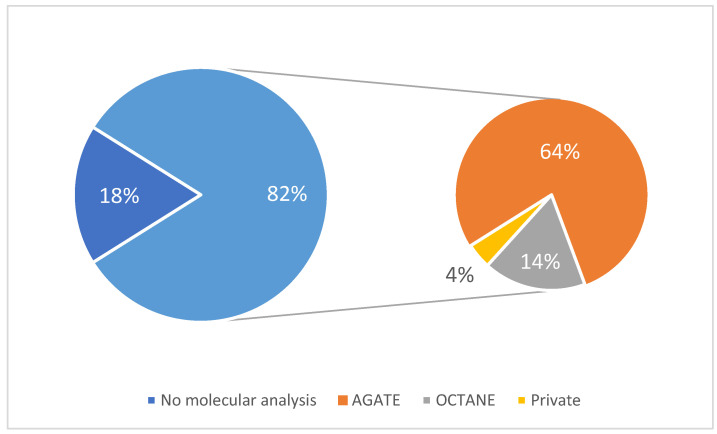 Figure 2
Peer Reviews
No public reviews on file for this paper yet. If you reviewed it on a platform where reviews are public (OpenReview, ICLR, NeurIPS, ICML), you can paste yours below so the community can read it here.
Videos
No videos yet. Explain this paper in a talk, walkthrough, or lecture? Add one.
Taxonomy
TopicsCancer Diagnosis and Treatment · Head and Neck Cancer Studies · Oral Health Pathology and Treatment