Occurrence of Trichinella Species in Wild Boar (Sus scrofa) Populations Across Bulgaria
Nikolay Lalkovski, Francesco Celani, Daniele Tonanzi, Gianluca Marucci

TL;DR
This study found that Trichinella britovi is the only species infecting wild boar in Bulgaria, with a 1.5% infection rate, mainly in the south.
Contribution
The study identifies Trichinella britovi as the sole species in Bulgarian wild boar, updating regional parasite knowledge.
Findings
Trichinella britovi was the only species detected in wild boar in Bulgaria.
Infection prevalence was 1.5% among 43,228 examined carcasses.
Most infected boar were from southern Bulgaria.
Abstract
Trichinellosis is a disease caused by parasitic worms that can be transmitted from animals to humans. Free-ranging wild boar play an important role in maintaining this parasite in nature and are also a potential source of human infection through the consumption of raw or undercooked meat. The aim of this study was to identify which species of this parasite are present in wild boar in Bulgaria and to determine the frequency of infection. The study was conducted over five hunting seasons, from 2020 to 2025, and more than 43,000 wild boar carcasses were examined. Approximately 1.5% of the animals were found to be infected. All positive samples belonged to a single parasite species, Trichinella britovi, even though other species have been occasionally reported in the past. Most infected wild boar originated from the southern part of the country. These findings provide valuable information…
Genes, proteins, chemicals, diseases, species, mutations and cell lines named across the full text — each resolved to its canonical identifier and authoritative record.
Click any figure to enlarge with its caption.
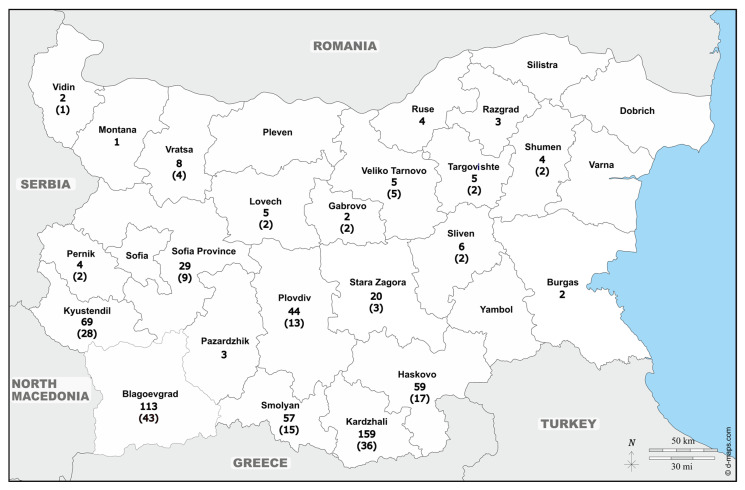 Figure 1
Peer Reviews
No public reviews on file for this paper yet. If you reviewed it on a platform where reviews are public (OpenReview, ICLR, NeurIPS, ICML), you can paste yours below so the community can read it here.
Videos
No videos yet. Explain this paper in a talk, walkthrough, or lecture? Add one.
Taxonomy
TopicsParasitic Diseases Research and Treatment · Mollusks and Parasites Studies · Helminth infection and control
1. Introduction
Trichinellosis is a foodborne zoonotic disease caused by species of the genus Trichinella, which includes ten recognized species and three additional genotypes. Four of these species, T. spiralis, T. britovi, T. nativa, and T. pseudospiralis, are prevalent in Europe [1]. In Bulgaria, trichinellosis represents one of the most important parasitic zoonoses.
Surveillance data indicate that the prevalence of Trichinella infection in wild boar in Bulgaria has historically been relatively high. According to the European Food Safety Authority (EFSA), prevalence declined from 1.25% in 2015 to 0.51% in 2018, with annual values of 1.25% (2015), 1.00% (2016), 0.95% (2017), and 0.51% (2018). During the same period, the incidence of confirmed human infections ranged from 0.31 to 0.77 per 100,000, whereas the average incidence in the European Union was considerably lower, ranging from 0.01 to 0.03 per 100,000.
Two species, T. spiralis and T. britovi, have been identified as the etiological agents of trichinellosis in Bulgaria [2,3]. The main source of human infection (58.6% of 29 outbreaks) was the consumption of raw or undercooked meat products, mainly sausages, prepared from wild boar meat [4]. The same Trichinella species have also been identified in wild boar, underscoring the importance of this host in the transmission of infection to humans. In samples examined between 2010 and 2016, the ratio of T. britovi to T. spiralis in wild boar populations was estimated at 45:1 [5].
The aim of this study was to describe the Trichinella species detected in wild boar in Bulgaria and their distribution across the country, based on surveillance carried out during five hunting seasons (2020–2025), thereby contributing to an improved understanding of species-specific prevalence in this host.
2. Materials and Methods
The research was conducted between October 2020 and February 2025, covering five hunting seasons. In Bulgaria, wild boar hunting begins in October and continues until the second weekend of January. Muscle tissue samples were collected from wild boars shot during regular hunting activities in several regions of Bulgaria (Figure 1). Ten grams of tissue were sampled from diaphragm of each animal and tested by artificial digestion according to ISO18743:2015 [6] at regional laboratories in charge for official controls. Trichinella larvae originating from positive animals were collected, stored in 90% ethanol, and sent to the European Union Reference Laboratory for Parasites (EURL-P; https://www.iss.it/en/eurlp-chi-siamo) (Rome, Italy) for species identification by multiplex PCR [7]. Briefly, DNA was purified from single larvae using a DNA IQ System kit (Promega, Madison, WI, USA) and a Tissue and Hair Extraction kit (Promega, USA). Five primer sets, targeting specific regions of the ribosomal DNA repeats (expansion segment V, ITS1 and ITS2), were used in multiplex PCR to obtain a species-specific electrophoretic DNA banding patterns [8,9].
3. Results
A total of 43,228 wild boar carcasses were examined using artificial digestion, of which 597 tested positive for Trichinella, corresponding to a prevalence of 1.5% (Figure 1, Table 1). Numerous larvae were visually observed in all positive samples; however, infection intensity could not be quantified due to the absence of larvae per gram measurements. Out of a total of 597 positive isolates, a subsample of 238 was submitted to the EURLP for species identification via multiplex PCR. The subsample included only the larvae which, under microscopic observation, showed to be in acceptable condition for analysis (i.e., intact cuticle and visible internal structures). Specifically, these included 23 isolates from animals hunted during the 2020–2021 season, 68 from 2021 to 2022, 39 from 2022 to 2023, 65 from 2023 to 2024, and 43 from 2024 to 2025. Most isolates (68%) submitted to EURLP for species identification originated from the southern part of the country. PCR products specific for Trichinella britovi were obtained from 186 samples (78.2%) of the 238 samples. For the remaining 52 samples, species identification was unsuccessful, likely due to insufficient DNA recovery resulting from sample degradation during storage.
4. Discussion
In Europe, expanding wild boar populations pose a potential risk for the spread of Trichinella spp. due to their high susceptibility to this nematode [10]. Wild mammals are common reservoir hosts, and parasite biomass is higher in wild animals than in domestic ones [11]. Although most trichinellosis outbreaks in Eastern Europe remain linked to pork consumption, especially from pigs raised under uncontrolled housing conditions [12,13], cases associated with game meat, particularly wild boar, are increasing. In some countries, such as Croatia and Poland, wild boar meat has even surpassed pork as the main source of human infection [14,15,16]. Despite this, the prevalence of Trichinella in European wild boar populations has remained relatively stable in recent years [17], while the number of wild boars continues to rise [18,19,20]. For instance, in Bulgaria, according to data provided by the Executive Forest Agency, the number of wild boars recorded in spring 2025 was 64,840, representing a 10.2% increase compared to 2024 [21].
Bulgaria is geographically divided by the Balkan Mountains into northern and southern regions. The north comprises the Danubian Plain and low hills, with a continental climate of cold winters and hot summers, and vegetation dominated by grasslands, agricultural fields, and mixed forests. Southern Bulgaria is more mountainous, featuring ranges such as the Balkan, Rhodope, Rila, and Pirin, with denser forest, richer undergrowth, and varied landscape. Most wild boars inhabit the south, at an approximate 2:1 ratio compared to the north. Habitat studies indicates that wild boars occupy about 57.5% of the national territory, favoring broad-leaved and continuous forests, particularly in the southern and southwestern regions, whereas northern areas are less suitable due to the extensive agricultural land [22].
Recent changes in wild boar population size may interact with other ecological factors affecting Trichinella circulation. For example, in Germany, an increase in Trichinella prevalence in wild boar populations between 2013 and 2023 occurred in areas inhabited by predator species such as raccoon dogs and wolves [23]. Similarly, in Poland, Trichinella infection in wild boars correlated positively with raccoon dog density, suggesting that these carnivores help maintain the sylvatic cycle. [24]. These findings indicate that parasite prevalence is influenced not only by host population size but also by the abundance and distribution of other competent hosts. Accordingly, increases in wild boar numbers, such as those observed in Bulgaria, have been hypothesized to interact with the presence of other reservoir species, potentially affecting Trichinella transmission dynamics. In this context, the raccoon dog, present in Bulgaria since 1968, is now widely distributed across the country. There are 75 recorded sightings covering almost the entire territory, with the majority (77.4%) occurring at altitudes between sea level and 199 m a.s.l., and 56% located within national protected areas [25]. However, no data on Trichinella infection in raccoon dogs were collected in this study. Thus, their presence is discussed here only as a potential ecological factor based on existing literature, rather than as evidence of causal role in the sylvatic cycle. By interacting with local wild boar populations, raccoon dogs could potentially contribute to the maintenance and spread of the parasite.
Epidemiological data from October 2020 to February 2025 indicate higher Trichinella prevalence in southern Bulgaria, with 558 out of 597 positive cases reported there, compared to only 39 cases from the northern regions. Although these data align with the previously discussed ecological patterns, this study did not directly assess the relationship between wildlife population dynamics, the presence of other reservoir hosts, and Trichinella prevalence.
The detection of T. britovi in the tested animals suggests its predominance in Bulgarian wild boar and is consistent with historical data. However, species identification was performed on a subset of positive samples only, and therefore the presence of other Trichinella species among the non-typed isolates cannot be excluded. Between 2000 and 2024, a total of 261 wild boar tested positive for Trichinella: 253 (97%) were infected with T. britovi, seven (2.7%) with T. spiralis, and one (0.3%) with T. pseudospiralis [26]. Taken together, these data support the view that T. britovi is the principal Trichinella species circulating among wild mammal populations in Bulgaria.
5. Conclusions
The increasing wild boar population in Bulgaria, particularly in the forested southern regions, may influence Trichinella transmission in wildlife. However, parasite prevalence may be influenced not only by wild boar abundance but also by the presence of other competent hosts, such as the raccoon dog, which is now widely established across the country. In this study, T. britovi was the only species detected among the analyzed isolates, consistent with historical records that suggest its dominance in Bulgarian wild boars, although the presence of other Trichinella species cannot be excluded. An effective management of zoonotic risk should therefore combine the monitoring of wild boar populations with the assessment of other wildlife hosts, and the evaluation of habitat conditions to prevent trichinellosis linked to the consumption of game meat.
The reference list from the paper itself. Each links out to its DOI / PubMed record.
- 1Pozio E. Zarlenga D. Taxonomy of the Trichinella genus Trichinella and Trichinellosis Bruschi F. Elsevier, Academic Press Oxford, UK 20213846
- 2Kurdova R. Muller N. Tsvetkova N. Michov L. Georgieva D. Ivanova M. Gottstein B. Characterisation of Trichinella Isolates from Bulgaria by Molecular Typing and Cross-Breeding Vet. Parasitol.200412317918810.1016/j.vetpar.2004.06.02115325044 · doi ↗ · pubmed ↗
- 3Petkova S. Mihov L. Vutova K. Tsenov I. La Rosa G. Pozio E. Epidemiological and Clinical Patterns of Trichinellosis in Bulgaria from 1995 to 2002 Parasite 200815868810.1051/parasite/200815108618416251 · doi ↗ · pubmed ↗
- 4Rainova I. Kaftandjiev I. Harizanov R. Tsvetkova N. Jordanova D. Marinova I. Kurdova R. Kantardjiev T. Lalkovski N. Outbreaks of Human Trichinellosis, Still a Challenge for the Public Health Authorities in Bulgaria J. Public Health 20162429129710.1007/s 10389-016-0724-9 · doi ↗
- 5Lalkovski N. Species Composition of Trichinella in Domestic and Wild Animals in Bulgaria Bulg. J. Vet. Med.2019229910410.15547/bjvm.2038 · doi ↗
- 6ISO 18743:2015 Microbiology of the Food Chain—Detection of Trichinella Larvae in Meat by Artificial Digestion Method International Organization for Standardization (ISO)Geneva, Switzerland 2015
- 7Pozio E. Zarlenga D. International Commission on Trichinellosis: Recommendations for Genotyping Trichinella Muscle Stage Larvae Food Waterborne Parasitol.201915 e 0003310.1016/j.fawpar.2018.e 0003332095609 PMC 7034036 · doi ↗ · pubmed ↗
- 8Zarlenga D.S. Chute M.B. Martin A. Kapel C.M. A Multiplex PCR for Unequivocal Differentiation of All Encapsulated and Non-Encapsulated Genotypes of Trichinella Int. J. Parasitol.1999291859186710.1016/S 0020-7519(99)00107-110616932 · doi ↗ · pubmed ↗