Cocirculation of endemic and recently introduced West Nile Virus lineage 1 clades in Southern Spain
Carlos S. Casimiro-Soriguer, Maria Lara, Irene Pedrosa-Corral, Cristina Gómez-Camarasa, Nicola Lorusso, J. Alberto Chaves, Jose M. Navarro-Marí, Laura Merino, Jose A. Lepe, Joaquin Dopazo, Sara Sanbonmatsu-Gámez, Javier Perez-Florido

TL;DR
Southern Spain is experiencing a surge in West Nile virus cases with multiple strains circulating, highlighting the need for better surveillance.
Contribution
The study identifies co-circulating endemic and newly introduced WNV lineage 1 clades in Southern Spain through genomic analysis.
Findings
Genomic analysis revealed multiple WNV lineage 1 clades co-circulating in Southern Spain.
Both endemic and recently introduced strains were identified in the 2024 outbreak.
Spain's role in the Africa-Europe WNV circulation is emphasized.
Abstract
In 2024, Andalusia (Southern Spain) reported its largest recent West Nile virus (WNV) outbreak, with 106 confirmed human cases and 16 deaths. Genomic analysis of 27 WNV isolates revealed the co-circulation of multiple WNV lineage 1 clades, including both endemic and recently introduced strains, reflecting a marked increase in viral genetic diversity. These findings underscore the critical role of integrated genomic surveillance systems in monitoring pathogen evolution and supporting timely public health responses to emerging zoonotic threats. •Genomic analysis of 27 WNV isolates reveals the co-circulation of endemic and newly introduced lineage 1 clades in Spain.•Phylogenetic analysis identifies persistent WNV strains from previous outbreaks alongside novel variants.•The findings highlight Spain's role in the circulation of WNV between Africa and Europe.•Findings also underscore the…
Genes, proteins, chemicals, diseases, species, mutations and cell lines named across the full text — each resolved to its canonical identifier and authoritative record.
Click any figure to enlarge with its caption.
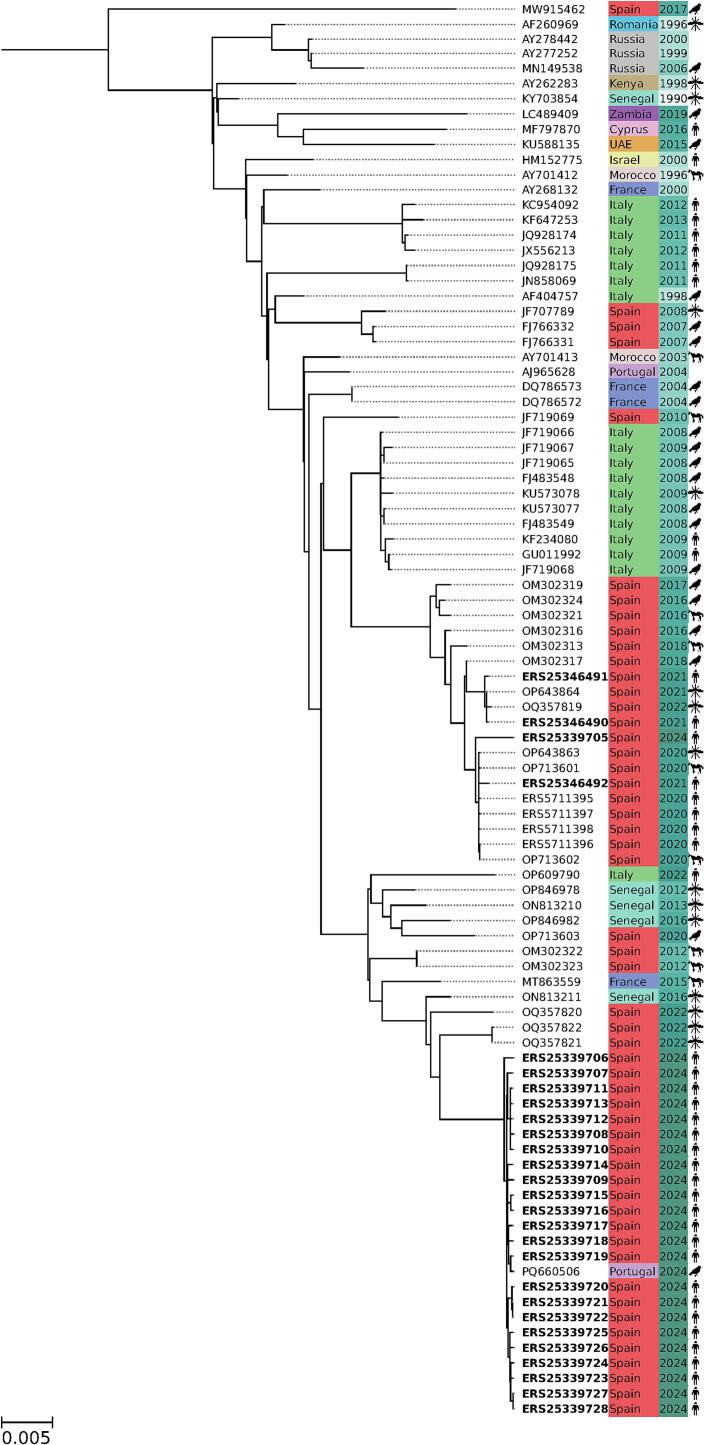 Figure 1
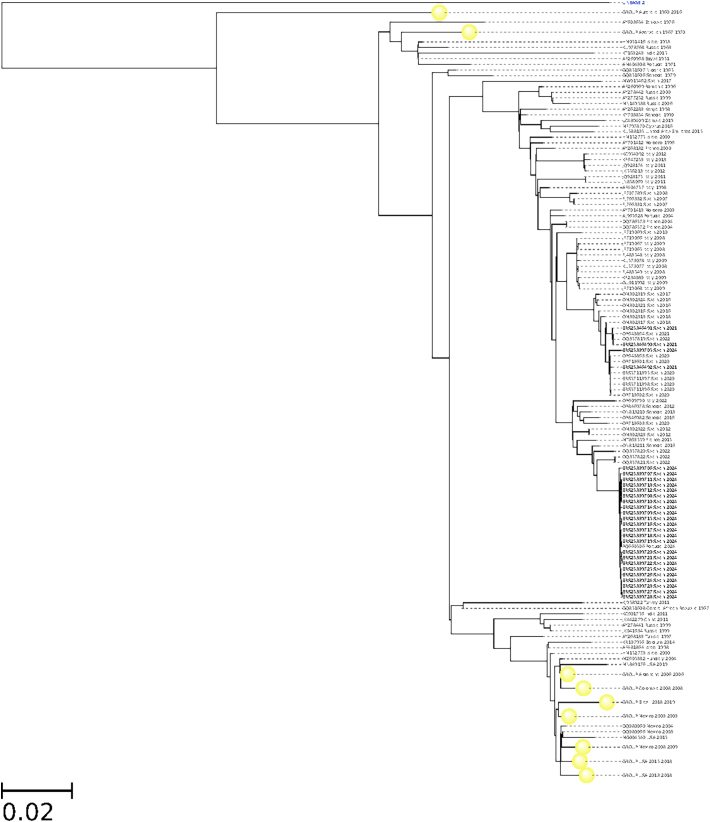 Figure 2
Peer Reviews
No public reviews on file for this paper yet. If you reviewed it on a platform where reviews are public (OpenReview, ICLR, NeurIPS, ICML), you can paste yours below so the community can read it here.
Videos
No videos yet. Explain this paper in a talk, walkthrough, or lecture? Add one.
Taxonomy
TopicsMosquito-borne diseases and control · Viral Infections and Outbreaks Research · HIV Research and Treatment
Introduction
1
WNV has been detected in mainland Europe since the mid-1990s [1] with two circulating lineages (1 and 2) causing sporadic outbreaks, affecting birds [2], horses [3] and humans [4]. In particular, the first occurrences in southern Spain were reported in early 2000s, with notable outbreaks occurring in Andalusia in 2010 and 2020 [5]. Both, lineage 1 and, more recently, lineage 2 have been detected in the region [5], [6]. The 2020 outbreak marked a turning point for regional surveillance efforts. However, in 2024, a resurgence occurred, resulting in the largest WNV outbreak in Andalusia to date, with 106 confirmed human cases and 16 fatalities [6], which prompted the inclusion of WNV in the genomic surveillance circuit of Andalusia [7], [8]. Here we provide a detailed molecular characterization of the last WNV lineage 1 outbreak in Andalusia, documenting the coexistence of imported viruses along with endemic viruses from a phylogenetic clade present in the south of Spain at least since 2020.
Genomic surveillance circuit in Southern Spain (Andalusia)
2
Sample collection in the surveillance circuit
2.1
Epidemiological surveillance in Andalusia is coordinated through the “Sistema de Vigilancia Epidemiológica de Andalucía” (SVEA) [9], integrated within the national surveillance network and guided by a One Health approach. The system combines human, animal, entomological, and environmental data streams to enable early detection and coordinated response to zoonotic threats like WNV. Surveillance activities follow EU case definitions [10] and involve routine case reporting, laboratory confirmation, and integration of data from equine and wildlife surveillance, supported by sectoral collaboration across regional ministries [11]. In response to previous outbreaks, Andalusia implemented an Integrated Surveillance and Vector Control Programme that mandates entomological monitoring and local mosquito control plans in affected municipalities [12]. The surveillance infrastructure is reinforced by genomic data integration through the regional “Sistema Integrado de Epidemiología Genómica de Andalucía” (SIEGA) platform, enabling pathogen lineage tracking to inform risk assessments and response strategies [8].
Specimens, including whole blood and urine, collected from cases with clinical suspicion of WNV infection in Andalusia (Southern Spain) during 2024 (see Table 1) were submitted to the Andalusian Virus Reference Laboratory Samples following the SVEA Protocol for WNV surveillance and alert [9].Table 1WNV isolates from human reported in this study with its corresponding sample source, date and location (province), along with the average sequencing depth and genome coverage. These sequences are represented in Fig. 1 along with the sequences from other isolates from human, mosquitoes, birds and horses.Table 1ENA IDSourceCollection dateLocationMean depthGenome CoverageERS25346490Urine17/08/2021Sevilla5315.6399.28ERS25346491Urine03/09/2021Sevilla4476.0288.79ERS25346492Urine21/09/2021Sevilla1596.5197.90ERS25339721Urine11/07/2024Sevilla5518.8797.95ERS25339711Urine14/07/2024Sevilla4127.7299.49ERS25339715Urine17/07/2024Sevilla3213.4898.16ERS25339713Urine22/07/2024Sevilla2040.8099.28ERS25339712Blood22/07/2024Sevilla19,197.2595.29ERS25339707Urine31/07/2024Sevilla2533.4599.28ERS25339722Urine03/08/2024Sevilla2421.3699.28ERS25339714Urine03/08/2024Sevilla3877.4698.16ERS25339719Urine07/08/2024Sevilla3606.4097.95ERS25339717Urine07/08/2024Sevilla2998.6197.95ERS25339718Urine12/08/2024Sevilla3724.1597.72ERS25339725Urine17/08/2024Sevilla3883.7197.79ERS25339710Urine24/08/2024Sevilla5296.1998.16ERS25339716Urine27/08/2024Sevilla3555.5297.95ERS25339727Urine30/08/2024Sevilla7783.9695.59ERS25339724Urine01/09/2024Sevilla9695.6398.16ERS25339728Urine04/09/2024Cordoba7763.3198.16ERS25339708Blood04/09/2024Cordoba7914.8299.49ERS25339723Urine06/09/2024Sevilla5448.1061.18ERS25339720Urine10/09/2024Jaen8986.4698.16ERS25339709Urine11/09/2024Sevilla14,155.0360.37ERS25339705Urine12/09/2024Huelva11,946.4399.28ERS25339706Urine18/09/2024Cordoba15,628.2395.57ERS25339726Blood20/09/2024Sevilla28,404.8397.28
Sample sequencing
2.2
RNA was extracted using the QIAsymphony DSP Virus/Pathogen Mini Kit (Qiagen, Hilden, Germany). A qRT-PCR targeting the 3’UTR region of the WNV genome was employed to detect viral RNA [13] in urine, serum and whole blood samples.
RNA extracted from WNV positive samples was reverse transcribed using LunaScript® RT SuperMix Kit (New England Biolabs, Ipswich, MA, USA). Multiplex PCR was carried out using Q5® Hot Start High-Fidelity (New England Biolab) protocol, utilizing a panel of 41 primer pairs previously validated for WNV genome amplification [5], [14].
PCR products were purified with Agencourt AMPure XP beads (Beckman Coulter), and libraries were prepared using the Illumina DNA Prep Kit. Samples were pooled in equal concentrations after quantification by Qubit 4 fluorometer (Invitrogen). Sequencing was performed on the iSeq 100 System using a iSeq 100 i1 Reagent v2 (300-cycle) (Illumina).
Raw paired-end reads (150 bp × 2) were analyzed using the nf-core/viralrecon pipeline software (v.2.6.0) [15] (see also [5], [6]). Quality control, trimming, alignment to a WNV lineage 1 reference genome (JF719067), and variant calling were performed using standard tools including Bowtie 2 (v2.4.4) [16], iVar (v1.4) [17] and bcftools (v1.16) [18]. A consensus genome was generated for each sample based on high-confidence variants (allele frequency ≥ 0.75).
The new WNV sequences reported here are available in the European Nucleotide Archive (ENA) database under the project identifier PRJEB43037.Fig. 1. Phylogenetic tree of the current Spanish samples in the context of the recent phylogenetically-related WNV sequences available (See Table 1 and Supplementary Table 1).Phylogenetic tree of the current Spanish samples in the context of the recent phylogenetically-related WNV sequences available (See Table 1 and Supplementary Table 1).Fig. 1
Phylogenetic analysis of the 2024 outbreak in Andalusia
2.3
A set of 228 whole genomes of WNV lineage 1 from previous outbreaks found in the GenBank repository (listed in Supplementary Table 1) were downloaded and aligned with the 24 new whole genome sequences from the 2024 outbreak, plus 3 extra whole genomes from the 2021 outbreak, reported in this study (Table 1) using MAFFT v7.515 [19].
Fig. 1 shows a phylogenetic tree depicting the current Spanish samples in the context of the recent phylogenetically-related WNV sequences available, reconstructed using the Augur toolkit (v21.0.0) [20]. This phylogeny can be interactively visualized using the SIEGA Nextstrain server [21]. Finally, Supplementary Fig. S1 depicts an expanded phylogenetic tree, constructed with a total of 255 whole genome sequences, covering virtually all WNV lineage 1 sequences available in the public repositories, that portraits the phylogenetic origin of all the European samples in the context of the WNV sequences reported worldwide.
Discussion
3
Fig. 1 provides a clear picture of the recent 2024 outbreak in the context of all the data available on recent WNV lineage 1 outbreaks. Largely, the 2024 outbreak clade, which also includes one Portuguese isolate (PQ660506) dating also from 2024 [22], derives from previous samples from mosquito reported in 2022 in Spain (OQ357821, OQ357822 and OQ357820) [23]. All these sequences derive from previous samples reported in 2020 in birds (OP713603), demonstrating the key role of Spain in the traffic of WNV between Europe and Africa [24], as confirmed by other related sequences from Senegal (OP846978 and ON813210 in 2013 as well as OP846982 and ON813211 in 2016), France (MT863559 in 2015) and Italy (OP609790 in 2022) Data on bird's migration [25] confirm that Spain is the transit point used for travelling between Africa and Europe. All the infected subjects in Table 1 came from small villages close to the Guadalquivir river and swamps around.
Interestingly, one of the sequences from the recent 2024 outbreak (See ERS25339705 in Table 1) is not related to the rest of isolates of the current outbreak reported here but it derives from WNV from the 2020 and 2021 outbreaks [5]. This clade has been continuously present in Spain at least since 2016, when it was reported in birds and horses [24].
These results confirm the coexistence of different genetic clades of WNV lineage 1, along with the recently reported occurrence of WNV lineage 2 [6], documenting a remarkable increase in the diversity of WNV populations in Southern Spain. This increase in the genetic diversity highlights the potential for altered virulence, host range, or transmission dynamics, and underscores the critical importance of proactive, integrated surveillance strategies combining vector monitoring, genomic sequencing, and rapid response measures, as exemplified by the Andalusian Programme for Surveillance and Control of WNV Vectors [12]. Advancing our understanding of the environmental and genomic determinants of WNV transmission remains essential for forecasting outbreaks and guiding targeted interventions. In this context, genomics-informed surveillance platforms, such as SIEGA [8], offer valuable support for real-time detection, lineage tracking, and evidence-based public health decision-making in response to emerging zoonotic threats [26].
The following are the supplementary data related to this article.Supplementary Fig. S1Phylogenetic tree of 228 whole genomes of WNV lineage 1 from previous outbreaks found in the GenBank repository (See also Supplementary Table 1).Supplementary Fig. S1Supplementary Table 1A set of 228 whole genomes of WNV lineage 1 from previous outbreaks found in the GenBank repository.Supplementary Table 1
CRediT authorship contribution statement
Carlos S. Casimiro-Soriguer: Methodology, Investigation. Maria Lara: Investigation, Formal analysis, Data curation. Irene Pedrosa-Corral: Resources, Methodology. Cristina Gómez-Camarasa: Resources. Nicola Lorusso: Conceptualization. J. Alberto Chaves: Conceptualization. Jose M. Navarro-Marí: Resources. Laura Merino: Resources. Jose A. Lepe: Resources, Methodology. Joaquin Dopazo: Writing – review & editing, Writing – original draft, Supervision, Resources, Conceptualization. Sara Sanbonmatsu-Gámez: Writing – review & editing, Writing – original draft, Methodology, Investigation, Conceptualization. Javier Perez-Florido: Writing – review & editing, Writing – original draft, Supervision, Methodology, Investigation, Formal analysis, Conceptualization.
Ethical issues
Viral samples were provided and sequenced in the context of the Andalusian Protocol for WNF surveillance and alert [9]. Only epidemiological data disconnected from the affected individual are used in the study, and no ethical approval was required.
Declaration of competing interest
Joaquin Dopazo reports administrative support, article publishing charges, and statistical analysis were provided by Horizon Europe. Joaquin Dopazo reports administrative support and statistical analysis were provided by Carlos III Health Institute. The other authors declare that they have no known competing financial interests or personal relationships that could have appeared to influence the work reported in this paper.
The reference list from the paper itself. Each links out to its DOI / PubMed record.
- 1Zeller H.Schuffenecker I.West Nile virus: an overview of its spread in Europe and the Mediterranean basin in contrast to its spread in the Americas Eur. J. Clin. Microbiol. Infect. Dis.23200414715610.1007/s 10096-003-1085-114986160 · doi ↗ · pubmed ↗
- 2Ziegler U.Bergmann F.Fischer D.Müller K.Holicki C.M.Sadeghi B.Sieg M.Keller M.Schwehn R.Reuschel M.Spread of West Nile virus and Usutu virus in the German bird population, 2019–2020 Microorganisms 1020228073545685710.3390/microorganisms 10040807 PMC 9030481 · doi ↗ · pubmed ↗
- 3de Heus P.Kolodziejek J.Camp J.V.Dimmel K.BagóZ.Hubálek Z.van den Hoven R.Cavalleri J.M.Nowotny N.Emergence of West Nile virus lineage 2 in Europe: characteristics of the first seven cases of West Nile neuroinvasive disease in horses in Austria Transbound. Emerg. Dis.672020118911973184092010.1111/tbed.13452 PMC 7317211 · doi ↗ · pubmed ↗
- 4Young J.J.Haussig J.M.Aberle S.W.Pervanidou D.Riccardo F.SekulićN.Bakonyi T.Gossner C.M.Epidemiology of human West Nile virus infections in the European Union and European Union enlargement countries, 2010 to 2018 Eurosurveillance 26202120010953398812410.2807/1560-7917.ES.2021.26.19.2001095 PMC 8120798 · doi ↗ · pubmed ↗
- 5Casimiro-Soriguer C.S.Perez-Florido J.Fernandez-Rueda J.L.Pedrosa-Corral I.Guillot-Sulay V.Lorusso N.Martinez-Gonzalez L.J.Navarro-MaríJ.M.Dopazo J.Sanbonmatsu-Gámez S.Phylogenetic analysis of the 2020 West Nile Virus (WNV) outbreak in Andalusia (Spain)Viruses 13202183610.3390/v 1305083634063166 PMC 8148183 · doi ↗ · pubmed ↗
- 6Lara M.Casimiro-Soriguer C.S.Pedrosa-Corral I.Gómez-Camarasa C.Lorusso N.Navarro-MaríJ.M.Dopazo J.Perez-Florido J.Sanbonmatsu-Gámez S.First autochthonous transmission of West Nile virus (WNV) lineage 2 to humans in Spain One Health 2020251010364027669310.1016/j.onehlt.2025.101036 PMC 12018207 · doi ↗ · pubmed ↗
- 7Casimiro-Soriguer C.S.Lara M.Aguado A.Loucera C.Ortuño F.M.Lorusso N.Navarro-MaríJ.M.Sanbonmatsu-Gámez S.Camacho-Martinez P.Merino-Diaz L.A genomic surveillance circuit for emerging viral pathogens Microorganisms 1320259124028475010.3390/microorganisms 13040912 PMC 12029405 · doi ↗ · pubmed ↗
- 8Casimiro-Soriguer C.S.Pérez-Florido J.Robles E.A.Lara M.Aguado A.Rodríguez Iglesias M.A.Lepe J.A.García F.Pérez-Alegre M.Andújar E.Jiménez V.E.Camino L.P.Loruso N.Ameyugo U.Vazquez I.M.Lozano C.M.Chaves J.A.Dopazo J.The integrated genomic surveillance system of Andalusia (SIEGA) provides a One Health regional resource connected with the clinic Sci. Rep.1420241920010.1038/s 41598-024-70107-039160186 PMC 11333592 · doi ↗ · pubmed ↗