Monitoring data to explore particle size distribution and elemental composition in a stormwater outlet from a German urban catchment
Karen L. Rojas-Gómez, Jakob Benisch, Björn Helm, Dietrich Borchardt, Peter Krebs

TL;DR
This paper presents a detailed dataset on stormwater pollutants in an urban area, combining real-time monitoring with chemical analysis to improve water management strategies.
Contribution
The study provides a unique combination of high-resolution monitoring data and event-based chemical analysis of stormwater pollutants.
Findings
Turbidity data effectively correlates with particle and elemental composition in stormwater.
Particle size distribution and elemental composition data reveal patterns in pollutant transport.
The dataset supports improved modeling and management of urban stormwater discharges.
Abstract
High-resolution data and continuous monitoring of water quality parameters enable a more accurate characterisation of stormwater pollutants dynamics. This article presents a unique dataset combining real-time online monitoring of turbidity and discharge data with event-based, size-fractionated chemical characterisation of stormwater. Turbidity and discharge were measured with a high temporal resolution at the stormwater outlet of a small urban catchment in Dresden, Germany. Additionally, for selected rainfall-runoff events, the following data were produced: total suspended solids concentrations and their particle-size distribution (<63 µm: fine particles; >63 µm: coarse fraction), elemental composition, and organic content. The online monitoring data covers the period from January 2018 to August 2022, whereas the sampled data were collected from September 2018 to 2021. Turbidity serves…
Genes, proteins, chemicals, diseases, species, mutations and cell lines named across the full text — each resolved to its canonical identifier and authoritative record.
Click any figure to enlarge with its caption.
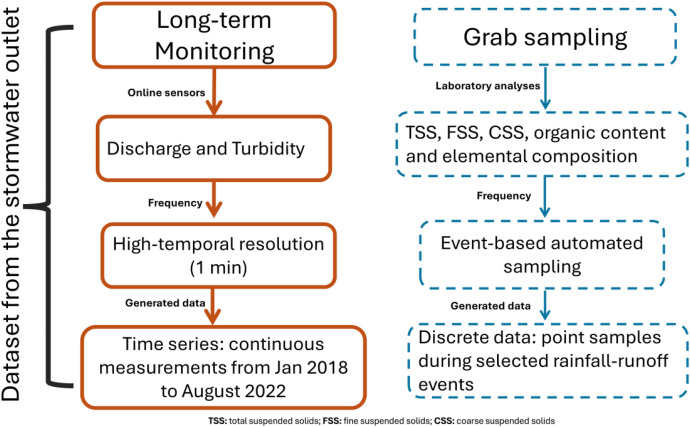 Figure 1
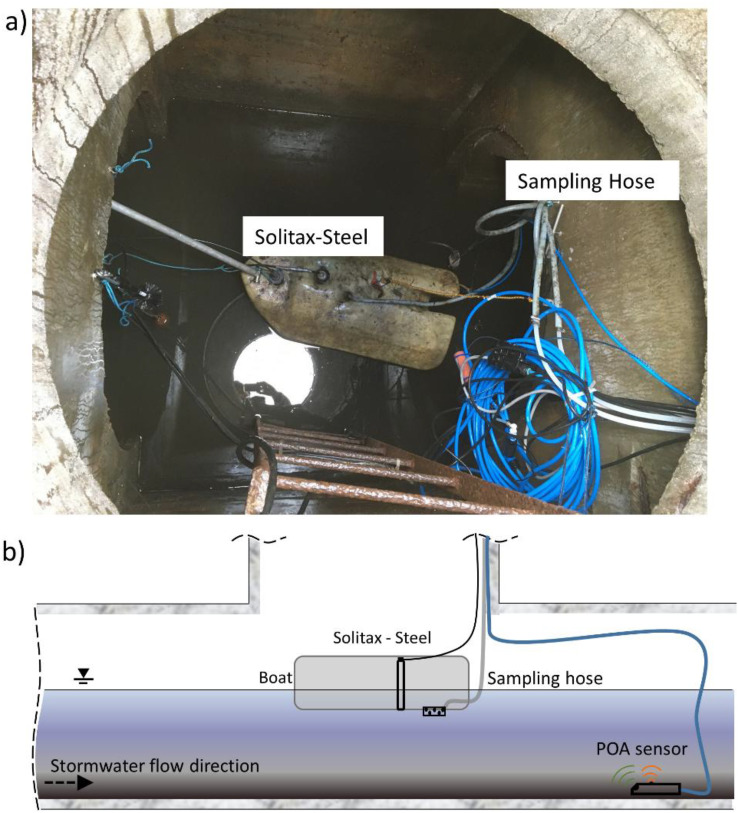 Figure 2
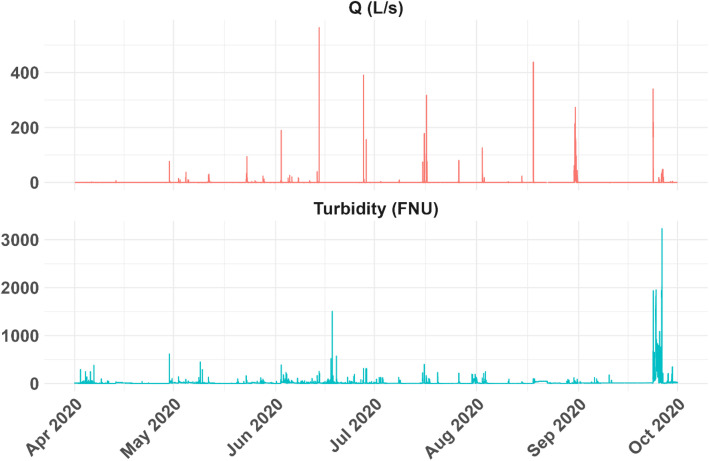 Figure 3
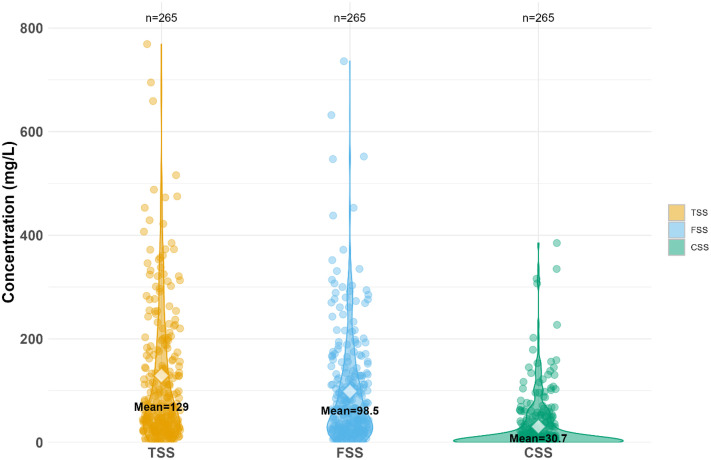 Figure 4
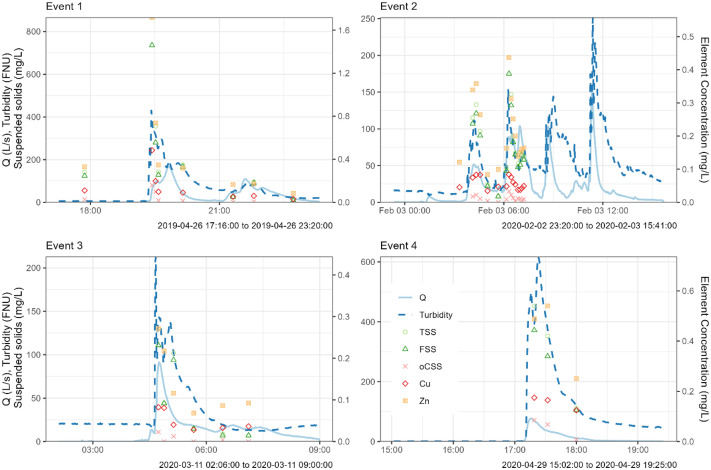 Figure 5
Peer Reviews
No public reviews on file for this paper yet. If you reviewed it on a platform where reviews are public (OpenReview, ICLR, NeurIPS, ICML), you can paste yours below so the community can read it here.
Videos
No videos yet. Explain this paper in a talk, walkthrough, or lecture? Add one.
Taxonomy
TopicsUrban Stormwater Management Solutions · Fecal contamination and water quality · Water Quality and Pollution Assessment
Specifications TableSubjectEarth & Environmental SciencesSpecific subject areaMonitoring suspended solids, elemental composition and particle-bound pollutants in stormwaterType of dataRaw dataTable (.csv format)Data collectionThe online monitoring station was equipped with online sensors for turbidity, flow rate and automatic sampling (MAXX GmbH) during storm events. A wedge sensor recorded velocity by the cross-correlation method and water level by a pressure cell (POA sensor, NIVUS) to measure discharge. A solitax-sc turbidity sensor (Hach) measured turbidity with a time resolution of 1 min. Stormwater samples were collected during storm events using the automatic sampler and were analysed for: total suspended solids (TSS), their fine fraction (<63 µm, FSS), coarse fraction (>63 µm, CSS), organic matter content using the Loss on Ignition (LOI %) method and elemental composition using an inductively coupled plasma optical emission spectrometry (ICP-OES, PerkinElmer).Data source locationStormwater outlet from an urban catchment in Dresden, Germany (51.004014° N, 13.844630° E). This monitoring station is part of the urban observatory managed by the working group on Urban Hydrology of the Institute for Urban Water Management - TU Dresden, GermanyData accessibilityRepository name: OPARA, Open Access Repository and Archive for Research Data of Saxon UniversitiesDigital Object Identifier: https://doi.org/10.25532/OPARA-1052Direct URL to data: https://opara.zih.tu-dresden.de/handle/123456789/1915Related research articleRojas-Gómez, K. L., Benisch, J., Helm, B., Borchardt, D., & Krebs, P. (2026). Identifying flush and transport patterns driving particle export and elemental composition of stormwater from a German urban catchment. Journal of Hydrology: Regional Studies, 64, 103,196. https://doi.org/10.1016/j.ejrh.2026.103196 [1]
Value of the Data
1
- •Our dataset comprises high-resolution turbidity and discharge monitoring data continuously measured during four years under real-world conditions at the outlet of a stormwater sewer network. The samples taken during rainfall events provide data on fine suspended solids, total suspended solids, organic, and elemental composition. The combination of long-term continuous proxy data (i.e., turbidity and discharge) with event-based, size-fractionated chemical characterisation (e.g., elemental composition) highlights the unique aspect of this dataset. This paired structure is particularly valuable for developing and calibrating models that link hydrology to water quality at the urban catchment scale.
- •This dataset may be used in a range of urban drainage studies focusing on stormwater and/or urban drainage networks (UDN). This may include: i) analysing the transport and export of particles and particle-bound pollutants from stormwater outlets (SWO); ii) defining design criteria for stormwater treatment facilities, and iii) supporting regulatory decision-making regarding the export of fine sediments in stormwater and particle-bound pollutants such as metals.
- •Acknowledging the importance of collaborative research and data sharing to design and manage urban drainage systems, researchers and practitioners can use this data to conduct further analysis on flush dynamics in stormwater outlets and to validate new approaches to simulate sediment and/or particle-bound pollutant transport in a stormwater network.
- •This dataset can be used to explore the potential of real-time stormwater control using turbidity as an easy-to-measure proxy parameter related to particle-bound pollutants such as heavy metals. This information can be used to predict concentrations of contaminants during rainfall events at a high temporal resolution and to calculate mass balances. Hence, our dataset can be used as a benchmark for data-driven operation and planning of UDNs, supporting, for example, the assessment of their performance and evaluating management alternatives.
- •Considerable monitoring, sampling, analytical efforts and resources have been used to generate this dataset to characterise a typical stormwater outlet from a city in Germany. This dataset may be used in future studies to avoid duplication of this effort, especially for researchers or practitioners focusing on this region (e.g., the German Association for Water, Wastewater and Waste Management – DWA).
- •Having a dataset with a clear description of discharge, turbidity, particle fractionation, and elemental composition of stormwater in an urban catchment might allow other researchers to explore the possible impact of SWO on the receiving water bodies using water quality and hydrodynamic simulations.
Background
2
This dataset supports an original research article [1,2]. The data was collected to provide a further understanding of the flush dynamics and transport patterns of particles and the elemental composition of stormwater. The collected continuous turbidity and discharge data through online monitoring were essential to capture the stormwater sediment dynamics of a SWO more accurately. Previous studies [3,4] have demonstrated that continuous turbidity measurements can serve as a high-resolution monitoring strategy for total suspended solids and particle-bound pollutants, as suspended particles in water generate light scattering. Hence, by combining data from online monitoring and from grab samples during rainfall events, we described the export and transport patterns of suspended solids and associated pollutants, such as metals, at the SWO [1]. This allowed us to understand the dynamic transport mechanisms of fine sediments and relevant elements attached to particles, considering complex runoff and discharge processes. Since data availability in the urban drainage research and practice communities remains a significant challenge [5], our dataset [2] integrates real-time monitoring with event-sampling data to further support evidence-based urban water management and innovation.
Data Description
3
The dataset [2] includes continuous discharge (Q) and turbidity measurements from January 2018 to August 2022 with a one-minute time resolution. The TSS, FSS, CSS, organic content and bulk elemental composition of stormwater samples taken during rainfall events includes: i) 265 grab samples with TSS, FSS and CSS data during September 2018 - 2021; ii) 157 grab samples with TSS, FSS, CSS and organic content of each fraction and iii) concentration of elements (Al, B, Ba, Ca, Co, Cr, Cu, Fe, K, Li, Mg, Mn, Na, Ni, P, Pb, Sr and Zn) in 32 stormwater samples from four storm events. The dataset is divided into three sub-datasets in a .csv format, with the following file names and headlines:
Main dataset: Q_Turbidity_MS5.csv
Date: time of the measurement in YEAR-MONTH-DAY HOUR:MINUTE:SECOND (YYYY-MM-DD hh:mm:ss) with a time zone equal to “UTC”
Q_lps: discharge data in L/s
FNU_SolitaxSteel: turbidity data in FNU
Sub-dataset 1: SuspendedSolids_MS5.csv
Date: time of the measurement in YEAR-MONTH-DAY HOUR:MINUTE:SECOND (YYYY-MM-DD hh:mm:ss) with a time zone equal to “UTC”
TSS_mgL: total suspended sediment data from grab samples in mg/L
FSS_mgL: fine fraction of the total suspended sediment data (< 63 µm) from grab samples in mg/L
CSS_mgL: coarse fraction of the total suspended sediment data (> 63 µm) from grab samples in mg/L
oFSS_mgL: organic content of FSS from grab samples in mg/L
oCSS_mgL: organic content of CSS from grab samples in mg/L
Sub-dataset 2: Elements_MS5.csv
Date: time of the measurement in YEAR-MONTH-DAY HOUR:MINUTE:SECOND (YYYY-MM-DD hh:mm:ss) with a time zone equal to “UTC”
Additional columns show the bulk element concentration of: Al, B, Ba, Ca, Co, Cr, Cu, Fe, K, Li, Mg, Na, Mn, Ni, P, Pb, Sr, and Zn. All these concentrations are measured in the bulk sample and reported in mg/L. NA values are reported concentrations below the detection limit (DoL).
Experimental Design, Materials and Methods
4
The dataset was generated by combining onsite online monitoring at the outlet of the stormwater sewer network (SWO) and grab sampling of stormwater during rainfall events (Fig. 1).Fig. 1. Workflow to generate the stormwater quality dataset using online monitoring and grab sampling.Fig 1 dummy alt text
Long-term and continuous monitoring at the SWO
4.1
The dataset comprises high-resolution turbidity and discharge data continuously measured from January 2018 to August 2022 in a monitoring station installed at the stormwater outlet (SWO) of an urban sub-catchment in Dresden, Germany (51.004014° N, 13.844630° E). This station is part of the monitoring network operated by the Chair for Urban Water Management of TU, Dresden [1,6,7].
The monitored urban sub-catchment (MS5) covers 23.6 ha (43 % impervious surfaces) and a separate sewer network drains it. The stormwater network (total length 2700 m) discharges to the nearby stream Lockwitzbach (mean flow 0.34 m^3^ s^−1^; discharge point: 51.004287° N, 13.8445545° E), which is a tributary of the Elbe River [1,6,7]. Rojas-Gómez et al. [1] show further details regarding the characteristics of the stormwater sewer network.
The online monitoring station measures turbidity at a 1 min time resolution using a Solitax-SC turbidity sensor (Hach, USA) housed in a steel case. Discharge is measured using a wedge sensor, which records velocity (via the cross-correlation method) and water level (pressure cell: POA-Sensor, NIVUS, Germany). The turbidity sensor is installed in a boat, located at the SWO (Fig. 2). This monitoring point within the sewer pipe is approximately 98 m upstream of the receiving stream. This last section of the sewer has a small longitudinal slope and its invert level is situated approximately at the same elevation as the receiving streambed. Therefore, this section of the sewer is permanently inundated with backwater from the stream, allowing the sensors to operate under constant wet conditions, limiting their exposure to dry periods and preventing the corrosion generated by alternating wet–dry conditions. No corrosion was observed during our monitoring period. Since groundwater infiltration was not relevant, groundwater–sewer interactions were beyond the scope of our study.Fig. 2. Sensors placed in the boat at the SWO for measuring turbidity and discharge (a) and the schematic representation of the installed sensors (b).Fig 2 dummy alt text
The sensors were calibrated before their installation. Afterwards, the event-based grab samples were used to generate site-specific regression equations to relate turbidity and suspended solids for further calibration (see examples in Rojas-Gómez et al. [1]). Real-time data transfer facilitated the definition of maintenance frequency, requirements, data management, visualisation and quality control. Here, we present an example of the discharge and turbidity data from the Solitax-steel sensor (Fig. 3). Additionally, weekly maintenance of the monitoring station included cleaning the sensors, downloading data loggers, and checking their functionality. Further details on sensor cleaning dates, maintenance intervals, and quality control measures for the long-term online monitoring station MS5 are shown in the supplementary material (Table S1).Fig. 3. Example of continuous discharge (Q in L/s) and turbidity (FNU) raw data measured from April to October 2020.Fig 3 dummy alt text
Sampling campaign and laboratory analysis
4.2
A sampling hose connected to an automatic sampler (MAXX GmbH) collects stormwater during rainfall events (Fig. 2). The sampling was carried out proportionally to volume, taking one sample every 30 m³, until all available bottles were filled (n = 24, volume per bottle: 1 L). The collected stormwater samples during rainfall events (September 2018 - 2021) were analysed for TSS, fine (<63 µm) and coarse (>63 µm) fractions, organic content, and elemental composition (Table 1). For the sample fractionation, a representative volume (200 mL) of each sample at a given time was wet sieved using stainless sieves (ø 50 mm, high 25 mm, test sieve DIN ISO 3310–1, VWR, Germany) with a mesh size of 63 µm. Subsequently, the fractionated sub-samples of fine suspended solids (FSS) and coarse suspended solids (CSS) were filtered separately using 0.45 µm cellulose nitrate membrane filters (Sartorius, Germany) following the method reported by Zhang et al. [8]. The soluble fraction corresponds to particles < 0.45 µm in accordance with DIN EN ISO 14,688–1. Then, the filters were evaporated at 105 °C until reaching constant weight to compute dry matter. The distribution of suspended solids is shown in Fig. 4. The organic matter content of the fine and coarse fraction of suspended solids was measured by the Loss on Ignition (LOI %) method (DIN EN 15,169, 2007) at 550 °C for 2 h [9]. For four selected storm events (32 stormwater samples) the concentration of elements (i.e., Al, B, Ba, Ca, Co, Cr, Cu, Fe, K, Li, Mg, Mn, Na, Ni, P, Pb, Sr and Zn) was determined by inductively coupled plasma optical emission spectrometry (ICP-OES, PerkinElmer, USA) in bulk samples (Fig. 5). The elemental composition was measured by drying the samples in an oven at 105 °C, homogenising, and digesting in a microwave with 5 mL H_2_O and 5 mL HNO_3_. The detection limit is shown in Table 2.Table 1. Parameters measured at the stormwater outlet: Discharge (Q), turbidity, total suspended solids (TSS), fine suspended solids (FSS), coarse suspended solids (CSS), organic content of the fractions (oFSS and oCSS) and elements.Table 1 dummy alt textVariableFrequency/number of samplesData collection methodQ, Turbidity1 minContinuous monitoringTSS, FSS and CSSn = 265Grab sampling during rainfall eventsTSS, FSS, oFSS, CSS, oCSSn = 157Grab sampling during rainfall eventsTSS, FSS, oFSS, CSS, oCSS, elements (Al, B, Ba, Ca, Co, Cr, Cu, Fe, K, Li, Mg, Mn, Na, Ni, P, Pb, Sr and Zn)n = 32Grab sampling during rainfall eventsFig. 4Distribution of total suspended solids (TSS), fine suspended solids (FSS) and coarse suspended solids (CSS) in the collected stormwater samples.Fig 4 dummy alt textFig. 5Four sampled runoff events containing data of discharge (Q), turbidity, total suspended solids (TSS), fine suspended solids (FSS), organic fraction of coarse suspended solids (oCSS), and elemental composition (e.g., Cu, Zn) in bulk sample. Modified from Rojas-Gómez et al. [1].Fig 5 dummy alt textTable 2Detection limit of the element concentration measured by the ICP-OES.Table 2 dummy alt textElementAlBBaCaCoCrCuFeKLiMgMnNaNiPPbSrZnDetectionlimit(mg L^−1^)0.0100.0100.0050.1000.0050.0050.0050.0050.5000.0100.0200.0010.5000.0200.2000.0100.0020.005
Limitations
- •Due to time and budget constraints, it was possible to sample only a limited number of rainfall events
- •Our sampling strategy was focused on point samples, rather than composite samples per event, limiting the volume of water available for laboratory measurements. Grab samples collected during events had a maximum volume of 1 L for measuring suspended solids (TSS, CSS, and FSS) and their elemental composition. This volume was insufficient to measure all elements in all cases, and hence it was only possible to measure the elemental composition of four events. Hence, data on elemental composition are scarce compared with TSS data
- •The reported element concentration was measured in the bulk sample (includes dissolved and particle-bound fraction)
Ethics Statement
The authors confirm that they have read and follow the ethical requirements for publication in Data in Brief. Our current work does not involve human subjects, animal experiments, or any data collected from social media platforms.
Funding
Open Access funding enabled and organized by Projekt DEAL. The Helmholtz International Research School TRACER (grant number HIRS-0017) funded the doctoral research of the first author K. L. Rojas-Gómez. This research was additionally funded by Helmholtz Water Science Network, Thematic Field 3: Urban Water Systems, and by the Deutsche Forschungsgemeinschaft (DFG, German Research Foundation); project Urban Resistom, grant number 460816351.
CRediT authorship contribution statement
Karen L. Rojas-Gómez: Methodology, Software, Data curation, Investigation, Visualization, Writing – original draft. Jakob Benisch: Investigation, Data curation, Methodology, Writing – review & editing. Björn Helm: Methodology, Writing – review & editing. Dietrich Borchardt: Supervision, Funding acquisition, Project administration, Writing – review & editing. Peter Krebs: Supervision, Funding acquisition, Project administration, Writing – review & editing.
The reference list from the paper itself. Each links out to its DOI / PubMed record.
- 1Rojas-Gómez K.L.Benisch J.Helm B.Borchardt D.Krebs P.Identifying flush and transport patterns driving particle export and elemental composition of stormwater from a German urban catchment J. Hydrol.: Reg. Stud.64202610319610.1016/j.ejrh.2026.103196 · doi ↗
- 2Benisch J.Rojas-Gómez K.L.Helm B.Borchardt D.Krebs P.“Monitoring data to explore particle size distribution and elemental composition in a stormwater outlet from a German urban catchment” [Data set]Technische Universität Dresden 202510.25532/OPARA-1052 OPARA · doi ↗
- 3Métadier M.Bertrand-Krajewski J.L.The use of long-term on-line turbidity measurements for the calculation of urban stormwater pollutant concentrations, loads, pollutographs and intra-event fluxes Water Res.462020126836685610.1016/j.watres.2011.12.03022221336 · doi ↗ · pubmed ↗
- 4Rügner H.Schwientek M.Beckingham B.Kuch B.Grathwohl P.Turbidity as a proxy for total suspended solids (TSS) and particle facilitated pollutant transport in catchments Environ. Earth Sci.692201337338010.1007/s 12665-013-2307-1 · doi ↗
- 5Pimiento M.A.Nielsen J.E.Rasmussen M.R.Brelot E.Bertrand-Krajewski J.-L.Schellart A.Tait S.Brüggemann T.Clemens-Meyer F.Rieckermann J.Leitão J.P.Ciambra A.Naves J.Anta J.The value of urban drainage systems data: facts, discussions and recommendations J. Hydraul. Res.634202541742410.1080/00221686.2025.2528652 · doi ↗
- 6Benisch J.Helm B.Chang X.Krebs P.Can short-term online-monitoring improve the current WFD water quality assessment regime? Systematic resampling of high-resolution data from four saxon catchments Water 166202488910.3390/w 16060889 · doi ↗
- 7Benisch J.Helm B.Krauss M.Byrne H.A.Becker S.Mayer R.P.Rojas Gómez K.L.Ahlheim J.Brack W.Krebs P.Fingerprints of micropollutants under baseflow and event discharge conditions: analysing gradients along two urban streams Water Sci. Technol.922025345210.2166/wst.2025.09140662897 · doi ↗ · pubmed ↗
- 8Zhang J.Hua P.Krebs P.The chemical fractionation and potential source identification of Cu, Zn and Cd on urban watershed Water Sci. Technol.72820151428143610.2166/wst.2015.35526465315 · doi ↗ · pubmed ↗