RFID-ExSim: A multi-scenario experimental dataset for collision timing, tag cloning, replay injection, and flooding stress in passive RFID systems
Yasser Hmimou, Mohammed Boutlane, Mohamed Tabaa, Azeddine Khiat, Zineb Hidila

TL;DR
RFID-ExSim is a dataset capturing RFID system behavior under normal and attack scenarios for security and reliability analysis.
Contribution
A multi-scenario RFID dataset for studying collisions, cloning, replay attacks, and flooding stress in passive RFID systems.
Findings
Over 400,000 RFID read events were recorded with millisecond-level timestamps.
The dataset includes five scenarios for analyzing RFID reliability and security.
It supports research in RFID authentication, intrusion detection, and machine learning.
Abstract
RFID-ExSim is an experimental dataset designed for studying passive RFID systems under normal operating conditions and in adversarial attack scenarios. The dataset was collected in a controlled laboratory environment using two synchronized ESP32-based MFRC522 RFID readers interacting with twelve passive RFID tags. In total, >400,000 raw RFID read events were recorded and stored in a structured JSONL format with millisecond-level timestamp resolution. The dataset is structured around five well-defined acquisition scenarios: (i) basic single-reader operation, (ii) dual-reader collision interference, (iii) tag cloning at the UID level, (iv) replay and software injection attacks, and (v) high-throughput stress sessions simulating denial-of-service conditions. Each recorded event includes the reader ID, local tag ID, hashed UID, raw payload, scenario label, and physical acquisition…
Genes, proteins, chemicals, diseases, species, mutations and cell lines named across the full text — each resolved to its canonical identifier and authoritative record.
Click any figure to enlarge with its caption.
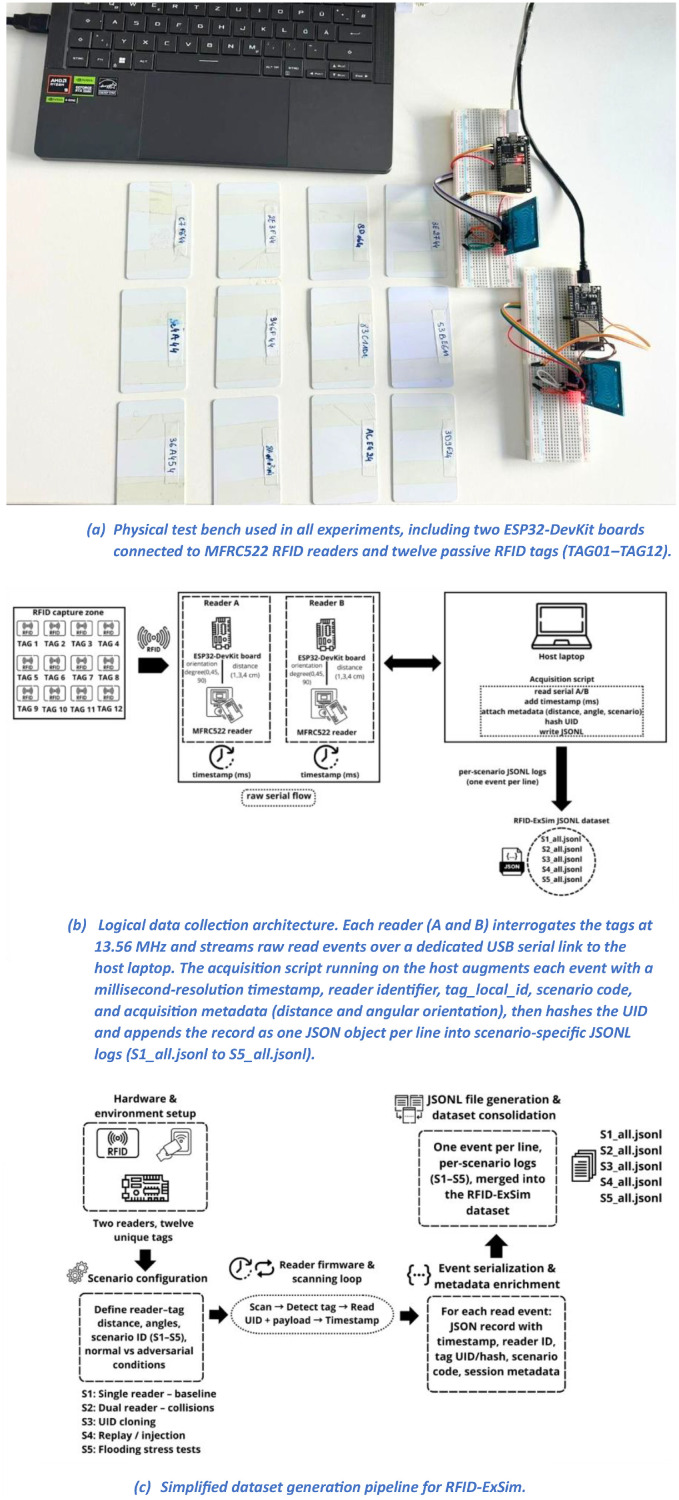 Figure 1
Peer Reviews
No public reviews on file for this paper yet. If you reviewed it on a platform where reviews are public (OpenReview, ICLR, NeurIPS, ICML), you can paste yours below so the community can read it here.
Videos
No videos yet. Explain this paper in a talk, walkthrough, or lecture? Add one.
Taxonomy
TopicsRFID technology advancements · Network Security and Intrusion Detection · Information and Cyber Security
Specifications TableSubjectComputer SciencesSpecific subject areaPassive RFID security experiments and attack scenario simulationType of dataRaw, Processed, Raw experimental logs in JSON Lines (JSONL) format.Data collectionThe dataset was collected using a controlled testbed featuring two synchronized ESP32 microcontrollers and MFRC522 RFID readers (13.56 MHz). Data were captured from twelve passive RFID tags under five scenarios (Baseline, Collision, Cloning, Replay, and Flooding) with variable distance (1, 3, 4 cm) and orientation (0°, 45°, 90°). Events were logged with millisecond-level timestamp resolution.Data source locationMultidisciplinary Laboratory of Research and Innovation (LPRI), Moroccan School of Engineering Sciences (EMSI), Casablanca 20,250, MoroccoData accessibilityRepository name:ZenodoData identification number (or DOI or persistent identifier):DOI: 10.5281/zenodo.17854328Direct URL to data:https://doi.org/10.5281/zenodo.17854328Instructions for accessing these data:All RFID-ExSim dataset files (raw JSONL logs, consolidated per-scenario datasets, metadata, and experimental plans) are publicly available without access restrictions via the Zenodo repository. The accompanying codebase, including ESP32 firmware and analysis scripts, is openly accessible on GitHub at:https://github.com/yasserhmimou9/RFID-ExSim-DatasetRelated research article‘none’
Value of the Data
1
- •The RFID-ExSim dataset provides a large-scale, structured collection of more than 400,000 real passive RFID read events acquired under controlled baseline and adversarial conditions. It includes five well-defined scenarios covering single-reader operation, multi-reader collisions, UID cloning, replay injection, and flooding stress. This diversity allows researchers to study both nominal RFID behavior and security-relevant threat patterns under reproducible experimental settings.
- •The dataset can be reused to benchmark collision detection, replay attack identification, and RFID-based intrusion detection algorithms. The availability of synchronized dual-reader logs with millisecond-resolution timestamps enables precise temporal analysis of interference, desynchronization, and UID conflict events across multiple physical configurations.
- •The structured JSONL format with rich metadata (distance, orientation, scenario ID, tag ID, reader ID, timestamp) facilitates direct reuse for machine learning, anomaly detection, and physical-layer authentication research. Researchers can directly train and evaluate supervised and unsupervised models without additional data cleaning or reconstruction.
- •The inclusion of UID cloning and replay injection scenarios provides empirical traces of identity-based attacks that are rarely available in open RFID datasets. These traces enable systematic testing of clone detection strategies, fingerprinting methods, and replay-resistant authentication mechanisms under real acquisition conditions.
- •The flooding stress scenario offers high-rate RFID traffic suitable for denial-of-service modeling and resilience evaluation. The associated logs expose read saturation, success-rate degradation, and reader asymmetry effects, which can be reused for time-series analysis, congestion modeling, and stress testing of RFID security systems.
Background
2
RFID systems are deployed widely in industrial logistics, access control, healthcare traceability, and IoT infrastructure due to their passive operation, low power consumption, and interoperability with embedded platforms [1]. However, their growing adoption has also exposed them to multiple security threats, including unauthorized identification, tag spoofing, unique identifier cloning, replay attacks, and communication flooding [2,5]. Previous [3,4] studies have demonstrated that passive RFID tags can be reverse engineered, cloned at low cost, and exploited by manipulating backscatter signals based on replay [2,6], but most of this work relies on limited or proprietary experimental data.
Recent research has explored physical layer attributes and temporal behavior as potential discriminators for clone detection and anomaly classification [7–11]. These [10] approaches require synchronized measurements, collision observations, and controlled adverse conditions, but the lack of open, structured, and reproducible RFID datasets remains a major limitation for comparative evaluation [12,13]. In particular, existing studies rarely provide empirical data covering collisions between multiple readers, replay injection, UID-level cloning, and high-load stress conditions under controlled geometric parameters [3,6,8,9].
The RFID-ExSim dataset was constructed to address this empirical gap through systematic acquisition of passive RFID interactions under nominal and adversarial scenarios [14]. By recording synchronized multi-reader events with controlled distance and orientation parameters, the dataset provides a unified experimental basis for studying RFID timing behavior, collision dynamics, identity duplication, and replay-induced artifacts.
Data Description
3
The RFID-ExSim dataset is distributed through a public repository and organized into structured directories containing raw acquisition logs, consolidated scenario datasets, metadata files, experimental plans, derived summary files, firmware source code, and documentation. All files are provided to enable direct access to the complete experimental recordings.
Main repository structure
3.1
The dataset is organized into the following main directories:
- •data/
- •docs/
- •figures/
- •firmware/
- •tags.csv
Raw data directory
3.2
The folder data/raw/ contains the complete set of original RFID acquisition logs recorded directly from the two ESP32–MFRC522 readers. Each acquisition run is stored as two synchronized JSON Lines (.jsonl) files, one for each reader:
- •session_ <Scenario> <Tag><run>_ ESP32_A.jsonl
- •session_ <Scenario> <Tag><run>_ ESP32_B.jsonl
Each raw file contains one JSON object per line corresponding to a single RFID read event. Each event includes the following attributes:
- •timestamp (millisecond resolution)
- •reader_id
- •uid_hash
- •payload
- •tag_local_id
- •scenario
- •session_id
- •distance_cm
- •orientation_deg
For each session, an associated .meta file is provided containing the experimental parameter settings.
Processed scenario files
3.3
The directory data/processed/ contains five consolidated JSONL files, each grouping all acquisition sessions for one experimental scenario:
- •rfid_dataset_S1_all.jsonl
- •rfid_dataset_S2_all.jsonl
- •rfid_dataset_S3_all.jsonl
- •rfid_dataset_S4_all.jsonl
- •rfid_dataset_S5_all.jsonl
These files contain the same event structure as the raw logs and combine all runs related to each scenario.
Scenario execution plans
3.4
The directory data/plans/ contains five CSV files defining the acquisition parameters for each scenario:
- •s1_plan.csv
- •s2_plan.csv
- •s3_plan.csv
- •s4_plan.csv
- •s5_plan.csv
Each plan file specifies:
- •session_id
- •tag_local_id
- •distance_cm
- •orientation_deg
- •number_of_repetitions
Calibration data
3.5
The directory data/calibration/ contains calibration measurements used for baseline configuration of the RFID system prior to scenario execution.
Metadata and summary files
3.6
The dataset includes structured metadata and summary descriptors derived from the raw logs:
- •meta_sessions_S1.csv
- •meta_sessions_S2.csv
- •s2_collisions_summary.csv
- •s3_clone_collisions_summary.csv
- •s3_summary_counts.csv
- •s4_merge_summary.json
- •s4_replay_summary.csv
- •s5_success_rates_per_session.csv
These files provide per-session and per-scenario descriptors without modifying the original raw events.
Documentation files
3.7
The folder docs/ contains dataset documentation:
- •methodology.md: describes acquisition procedures and logging formats
- •scenarios.md: defines the five experimental scenarios and execution rules
Figures directory
3.8
The figures/ directory contains graphical visualizations derived directly from the dataset, including:
- •read distributions
- •collision histograms
- •replay latency distributions
- •flooding scenario time series
- •read asymmetry plots
Each figure is associated with one specific scenario.
Firmware directory
3.9
The directory firmware/ contains the firmware used for RFID acquisition:
- •esp32_reader/: source code for the ESP32 reader nodes
- •notes_wiring.md: hardware wiring configuration notes
Tag mapping file
3.10
The file tags.csv maps the physical RFID tags to anonymized identifiers. The file includes:
- •tag_local_id
- •uid_hash
- •initial_label
Dataset overview
3.11
- •Number of RFID readers: 2
- •Number of RFID tags: 12
- •Number of scenarios: 5
- •Data format: JSON Lines (JSONL), CSV
- •Timestamp resolution: millisecond
- •Total number of records: over 400,000 RFID read events
- •Spatial acquisition parameters: distance (1, 3, 4 cm), orientation (0°, 45°, 90°)
Experimental Design, Materials and Methods
4
The RFID-ExSim dataset was acquired using a controlled experimental testbed designed to ensure repeatable and synchronized data acquisition across multiple RFID attack and stress scenarios. The acquisition system is composed of two ESP32-DevKit microcontroller boards, each connected to an MFRC522 RFID reader operating at 13.56 MHz. The two readers are designated as Reader A and Reader B and are connected via USB serial links to a host laptop used for centralized data logging. Twelve passive RFID tags compliant with ISO/IEC 14443-A were used throughout all experiments. The physical experimental testbed, including the two ESP32-DevKit boards, MFRC522 RFID readers, and passive tags, is illustrated in Fig. 1.a.Fig. 1. Experimental setup and dataset generation pipeline for RFID-ExSim.Fig 1 dummy alt text
Each ESP32 executes identical firmware developed using the Arduino framework. The firmware continuously scans for nearby RFID tags using a polling loop and transmits each successful detection event over the serial interface. For each detection, the firmware outputs the raw UID, reader identifier, and the exact acquisition timestamp. On the host machine, a Python-based acquisition program records all incoming serial events from both readers in real time and converts them into structured JSONL (JSON Lines) files. The logical acquisition architecture and real-time data flow from RFID detection to structured JSONL logging are depicted in Fig. 1.b. Each recorded event includes the following fields: timestamp (millisecond resolution), reader ID, local tag ID, hashed UID, raw payload, scenario label, session ID, tag-to-reader distance (cm), and tag angular orientation (degrees).
The ESP32 firmware was developed and compiled using Arduino IDE version 1.8.19. RFID communication was implemented using the MFRC522 Arduino library version 1.4.12 (SPI interface), compatible with ISO/IEC 14443-A tags. On the host machine, the acquisition pipeline was implemented in Python 3.10 using pyserial 3.5 for serial communication, hashlib for UID hashing, and json for JSONL serialization. All software dependencies, firmware source code, and acquisition scripts are publicly available in the associated GitHub repository and documented in the methodology.md file.
All experiments were conducted under fixed geometric and environmental conditions. The tags were placed on a non-metallic surface to avoid electromagnetic interference. Three discrete distances between tag and reader were used: 1 cm, 3 cm, and 4 cm. Three angular orientations were also applied for each tag: 0°, 45°, and 90° These physical parameters were manually controlled and systematically varied across all acquisition sessions.
Data acquisition is organized into five distinct experimental scenarios. Scenario S1 corresponds to baseline single-reader operation, where only one reader actively scans tags without interference. Scenario S2 implements dual-reader simultaneous operation to induce collision conditions. Scenario S3 reproduces tag cloning through UID duplication, where multiple tags broadcast identical identifiers. Scenario S4 implements replay and software-based injection attacks by reinjecting previously recorded UIDs through controlled firmware-level emulation. Scenario S5 generates flooding and high-throughput stress conditions by forcing continuous repeated UID transmissions to simulate denial-of-service behavior. An overview of the RFID-ExSim dataset generation pipeline and the five experimental scenarios is shown in Fig. 1.c.
Each scenario is executed in multiple acquisition sessions. For every session, the corresponding scenario label, physical distance, and orientation are explicitly encoded in the dataset metadata. The flood and cloning scenarios are generated through controlled manipulation of the firmware and the Python acquisition scripts. No synthetic data generation or simulation-based modification is applied; all records correspond to physical acquisitions captured directly from the hardware setup.
The final dataset structure consists of (i) raw JSONL logs separated by scenario and session, (ii) merged per-scenario datasets aggregating all sessions, (iii) metadata files describing tag identities, reader assignments, distance and orientation parameters, and (iv) experimental configuration files documenting acquisition conditions. All firmware source code for the ESP32 readers, along with the Python acquisition and parsing scripts used for dataset generation, are made publicly available in the associated GitHub repository.
Limitations
The dataset was acquired in a controlled indoor laboratory environment using a fixed experimental configuration composed of two ESP32-based MFRC522 RFID readers and twelve passive RFID tags. Consequently, the environmental conditions such as temperature variability, electromagnetic noise from external sources, and large-scale spatial deployment were not explored.
The acquisition parameters were defined using three discrete tag-to-reader distances (1 cm, 3 cm, and 4 cm) and three angular orientations (0°, 45°, and 90°), which represent a subset of possible geometric configurations.
All experiments were conducted using a single RFID technology operating at 13.56 MHz and identical reader hardware and firmware versions. The dataset does not include additional RFID standards, frequency bands, or reader models.
These elements define the scope of the experimental acquisition conditions without affecting the integrity or reproducibility of the recorded data.
Ethics Statement
The authors confirm that they have read and comply with the ethical requirements for publication in Data in Brief. The current work does not involve human subjects, animal experiments, or any data collected from social media platforms. The dataset was generated exclusively using RFID hardware devices under controlled laboratory conditions, without involving personal data, biological materials, or human participation.
CRediT authorship contribution statement
Yasser Hmimou: Conceptualization, Methodology, Software, Investigation, Data curation, Formal analysis, Writing – original draft. Mohammed Boutlane: Methodology, Validation, Resources, Writing – review & editing. Mohamed Tabaa: Supervision, Conceptualization, Project administration, Writing – review & editing. Azeddine Khiat: Supervision, Writing – review & editing. Zineb Hidila: Supervision, Writing – review & editing.
The reference list from the paper itself. Each links out to its DOI / PubMed record.
- 1Munoz-Ausecha C.Ruiz-Rosero J.Ramirez-Gonzalez G.RFID applications and security review Computation 9620216910.3390/computation 9060069 · doi ↗
- 2Fernández-Caramés T.Fraga-Lamas P.Suárez-Albela M.Castedo L.Reverse engineering and security evaluation of commercial tags for RFID-based Io T applications Sensors 171220162810.3390/s 1701002828029119 PMC 5298601 · doi ↗ · pubmed ↗
- 3Chu C.Wang R.Deng N.Li G.Efficient and reliable identification of probabilistic cloning attacks in large-scale RFID systems Micromachines 168202589410.3390/mi 1608089440872401 PMC 12388367 · doi ↗ · pubmed ↗
- 4Khan S.Ray B.Karmakar N.Fingerprinting chipless RFID with a MIMO system for tag authentication in Internet of Things Internet Things 31202510154210.1016/j.iot.2025.101542 · doi ↗
- 5Li J.Li A.Han D.Zhang Y.Li T.Zhang Y.RCID: fingerprinting passive RFID tags via wideband backscatter Proc. IEEE INFOCOM 202270070910.1109/INFOCOM 48880.2022.9796663 · doi ↗
- 6Dhakal R.Kandel L.N.Shekhar P. Radio frequency fingerprinting authentication for Io T networks using Siamese networks Io T 63202547
- 7Gong C., Liang B., Wang P., Ji X., Chen Y., Xu C. RF-rock: an intermodulation-based RFID unauthorized identification attack without tag activation. 2025;1029–1044. 10.1145/3680207.3765262 · doi ↗
- 8Feng Y., Huang W., Wang S., Zhang Y., Jiang S., Cao Z. Anti-clone: a lightweight approach for RFID cloning attacks detection. 2022;75–90. 10.1007/978-3-031-24386-8_5