Truffle fungi enriched in cattle-grazed native pecan groves under NPK fertilization
Amandeep Kaur, Wei Ren, Tingying Xu, Niels Maness, Shiping Deng, Jahanifard Mohadeseh, Zobair Rahman Biswas, Harpreet Singh, Lu Zhang

Abstract
Genes, proteins, chemicals, diseases, species, mutations and cell lines named across the full text — each resolved to its canonical identifier and authoritative record.
Click any figure to enlarge with its caption.
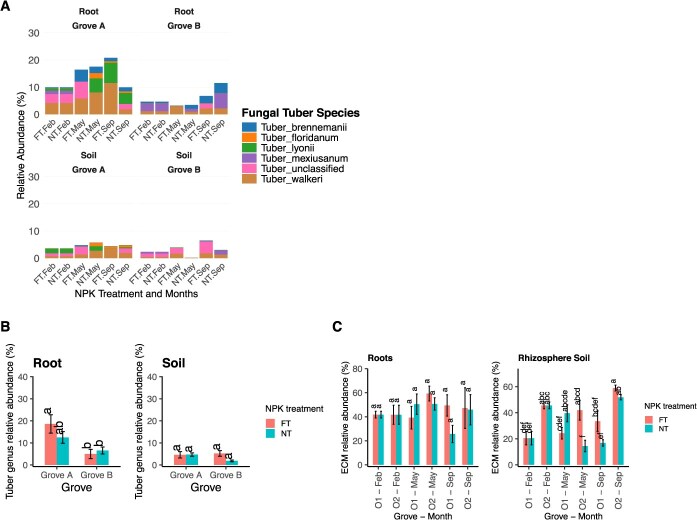 Figure 1
- —Oklahoma State University J.D. (Scotty) Scott Horticulture Pecan Research Professorship and Oklahoma Department of Agriculture, Food, and Forestry Specialty Crop Block Grant Program (‘Investigating Mi
Peer Reviews
No public reviews on file for this paper yet. If you reviewed it on a platform where reviews are public (OpenReview, ICLR, NeurIPS, ICML), you can paste yours below so the community can read it here.
Videos
No videos yet. Explain this paper in a talk, walkthrough, or lecture? Add one.
Taxonomy
TopicsMycorrhizal Fungi and Plant Interactions · Polysaccharides Composition and Applications · Plant Growth Enhancement Techniques
Dear Editor,
Pecan (Carya illinoinensis [Wangenh.] K. Koch) is a major tree nut crop native to North America, with Oklahoma contributing nearly 80% of US native and seedling pecan production in 2023 (USDA, 2024). Native pecan groves typically lack structured orchard practices such as fertilization, irrigation, or herbicide application. Instead, they depend on natural nutrient cycling. Among rhizosphere microbes, ectomycorrhizal (ECM) fungi, including truffle-forming Tuber species—a group known for their ecological and commercial value, form mutualistic associations with pecan roots and, in some species, produce edible truffles [1, 2]. Fertilization is known to restructure microbial communities, sometimes enhancing certain ECM taxa while suppressing others [3]. However, the response of ECM fungi, particularly Tuber, to fertilization remains largely unexplored in native pecan groves. Here, we report evidence that cattle grazing combined with NPK fertilization promotes the enrichment of Tuber species, including the pecan truffle (Tuber lyonii), in Oklahoma native pecan groves. We analyzed fungal communities from roots and rhizosphere soils of two native pecan groves with contrasting management: Grove A, incorporated cattle grazing while Grove B incorporated hay production but not grazing. In each grove, two fertilizer treatments (Full NPK consisting of 300lbs/acre fertilizer in ratio of 11 N:27P:27 K versus No NPK fertilizer) were utilized, and roots and rhizosphere soils were sampled prior to fertilization in February and after fertilization in May and September 2023. Total DNA was extracted and sequenced (Illumina MiSeq). The sequences were processed with Mothur (v1.48) [4] and R (v4.4.1). Relative abundances of fungal taxa were quantified at genus and species levels, with emphasis on ectomycorrhiza, particularly the genus Tuber. Fungal communities showed strong variation across groves, fertilization, and season. In Grove A (cattle grazing), Tuber and Russula dominated roots, while Grove B (hay) roots were dominated by Inocybe and Russula**.** In Grove A roots in September under Full NPK, relative abundance of Tuber (~20%) was higher compared to No NPK (~9%) (Fig. 1A). Although Tuber abundance was lower in roots from Grove B, NPK fertilization increased it is abundance in the rhizosphere soil (Fig. 1B). Fertilization boosted Tuber abundance in both groves, but the effect was most pronounced in grazed systems, suggesting that grove legacy interacts with nutrient inputs to shape ECM composition (Fig. 1C). Species-level resolution revealed five Tuber taxa: T. lyonii, T. walkeri, T. floridanum, T. brennemanii, and T. mexiusanum (Fig. 1A). Among these, T. walkeri was the most widespread across groves, while T. lyonii was concentrated in Grove A roots and increased under Full NPK during September, aligning with its typical fruiting season. T. floridanum was also favored in Grove A, while T. mexiusanum was enriched in Grove B under No NPK, indicating their sensitivity to fertilization. T. brennemanii appeared more tolerant of nutrient additions, persisting with or without NPK fertilization. These species-specific responses demonstrate ecological filtering within native pecan systems. Functional guild analysis confirmed ECM fungi as the dominant group in both native pecan roots and soils (Fig. 1C), consistent with the well-established role of ECM associations with improved pecan roots [4]. In roots, ECM abundance was only slightly higher under Full NPK (41%) than No NPK (37%) (nonsignificant). Soil showed significant variation, overall, with higher ECM in Grove B and Full NPK treatment. Seasonal variation was also evident: in Grove A, T. lyonii and T. walkeri peaked in September, coinciding with late-season carbon allocation. This suggests that fertilizer inputs, grazing, and seasonal host physiology jointly influenced truffle colonization dynamics.
The economic potential of these findings could be significant. T. lyonii, the pecan truffle, is already harvested in improved pecan orchards [1], and its enrichment under grazing and fertilization suggests native groves could also be managed as dual-use systems. This shift would allow native groves, traditionally valued for cattle and nut production, to be managed for cattle, nuts, and truffles. Such co-production could diversify growers’ income and align native pecan systems with European truffle–orchard models. Management appears species-specific: T. lyonii and T. walkeri benefit from NPK, while T. mexiusanum persists in unfertilized refugia. Tailoring fertilization and grazing could optimize both truffle biodiversity and pecan yield. Our findings suggest that under the right grove management fertilization can enhance desirable truffle taxa, consistent with recent reports that moderate nitrogen inputs may favor symbiotrophic fungi [3]. This expands our understanding of nutrient–fungi–host interactions and demonstrates how management legacies condition microbial responses. Fostering ECM fungi, particularly truffles, may enhance both ecological functions, such as nutrient acquisition, stress resilience, and economic outcomes through potential co-harvest of nuts and truffles. In conclusion, we provide the first report of species-specific Tuber enrichment in native pecan groves, indicating that cattle grazing and NPK fertilization may foster conditions favorable for pecan truffle production. Grove A, the grazed system, supported higher T. lyonii and T. walkeri abundance, particularly in fertilized roots during September. These results highlight the potential for integrating truffle co-cultivation into native pecan management, representing a novel horticultural innovation. Future research should confirm truffle fruiting in these groves, evaluate inoculation strategies, and quantify economic returns from dual-use pecan–truffle systems.
The reference list from the paper itself. Each links out to its DOI / PubMed record.
- 1Bonito G, Brenneman T, Vilgalys R. Ectomycorrhizal fungal diversity in orchards of cultivated pecan (Carya illinoinensis; Juglandaceae). Mycorrhiza. 2011;21:601–1221369784 10.1007/s 00572-011-0368-0 · doi ↗ · pubmed ↗
- 2Ge ZW, Brenneman T, Bonito G. et al. Soil p H and mineral nutrients strongly influence truffles and other ectomycorrhizal fungi associated with commercial pecans (Carya illinoinensis). Plant Soil. 2017;418:493–505
- 3Ren W, Zhang L, Maness N. et al. Changes in the diversity of pecan (Carya illinoinensis) rhizosphere microbial community with different nitrogen fertilization, a case study in Oklahoma pecan orchard. Sci.Hortic. 2023;321:112365
- 4Schloss PD, Westcott SL, Ryabin T. et al. Introducing mothur: open-source, platform-independent, community-supported software for describing and comparing microbial communities. Appl Environ Microbiol. 2009;75:7537–4119801464 10.1128/AEM.01541-09PMC 2786419 · doi ↗ · pubmed ↗