SynNER: syntax-infused named entity recognition in the biomedical domain
Muhammad Imran, Olga Zamaraeva, Carlos Gómez-Rodríguez

TL;DR
This paper introduces SynNER, a method that uses syntax to improve biomedical named entity recognition, achieving better accuracy on several datasets.
Contribution
The novel integration of explicit syntactic knowledge via attention mechanisms and multi-task learning in biomedical NER.
Findings
SynNER improves F1 scores over state-of-the-art methods on three biomedical datasets.
The method reduces mismatches in handling tokens like n-dash and parentheses, and syntactic dependencies.
Parsing as sequence labeling provides additional benefits to NER accuracy.
Abstract
This study evaluates the usefulness of explicit syntactic knowledge, integrated via a neural mechanism, in improving the accuracy of named entity recognition in the domain of biomedical text processing. Syntactic structure of a text can be helpful to determine whether a certain part of the text is an entity or not. Parsing is an essential technique in natural language processing (NLP) that can be utilized to determine the syntactic structure of sentences in human languages. We propose to infuse syntactic knowledge through the attention mechanism using dependency parsing and sequence labelling parsing, as well as the multi-task learning paradigm. Experiments were conducted on five datasets: MTSamples, VAERS, NCBI-disease, BC2GM, and JNLPBA. We demonstrate improvements in the F1 score over the current state of the art on 3 out of 5 datasets (MTSamples, VAERS, and NCBI). We reduce the…
Genes, proteins, chemicals, diseases, species, mutations and cell lines named across the full text — each resolved to its canonical identifier and authoritative record.
Click any figure to enlarge with its caption.
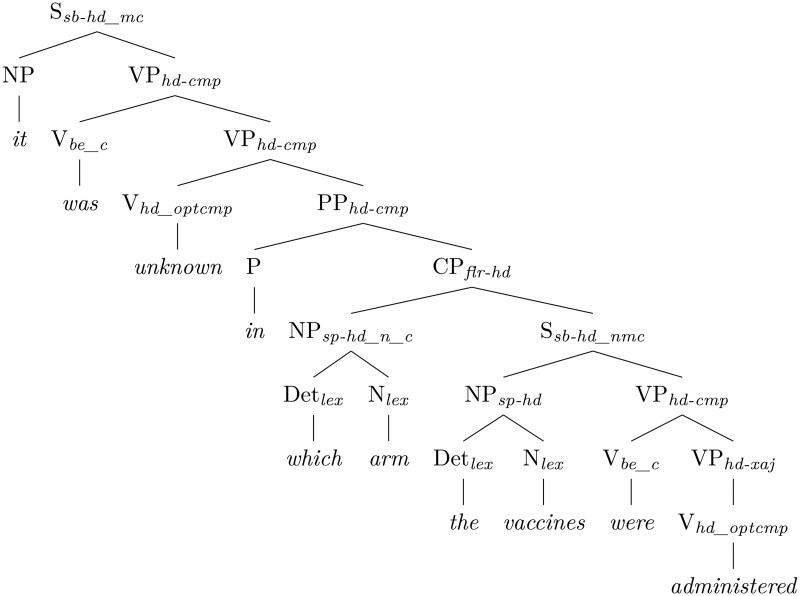 Figure 1
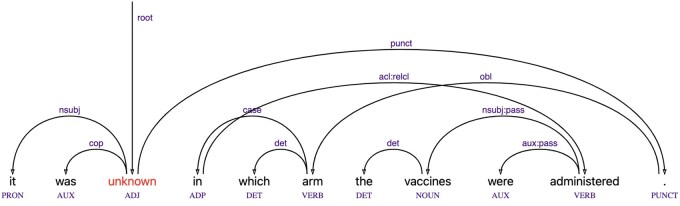 Figure 2
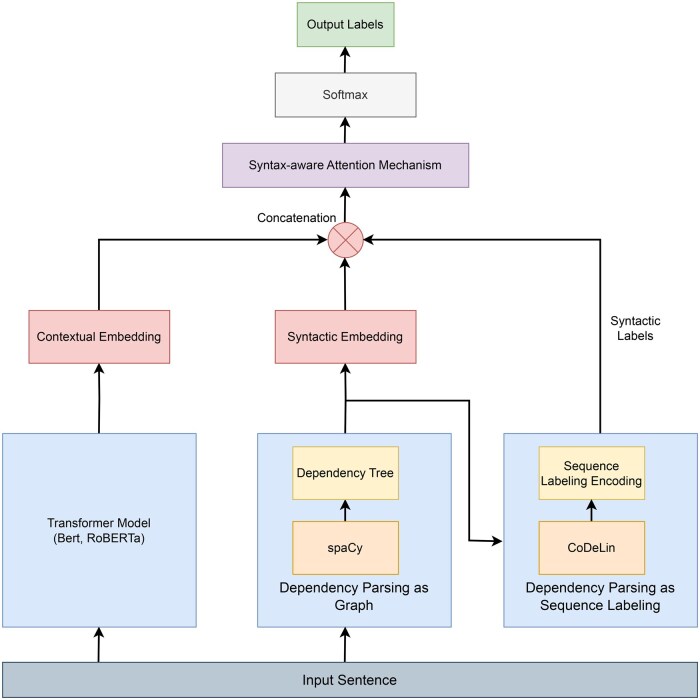 Figure 3
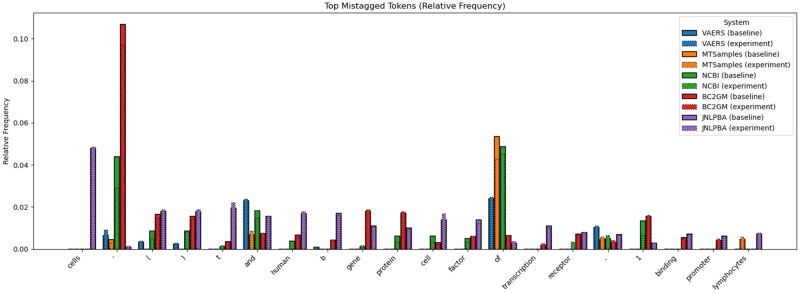 Figure 4
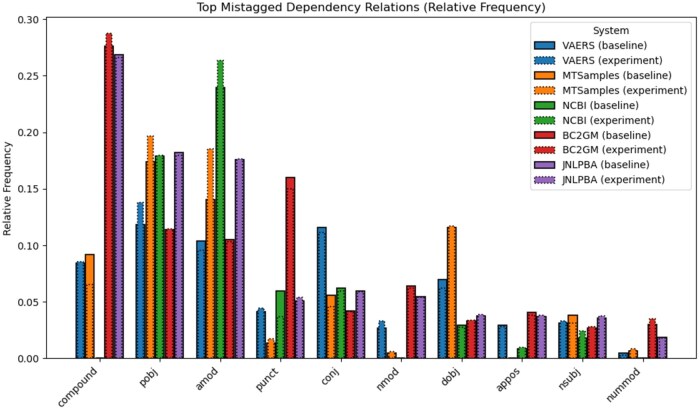 Figure 5
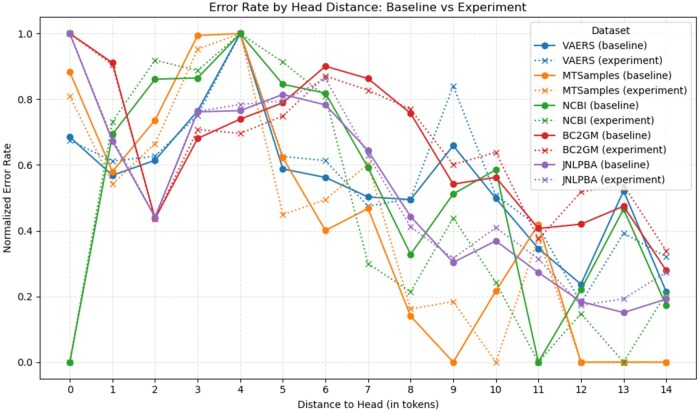 Figure 6
| Dataset | Train | Dev | Test | Entity Type |
|---|---|---|---|---|
| MTSamples | 602 | 201 | 201 | Medical Transcriptions |
| VAERS | 603 | 126 | 286 | Nervous System Disorder |
| NCBI | 4373 | 1,457 | 1,457 | Disease |
| BC2GM | 12,079 | 4,026 | 4,026 | Gene/Protein |
| JNLPBA | 14,884 | 4,961 | 4,961 | Gene/Protein, Cell |
| Dataset | Method | F1-score | Reported by |
|---|---|---|---|
| MTSamples | GPT-4 prompting | 0.593 | Hu et al. 2024 |
| BioClinicalBert fine tuning | 0.785 | Hu et al. 2024 | |
| VAERS | GPT-4 prompting | 0.542 | Hu et al. 2024 |
| BioClinicalBert fine tuning | 0.668 | Hu et al. 2024 | |
| GPT-3.5 fine tuning, | 0.781 | Li et al. 2025 | |
| NCBI | LLM 50-shot prompting | 0.726 | Mu et al. 2024 |
| LLM fine tuning with multi-task learning | 0.899 | Dai et al. 2024 | |
| BERT+BiLSTM+CRF with feature engineering | 0.9166 | Alamro et al. 2024 | |
| LLM + | 0.9176 | Li et al. 2024 | |
| BC2GM | Syntax features; NER as node classification | 0.8515 | Zheng et al. 2022 |
|
| 0.8719 | Park et al. 2024 | |
| Instruction tuning, GPT-4 | 0.8762 | Rohanian et al. 2024 | |
| BioBERT+BiLSTM with embedding | 0.8912 | Alamro et al. 2024 | |
| JNLPBA | Syntax features; NER as node classification | 0.7816 | Zheng et al. 2022 |
| BioBERT+BiLSTM with embedding | 0.7939 | Alamro et al. 2024 | |
| Instruction tuning, GPT-4 | 0.8230 | Rohanian et al. 2024 | |
| BiLSTM+CRF with pretrained word embedding | 0.8432 | Dash et al. 2022 |
| Dataset | Encoders | Baseline | DP as Graph | DP as Seq. Labeling | Multi-task Learning | ||||||||||||||
|---|---|---|---|---|---|---|---|---|---|---|---|---|---|---|---|---|---|---|---|
| Rel | Abs | Rel | Abs | ||||||||||||||||
| P | R | F1 | P | R | F1 | P | R | F1 | P | R | F1 | P | R | F1 | P | R | F1 | ||
| MTSamples | bert-base-uncased | 0.720 | 0.761 | 0.740 | 0.736 | 0.764 | 0.750 | 0.767 | 0.764 | 0.765 | 0.757 | 0.757 | 0.757 | 0.726 | 0.736 | 0.731 | 0.736 | 0.757 | 0.747 |
| distilbert-base-uncased | 0.704 | 0.729 | 0.716 | 0.731 | 0.757 | 0.744 | 0.747 | 0.729 | 0.738 | 0.711 | 0.718 | 0.715 | 0.730 | 0.743 | 0.736 | 0.765 | 0.732 | 0.748 | |
| roberta-base | 0.749 | 0.746 | 0.748 | 0.773 | 0.754 | 0.763 | 0.794 | 0.799 | 0.796 | 0.763 | 0.792 | 0.777 | 0.722 | 0.739 | 0.730 | 0.731 | 0.736 | 0.733 | |
| biobert-v1.1 | 0.708 | 0.743 | 0.725 | 0.779 | 0.771 | 0.775 | 0.773 | 0.757 | 0.765 | 0.804 | 0.796 |
| 0.799 | 0.785 | 0.792 | 0.785 | 0.771 | 0.778 | |
| Bio_ClinicalBERT | 0.774 | 0.736 | 0.755 | 0.742 | 0.718 | 0.730 | 0.728 | 0.736 | 0.732 | 0.785 | 0.771 | 0.778 | 0.797 | 0.775 | 0.786 | 0.755 | 0.725 | 0.740 | |
| BiomedNLP | 0.769 | 0.785 | 0.777 | 0.738 | 0.785 | 0.761 | 0.783 | 0.775 | 0.779 | 0.758 | 0.739 | 0.749 | 0.795 | 0.778 | 0.786 | 0.781 | 0.768 | 0.774 | |
| SapBERT | 0.693 | 0.754 | 0.722 | 0.769 | 0.750 | 0.759 | 0.745 | 0.771 | 0.758 | 0.698 | 0.750 | 0.723 | 0.78 | 0.799 | 0.790 | 0.760 | 0.771 | 0.766 | |
| Prior Comparable SOTA (BioClinicalBert fine tuning, Hu et al. 2024 | |||||||||||||||||||
| VAERS | bert-base-uncased | 0.532 | 0.675 | 0.595 | 0.597 | 0.663 | 0.629 | 0.595 | 0.605 | 0.600 | 0.568 | 0.638 | 0.601 | 0.580 | 0.644 | 0.610 | 0.549 | 0.615 | 0.58 |
| distilbert-base-uncased | 0.539 | 0.599 | 0.568 | 0.546 | 0.605 | 0.574 | 0.545 | 0.566 | 0.555 | 0.566 | 0.650 | 0.605 | 0.554 | 0.626 | 0.588 | 0.520 | 0.593 | 0.555 | |
| roberta-base | 0.610 | 0.708 | 0.655 | 0.625 | 0.716 | 0.667 | 0.609 | 0.708 | 0.655 | 0.618 | 0.710 | 0.661 | 0.568 | 0.669 | 0.614 | 0.572 | 0.648 | 0.608 | |
| biobert-v1.1 | 0.588 | 0.691 | 0.635 | 0.612 | 0.679 | 0.644 | 0.576 | 0.661 | 0.616 | 0.608 | 0.661 | 0.634 | 0.647 | 0.708 | 0.676 | 0.608 | 0.661 | 0.634 | |
| Bio_ClinicalBERT | 0.580 | 0.665 | 0.620 | 0.582 | 0.681 | 0.628 | 0.586 | 0.689 | 0.633 | 0.587 | 0.687 | 0.633 | 0.594 | 0.648 | 0.620 | 0.595 | 0.652 | 0.622 | |
| BiomedNLP | 0.570 | 0.652 | 0.608 | 0.649 | 0.708 | 0.677 | 0.568 | 0.695 | 0.625 | 0.599 | 0.698 | 0.645 | 0.601 | 0.667 | 0.632 | 0.594 | 0.667 | 0.629 | |
| SapBERT | 0.606 | 0.693 | 0.647 | 0.653 | 0.743 |
| 0.636 | 0.722 | 0.676 | 0.661 | 0.730 | 0.694 | 0.613 | 0.698 | 0.653 | 0.628 | 0.691 | 0.658 | |
| Prior Comparable SOTA (BioClinicalBert fine tuning, Hu et al. 2024 | |||||||||||||||||||
| NCBI | bert-base-uncased | 0.876 | 0.875 | 0.876 | 0.892 | 0.893 | 0.893 | 0.883 | 0.871 | 0.876 | 0.861 | 0.879 | 0.896 | 0.881 | 0.888 | 0.885 | 0.884 | 0.890 | 0.887 |
| distilbert-base-uncased | 0.879 | 0.873 | 0.876 | 0.883 | 0.876 | 0.879 | 0.858 | 0.880 | 0.875 | 0.870 | 0.886 | 0.872 | 0.877 | 0.880 | 0.879 | 0.888 | 0.881 | 0.884 | |
| roberta-base | 0.864 | 0.894 | 0.879 | 0.881 | 0.909 | 0.895 | 0.899 | 0.899 | 0.895 | 0.906 | 0.896 | 0.894 | 0.872 | 0.882 | 0.877 | 0.868 | 0.877 | 0.872 | |
| biobert-v1.1 | 0.893 | 0.897 | 0.895 | 0.894 | 0.903 | 0.898 | 0.894 | 0.899 | 0.888 | 0.900 | 0.898 | 0.890 | 0.891 | 0.907 | 0.899 | 0.894 | 0.899 | 0.896 | |
| Bio_ClinicalBERT | 0.903 | 0.881 | 0.892 | 0.891 | 0.892 | 0.892 | 0.890 | 0.901 | 0.882 | 0.902 | 0.876 | 0.872 | 0.884 | 0.883 | 0.883 | 0.886 | 0.875 | 0.880 | |
| BiomedNLP | 0.888 | 0.899 | 0.894 | 0.893 | 0.899 | 0.896 | 0.883 | 0.913 | 0.908 | 0.884 | 0.892 | 0.914 | 0.904 | 0.907 | 0.905 | 0.895 | 0.905 | 0.900 | |
| SapBERT | 0.882 | 0.912 | 0.897 | 0.896 | 0.914 | 0.905 | 0.916 | 0.910 | 0.907 | 0.921 | 0.917 |
| 0.891 | 0.906 | 0.898 | 0.890 | 0.899 | 0.894 | |
| Prior Comparable SOTA (BERT+BiLSTM+CRF with feature engineering, Alamro et al. 2024 | |||||||||||||||||||
| BC2GM | bert-base-uncased | 0.806 | 0.806 | 0.806 | 0.817 | 0.792 | 0.804 | 0.799 | 0.810 | 0.805 | 0.804 | 0.811 | 0.808 | 0.782 | 0.779 | 0.781 | 0.779 | 0.777 | 0.778 |
| distilbert-base-uncased | 0.767 | 0.791 | 0.779 | 0.781 | 0.784 | 0.783 | 0.789 | 0.797 | 0.793 | 0.789 | 0.796 | 0.793 | 0.776 | 0.767 | 0.772 | 0.762 | 0.761 | 0.762 | |
| roberta-base | 0.789 | 0.787 | 0.788 | 0.806 | 0.813 | 0.810 | 0.809 | 0.806 | 0.807 | 0.810 | 0.813 | 0.812 | 0.774 | 0.778 | 0.776 | 0.765 | 0.766 | 0.766 | |
| biobert-v1.1 | 0.837 | 0.819 | 0.828 | 0.828 | 0.837 | 0.832 | 0.836 | 0.847 | 0.841 | 0.837 | 0.842 | 0.840 | 0.807 | 0.825 | 0.816 | 0.792 | 0.810 | 0.801 | |
| Bio_ClinicalBERT | 0.793 | 0.793 | 0.793 | 0.802 | 0.801 | 0.801 | 0.805 | 0.815 | 0.810 | 0.812 | 0.819 | 0.816 | 0.795 | 0.802 | 0.799 | 0.778 | 0.791 | 0.784 | |
| BiomedNLP | 0.834 | 0.824 | 0.829 | 0.846 | 0.834 | 0.840 | 0.832 | 0.848 | 0.840 | 0.839 | 0.845 |
| 0.815 | 0.814 | 0.814 | 0.798 | 0.816 | 0.807 | |
| SapBERT | 0.837 | 0.827 | 0.832 | 0.833 | 0.843 | 0.838 | 0.841 | 0.842 |
| 0.840 | 0.844 |
| 0.814 | 0.821 | 0.818 | 0.798 | 0.826 | 0.812 | |
| Prior Comparable SOTA (BioBERT+BiLSTM with embeddings, Alamro et al. 2024 | |||||||||||||||||||
| JNLPBA | bert-base-uncased | 0.786 | 0.788 | 0.787 | 0.770 | 0.803 | 0.786 | 0.777 | 0.802 | 0.789 | 0.779 | 0.800 | 0.789 | 0.782 | 0.803 | 0.792 | 0.774 | 0.798 | 0.786 |
| distilbert-base-uncased | 0.766 | 0.784 | 0.775 | 0.782 | 0.785 | 0.784 | 0.750 | 0.802 | 0.775 | 0.750 | 0.796 | 0.772 | 0.779 | 0.798 | 0.788 | 0.775 | 0.789 | 0.782 | |
| roberta-base | 0.786 | 0.813 | 0.800 | 0.784 | 0.812 | 0.797 | 0.789 | 0.819 | 0.804 | 0.779 | 0.815 | 0.797 | 0.754 | 0.781 | 0.767 | 0.759 | 0.776 | 0.768 | |
| biobert-v1.1 | 0.779 | 0.818 | 0.798 | 0.790 | 0.806 | 0.798 | 0.786 | 0.812 | 0.799 | 0.781 | 0.822 | 0.801 | 0.789 | 0.816 | 0.802 | 0.783 | 0.814 | 0.798 | |
| Bio_ClinicalBERT | 0.781 | 0.795 | 0.788 | 0.773 | 0.805 | 0.788 | 0.774 | 0.809 | 0.791 | 0.772 | 0.806 | 0.789 | 0.779 | 0.808 | 0.793 | 0.778 | 0.797 | 0.787 | |
| BiomedNLP | 0.796 | 0.801 | 0.799 | 0.789 | 0.818 | 0.804 | 0.786 | 0.822 | 0.804 | 0.787 | 0.815 | 0.801 | 0.798 | 0.816 |
| 0.787 | 0.810 | 0.798 | |
| SapBERT | 0.784 | 0.810 | 0.797 | 0.778 | 0.818 | 0.798 | 0.785 | 0.818 | 0.801 | 0.781 | 0.815 | 0.797 | 0.792 | 0.816 | 0.804 | 0.793 | 0.820 | 0.806 | |
| Prior Comparable SOTA (BiLSTM+CRF with pretrained word embeddings, Dash et al. 2022 | |||||||||||||||||||
|
|
- —Europe research and innovation programme
Peer Reviews
No public reviews on file for this paper yet. If you reviewed it on a platform where reviews are public (OpenReview, ICLR, NeurIPS, ICML), you can paste yours below so the community can read it here.
Videos
No videos yet. Explain this paper in a talk, walkthrough, or lecture? Add one.
Taxonomy
TopicsTopic Modeling · Machine Learning in Healthcare · Biomedical Text Mining and Ontologies
Background and significance
Named entity recognition (NER) is a fundamental task in natural language processing (NLP). It is concerned with detecting portions of text which refer to persons, institutions, locations, substances, and generally entities characterized by having a name. Through the history of NLP, NER has been attempted with a variety of methods, starting from rule-based pipelines (see Grishman et al. 19961 for the earliest mention of the term) and recently, with large language models (LLMs) such as GPT-4 (see Li et al.2 for an overview of deep learning approaches in NER). While highly capable, generative LLMs often do not achieve the same level of precision as specialized encoder-based architectures for tasks requiring high precision, like NER, which is concerned with detecting precise spans of entities in the text. For that reason, despite the overwhelming interest in solving NER with LLMs as part of the generalized AI aspirations, work continues on developing specialized NLP pipelines for NER. For now, the best solutions include fine-tuning, feature engineering, and generally multi-component pipelines.
This is particularly true in biomedical NER, where distributions of entities can differ noticeably between the training data for language models and the downstream task datasets, leading to low scores in zero-shot and even multi-shot prompting of LLMs including GPT-4. Fine-tuning remains necessary, but even with fine-tuning, many datasets remain challenging for the current state of the art. This motivates additional components on top of fine-tuning.
In NLP, dependency parsing is one of the robust ways to enrich text representation, available now for many languages and independent from the text domain. For NER in particular, using parsing is underexplored, although the nature of syntactic dependencies should, in principle, be beneficial for determining correct entity spans better. Furthermore, parsing can be thought of as sequence labelling,3^,^4 making it readily applicable in NER. This is what the experiments presented in this paper demonstrate: we integrate the syntactic structures (obtained by dependency parsing) into the attention mechanism using relational graph convolutional networks and sequence labelling encodings, which allows weighing the contribution of syntactic information for each token. This novel approach allows us to beat the state of the art on three out of five datasets (MTSamples, VAERS, NCBI), showing in particular the efficacy of sequence labelling parsing.
State of the art
Recent work on named entity recognition (NER) in the biomedical domain has been focusing on using large language models (LLM),5 despite BioBERT+BiLSTM still showing some of the best results.6^,^7 Trying to solve as many different problems as possible with generative AI showing its general capacities is a general trend. In the case of NER, the pretrained LLMs are either fine-tuned (trained additionally for the task) or prompted as they are. Fine-tuning is expensive and does not help as much to show AI’s generalizability, but tends to yield better results. As one example, the proposed Category Semantic Enhanced framework for Named Entity Recognition (CSE-NER) uses contrastive learning to inject category semantics into the fine-tuning process, mitigating domain shift.8 Another study demonstrated that ensembling fine-tuned LLMs with traditional deep learning models yields superior performance for extracting complex entities like adverse events.9 To address computational demands, one study created compact biomedical transformers using knowledge distillation, achieving near-par performance with their larger counterparts.10 Prompting in NER is usually defined by the number of examples supplied to the LLM through the prompt: zero-shot (no examples provided) to N-shot where N typically ranges from 1 to 5 but can reach 50 and more.11 In addition to using stand-alone LLMs (fine-tuned or not), NER uses pipelines of tools. This continues to be necessary, due to distributional differences between the training data and the downstream task, and since generative LLMs are currently not very good at tasks requiring precision (such as locating an entity’s precise span). Pipeline components include multi-task learning (separate fine-tune stages), feature engineering (adding POS-tags, word embedding) in combination with specialized language models,6^,^7^,^12 data augmentation,13 and information retrieval (additional examples of contexts in which entities can be found).14 Information retrieval-based pipelines tend to yield higher accuracies than methods with no retrieval, however they depend on the availability of additional information. Also using information retrieval, a practical tool (GPDminer) leverages a BERT-based engine for end-to-end NER and relation extraction in biomedical literature.15
Using syntactic knowledge and the related parsing methodologies is underexplored in NER, and shows substantial promise, since constituencies and dependencies are direct cues for correct entity boundaries. Some early examples of using parsing in NER incorporated syntactic features in the NER pipelines of the day, showing improvements.16–18 In the neural era, linguistic features obtained with shallow parsing (chunking) were shown to improve accuracy for entity spans, however at the time, they were only able to show this effect for neural NER models without the attention mechanism.19 More recently, syntactic parses were integrated into the attention mechanism by reframing the NER task as a graph node classification problem, showing improvements on eight benchmark datasets.20 This work is an example of thinking of syntactic information as motivating a more structural look at the problem of NER itself; see also Tian et al.,21 who were one of the first to incorporate syntactic information into a NER pipeline not by simply concatenating it to data representations but in the form of key-value memory networks. In another study,22 authors report notably high performance for their AIMFF model. Their description of the evaluation suggests that the reported F1 scores may be based on token-level alignment rather than entity-based metrics, as they refer to “words” within entities and do not specify whether strict or relaxed entity-level criteria were applied. Since no public code is available for verification, we do not include their results as we do not know if they are comparable to our entity-based metrics or rather to our token-level evaluation.
More recent work showed that parsing can be thought of as sequence labelling,3^,^4 and so can NER, which makes the connection between the two more readily natural.23 Our study combines modern attention-based architectures with the view on parsing as sequence labelling, while also reproducing some baseline results with language models fine-tuning and with traditional dependency parsing.
Materials and methods
Datasets
In this study, we use five biomedical benchmark datasets described in Chen et al.24 (Table 1).
Table 2 summarizes the state of the art on five benchmark datasets. Our study trains models without using any external data beyond the datasets’ training sets. Thus, following standard evaluation practices, our results are directly comparable to those from fine-tuning, but should not be compared against results from ensemble methods or systems that use additional data sources, such as information retrieval pipelines. The F1 scores are entity-based strict match, so the entity is counted as correctly recognized only if the entire span and the type of the entity was correctly identified (cf. token-based evaluation where every token belonging to a name of an entity counts towards the score).1
Methods
To incorporate syntactic knowledge into NER, we propose a hybrid model that integrates dependency parsing information into a transformer-based architecture through a graph attention mechanism. Specifically, we leverage dependency tree (dependency heads and relations following the Universal Dependencies annotation scheme;26 Figure 2) to construct a graph structure over tokens and apply a Relational Graph Attention Network (RGAT27) to model syntax-aware token interactions. We used the spaCy parser (general-purpose) to obtain dependency trees and encoded them under a sequence labelling setup28 using Relative and Absolute Encoding linearization techniques.4 While this parser is not optimized for biomedical text, its output served as an effective syntactic feature in our model; employing a biomedically-trained parser presents a promising avenue for future performance gains.
Syntactic parsing
Syntactic parsing is mapping sentence strings to their underlying structural representations. In linguistics, the study of sentence structure is called syntax, and parsing is the essential part of studying and using syntax in natural language processing (NLP). Parsing can be done by explicitly modeling grammar rules, which allows for internal consistency and interpretability, and by training statistical and neural systems, which allows for complete coverage of the data and overall robustness. For downstream tasks, such as NER, robustness is key. The two primary approaches to parsing are constituency and dependency parsing. Constituency parsing is a way of analyzing a sentence by organizing its parts into a tree structure that shows how they group together to form meaningful components (see Figure 1). For example, words like the vaccines form a noun phrase—a group of words that together act like a noun. Similarly, administered in the left arm is a verb phrase, acting like a verb. The parser builds a hierarchy where each group, or constituent, reflects how the sentence is structured grammatically. Figure 1 shows the English Resource Grammar29^,^30 constituency visualization of the analysis of the sentence It was unknown in which arm the vaccines were administered (VAERS 2025). The constituency parse shows that the sentence contains such noun phrases as the vaccines and which arm, that the vaccines combine with the verb phrase were administered as its subject, and so on.
A constituency parse.
Constituency parsing is complex and slow. While it remains important in some areas, in many downstream tasks dependency parsing has long been considered an efficient alternative. Dependency parsing maps the sentence string to an underlying graph of relations between parts of the sentence. Figure 2 shows a dependency analysis for the same sentence, obtained by the Salsa system.2^,^31 While a dependency parse does not directly represent constituents, some constituency information can be reconstructed from it and used for boosting precision in recognizing named entity spans. In many cases, dependencies are even more important for detecting such spans than constituency, for example long distance dependencies (where some parts of a constituent can be separated from it). In the example sentence, in which arm is modifying the verb administered and, in a canonical sentence not containing an embedded question, it would directly follow the verb (eg, The vaccines were administered in the left arm). However, in the example, it is separated from the verb by the noun phrase the vaccines.
A dependency parse.
Parsing as sequence labelling 3 ^,^ 4 is a modern approach to constituency and dependency parsing which reframes parsing as a more generic task, connecting it to the array of NLP tasks solved successfully with neural architectures. The essence of parsing as sequence labelling is linearizing sentence structure such that it is presented as a string of words where each word is labeled (in a one-to-one correspondence) with a piece of syntactic information. When combined, this sequence of labels can be used to reconstruct each word’s grammatical role and the sentence’s overall structure (ie, the constituent or dependency tree).
Model architecture
The model architecture (Figure 3) is built around two complementary pathways: one that provides contextual embeddings derived from a pretrained transformer backbone, and another that uses a dependency parser to obtain syntactic relationships and explicitly encodes them, either directly as a dependency graph or through sequence labelling. These syntactic relationships are then fused (through a syntax-aware attention mechanism) to produce syntax-aware token-level embeddings for NER.
Overall system architecture.
In the first pathway, the input sentence is encoded by a pretrained transformer model (BERT, RoBERTa), whose final hidden states provide rich contextual representations for each token. Simultaneously, in the second pathway, the system first obtains syntactic relationships for the sentence through dependency parsing (spaCy). These syntactic relationships are then incorporated into the model via one of two alternative approaches. (1) In the first approach, the system constructs a dependency graph directly for the dependency parse tree, where tokens are connected according to their grammatical relationships. A multi-headed RGAT27 then propagates information along these edges, allowing the model to capture higher-order syntactic patterns. The output of this graph network yields structured embeddings that emphasize how tokens function within the overall sentence structure. (2) In the second approach, the dependency parse trees are converted into a sequence of syntactic labels using a sequence labelling framework CoDeLin.32 For each token, the syntactic label (head position, dependency relation) is converted into an embedding vector (eg, relation label embedding). These embedding reflect the positional relationship (using relative encoding or absolute encoding) between each token and its syntactic head, ensuring that local structural cues are available.
The system combines these complementary pathways through a lightweight syntax-aware attention mechanism that learns, for each token, the appropriate balance between its contextual embedding and its syntactic embedding. The two representations (contextual and syntactic) are merged via a learned weighting mechanism, enabling the model to emphasize contextual cues when they are most informative and to fall back on syntactic signals when they better capture entity boundaries.
Finally, the fused token representations are fed into a standard classification layer that assigns a probability distribution over possible entity labels for each token. Thus, our system SynNER combines both context and syntax in a simple, trainable model to provide more accurate named entity predictions.
Syntax-aware attention mechanism
The attention mechanism is a learned fusion mechanism designed to integrate semantic features from a pretrained transformer (eg, BERT, RoBERTa) with syntactic features derived from dependency parsing tree, modelled through RGAT. This mechanism allows the model to dynamically weigh the contribution of semantic and syntactic information for each token during the Named Entity Recognition (NER) task.
To effectively integrate semantic and syntactic information, the model employs a token-level attention mechanism that dynamically fuses contextual embedding from the transformer model with structure-aware embeddings derived from RGAT. For each token, the semantic vector from the transformer output and the projected syntactic vector from the GAT output are concatenated into a combined feature vector:
This concatenated vector is passed through a lightweight feedforward attention network consisting of a linear transformation followed by a non-linear activation and a final scoring layer:
where , , and denotes the attention weights corresponding to the transformer-based (semantic) and GAT-based (syntactic) features, respectively. These attention weights are normalized using the softmax function such that . The final fused representation for each token is computed as a weighted combination of the semantic and syntactic features:
The fused representations are then passed through a dropout layer for regularization before being projected into the label space via a linear classifier (classification layer), producing entity type predictions for each token. This attention-based fusion allows the model to dynamically adjust the contribution of semantic and syntactic information for each token, thereby enhancing representation quality and improving performance on the NER task.
Multi-task learning for NER
An alternative way to incorporate syntax information into NER process is Multi-task learning (MTL). MTL is a powerful framework for improving NER by jointly training it with syntactically related auxiliary tasks such as dependency parsing as sequence labelling. We implement MTL with MaChAmp Toolkit,33 where both tasks share a common encoder (a pretrained transformer model) while maintaining separate task-specific decoders. The auxiliary parsing task guides the model to learn syntactic structures, such as head–dependent relations and phrase boundaries, which are especially valuable in the biomedical domain where entities often align with noun phrases or syntactic constituents. By incorporating dependency parsing as sequence labelling as an auxiliary task, the model’s shared representation becomes aware of grammatical roles and structural cues that help identify entity spans.
Results
Table 3 presents our results. Our baseline is fine-tuned transformer-based models without syntactic features. Comparing to this baseline makes it clear that infusing syntactic information in the form of dependency parsing, particularly when encoded in sequence labelling form, into the attention mechanism brings benefits on all datasets. Furthermore, we beat the relevant SOTA (methods not involving ensemble pipelines; Table 2) on three out of five datasets (MTSamples, VAERS, and NCBI). More detailed results can be found in the Appendix A in supplementary materials.
In terms of the models, we observed the best results with SapBERT on most datasets except MTSamples, where bioBERT performed better. Sequence labelling with absolute encoding appears the most beneficial syntax representation to add to the attention mechanism; in the case of VAERS, there is a negligible difference between sequence labelling and the direct graph encoding. We note that VAERS remains one of the most challenging datasets and that with dependency parsing, we were able to improve SOTA by 2.7%. Sequence labelling parsing is meant to combine local and global information about the sentence structure and its elements; our hypothesis corroborated by the results is that it is most beneficial where long distance and local information are comparably important.
We observe the least success with the BC2GM and JNLPBA datasets. These datasets are more homogeneous, but also more technical than MTSamples, VAERS, or NCBI. The named entities they contain are often in the form of number and punctuation sequences. It is possible that the opaqueness/arbitrariness of gene and protein names makes it more difficult to disambiguate between them and other entities, since the role of context with respect to gene names may not be similar to other kinds of entities. Furthermore, we note that the best results achieved on these two datasets include BiLSTM and pretrained word embedding. It makes sense that word embedding would help, since the embedding would offset the negative effect that the opaqueness of gene and protein names may have on the NER task.
Discussion
Table 4 presents the error analysis we performed on the mismatches between the gold labels provided with the datasets and our overall best systems’ predictions, namely dependency parsing as sequence labelling with absolute encodings. We have aggregated the errors based on entity types (in the case of NCBI and BC2GM datasets, there is only a single entity type for each). The example illustrating each category was picked based on the frequency of the mistagged tokens in the given dataset (and secondly, on the sentence length; we picked shorter examples for the table). Pink spans are gold entities; blue spans are predicted entities; finally, underlined spans are those for which the type is different between gold and predicted. Most mistagged tokens per dataset are presented in Figure 4. The only mismatch intersection between all datasets are function words (and, of) and punctuation. Some of the most noticeable gains are due to now properly tagged n-dash (‘–’) and parentheses, which indicates gains in tagging compounds and appositions, dependency types we do see as most frequently mistagged (Figure 5), although while on some datasets (MTSamples), we get fewer mismatches in these categories compared to the baseline, in other datasets we get more (BC2GM).
Most mistagged tokens: comparison between our system and the baseline.
Most mistagged dependency relations: comparison between our system and the baseline.
Figure 5 also shows that, while there are few specific mismatch-prone tokens across datasets, there is a similar proportion of mismatches between all datasets with respect to syntactic subjects and ‘prepositional’ objects nsubj, pobj, whereas with respect to direct objects (those that do not require a preposition), the MTSamples dataset has noticeably more mismatches than other datasets. It also makes sense that in most datasets (except NCBI) many noun compounds cause mismatches between our system predictions and gold labels, because it is not always clear how to determine what is and what is not a compound; sometimes gold labels interpret as separate entities what our system tags as a single entity, and vice versa. In the end, there is a degree of arbitrariness in this kind of tagging (see also examples of mismatches in Table 4 to assess the degree of arbitrariness).
Figure 6 shows normalized error rates as a function of the mistagged token’s distance to its syntactic head. Intuitively, longer dependencies may indicate higher complexity of utterance, which may correlate with the difficulty of performing NLP tasks on such utterances. This in turn motivates including syntactic features in NLP pipelines. Our experiment shows that including syntactic features does reduce error rates noticeably as distance to head increases in the NCBI dataset, but that we do not see this effect in other datasets. In fact, for BC2GM it seems to be the reverse: syntactic features reduce error rates for shorter distances to the head, but it still increases as the distance grows.
Error rate depending on distance of mistagged token to syntactic head, comparison with baseline.
Across categories, function words account for the majority (in some categories, above 50%) of mismatched tokens across datasets. We see many instances of the words of, and, and the, which highlights the strictness of the metric that we apply to evaluation and, related to that, some of the difficulties of obtaining a consistent gold annotation (in the gold annotation, there seems to be a lack of a consistent pattern of including or not including function words in entities). As for substance words in the mismatched entities, there are no specific lexical items that would persist across datasets. This is perhaps not surprising, as it is the diversity and uncommon nature of the named entity array that makes the NER task particularly challenging.
It is worth remarking that false negatives in our system (gold entities that our system misses) are often due to a single error related to the beginning (B) token. For example, in the NCBI example in Table 4, the system successfully identifies each of the tokens in the gold span except the first one, and assigns an I-tag to all of them, while failing to mark the beginning with a B-tag, causing the system to lose the whole entity in evaluation. In other cases, the spans may match perfectly but the first token will not be a B-token but an I-token. This last kind of problem can be solved by simple postprocessing (eg, ensuring that the first tag is always a B-tag), with the potential to further increase accuracy. Both problems may be related to the training data lacking in consistency where it comes to span annotations for similar syntactic structures, ie, sometimes a quantifier (such as ‘some’) is included in the entity and sometimes not, which may confuse the training.
Finally, we note that many of the false positives (where our system tags an entity although the gold annotation marks it as ‘outside’ of any entity span) seem to be cases of questionable gold labelling. Often it is not clear why something would not be tagged in the gold reference. Many of the type mismatches also seem questionable. (This has no bearing on the comparison of our system to others’, as everyone is using the same gold standard.) What this means is that the NER systems such as ours are likely to be better than the current evaluation setups allow us to show. Our error analysis also illustrates some important differences between the datasets: that NCBI is “easy” (various systems will usually score in the 90%s even with strict metrics) because it only has one entity type; that VAERS is “hard” because it has many entity types; and that having many entity types unsurprisingly leads to more inconsistencies in gold label annotations. We hypothesize that higher inconsistency levels of annotation in VAERS could be the reason for the higher percentage of mismatches being due to “wrong type”, compared for example to JNLPBA, which has even more entity types, yet the percentage of mismatches due to wrong type there is lower than in VAERS. Confirming this is future work.
Conclusion
The models keep improving, and today, a transformer-based model fine-tuned for the NER task outperforms the models which were used in the recent reported SOTA. However, the biomedical datasets remain challenging, with some SOTA still being under 70% F1 score and none approaching 100%. We demonstrate that infusing syntactic information into the attention mechanism of the architecture improves the performance of certain models enough to surpass the previous state of the art on several benchmark datasets, in some cases, up to 5%. The intuition that syntactic structure is important for NER is supported by our error analysis, which shows the large proportion of compounds and adjectival modifiers among errors, as well as function words such as ‘and’ and ‘of’; in other words, complex phrases. Future work should pay attention to the consistency of labelling complex phrases (perhaps employing a syntactic parser as part of the labelling procedure) and explore further opportunities for using linguistic analysis in attention mechanisms of NER systems.
Supplementary Material
ooaf149_Supplementary_Data
The reference list from the paper itself. Each links out to its DOI / PubMed record.
- 1Grishman R , Sundheim BM. Message understanding conference-6: A brief history. In: COLING 1996 volume 1: The 16th international conference on computational linguistics, 1996.
- 2Li J , Sun A, Han J, Li C. A survey on deep learning for named entity recognition. IEEE Trans Knowl Data Eng. 2022;34:50–70.
- 3Gómez-Rodríguez C , Vilares D. Constituent Parsing as Sequence Labeling. In: Proceedings of the 2018 Conference on Empirical Methods in Natural Language Processing; 2018. p. 1314–24.
- 4Strzyz M , Vilares D, Gómez-Rodríguez C. Viable Dependency Parsing as Sequence Labeling. In: Proceedings of the 2019 Conference of the North American Chapter of the Association for Computational Linguistics: Human Language Technologies, Volume 1 (Long and Short Papers). 2019. p. 717–23.
- 5Keloth VK , Hu Y, Xie Q, et al Advancing entity recognition in biomedicine via instruction tuning of large language models. Bioinformatics. 2024;40:btae 163.38514400 10.1093/bioinformatics/btae 163PMC 11001490 · doi ↗ · pubmed ↗
- 6Hu Y , Chen Q, Du J, et al Improving large language models for clinical named entity recognition via prompt engineering. J Am Med Inform Assoc. 2024;31:1812–1820.38281112 10.1093/jamia/ocad 259PMC 11339492 · doi ↗ · pubmed ↗
- 7Alamro H , Gojobori T, Essack M, Gao X. Bio BBC: a multi-feature model that enhances the detection of biomedical entities. Sci Rep. 2024;14:7697.38565624 10.1038/s 41598-024-58334-x PMC 10987643 · doi ↗ · pubmed ↗
- 8Dai D , Zhang G, Li S, et al CSE-NER: A category semantic enhanced multi-task learning framework for named entity recognition. In: 2024 5th International Seminar on Artificial Intelligence, Networking and Information Technology (AINIT); 2024. p. 1730–5.