Outpatient overstitch repair of perforation following endoscopic submucosal dissection: a novel, cost-effective approach
Hugo Gonçalo Guedes, Julia Schettini Veloso, Juliana de Meneses, Julio Cesar de Soares Veloso

Abstract
Genes, proteins, chemicals, diseases, species, mutations and cell lines named across the full text — each resolved to its canonical identifier and authoritative record.
Click any figure to enlarge with its caption.
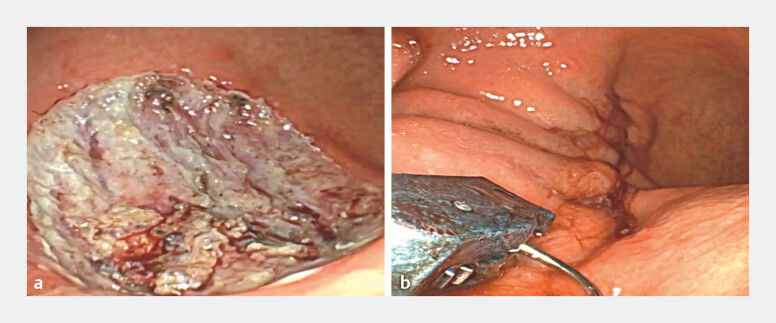 Fig. 1
Peer Reviews
No public reviews on file for this paper yet. If you reviewed it on a platform where reviews are public (OpenReview, ICLR, NeurIPS, ICML), you can paste yours below so the community can read it here.
Videos
No videos yet. Explain this paper in a talk, walkthrough, or lecture? Add one.
Taxonomy
TopicsGastric Cancer Management and Outcomes · Esophageal and GI Pathology · Esophageal Cancer Research and Treatment
The OverStitch NXT single-channel suturing system is a novel endoscopic approach for outpatient closure of intra-procedural perforations. Compared to its double-channel predecessor, this device can be mounted on conventional endoscopes and presents increased flexibility and maneuverability. Thus, it is a technically feasible and safe method for endoscopic suturing.
We report here a case of an 80-year-old patient, with high cardiac risk, with intra-procedural endoscopic submucosal dissection (ESD) complications, after full-thickness perforation and pneumoperitoneum occurred, following endoscopic dissection of a 2 cm well-differentiated gastric adenocarcinoma ( Video 1 ). The pneumoperitoneum was drained percutaneously, and after the completion of the dissection, the mucosal defect was closed using the OverStitch NXT single-channel suturing system ( Fig. 1 ). The patient recovered fully without complications and was discharged within 24 hours.
Endoscopic aspect of full thickness endosuture after ESDʼs perforation.Video 1
Comparison of the endoscopic view of a an endoscopic submucosal dissection (ESD) lesion with intra-procedural perforations and the b ESD lesion after endoscopic overstitch suturing.
Intraoperative perforations during ESD occur in approximately 2.3% of cases, and endoscopic closure should be considered first. When endoscopic closure is successfully achieved, patients can be managed conservatively with fasting, installation of nasogastric tube, and antimicrobial therapy, reducing global hospital costs and the need for surgical interventions 1 .
The use of standard clips have important limitations, as they typically grasp only the mucosa, may create submucosal dead space prone to wound dehiscence, and are often technically challenging in larger defects, requiring multiple applications that increase procedural time and cost 2 3 . In contrast, endoscopic suturing provides reliable tissue approximation and has been associated with early, same-day discharge in a substantial proportion of patients, suggesting that the reduced length of stay and avoidance of prolonged hospitalization may help offset device-related costs, while preserving patient safety and comfort 3 4 . Therefore, novel suturing devices, such as the OverStitch NXT single-channel system, present minimally invasive, cost-effective and efficient closure of defects in therapeutic endoscopic procedures like ESD.
Endoscopy_UCTN_Code_TTT_1AO_2AO
The reference list from the paper itself. Each links out to its DOI / PubMed record.
- 1Ono H Yao K Fujishiro M Guidelines for endoscopic submucosal dissection and endoscopic mucosal resection for early gastric cancer (second edition)Dig Endosc 20213342010.1111/den.1388333107115 · doi ↗ · pubmed ↗
- 2Nomura T Sugimoto S Temma T Suturing techniques with endoscopic clips and special devices after endoscopic resection Dig Endosc 20233528730110.1111/den.1442735997063 · doi ↗ · pubmed ↗
- 3Han S Wani S Edmundowicz SA Feasibility of endoscopic suturing to prevent adverse events and hospitalization after endoscopic submucosal dissection Endosc Int Open 20208 E 1212 E 121710.1055/a-1197-653432904784 PMC 7458724 · doi ↗ · pubmed ↗
- 4Keihanian T Zabad N Khalaf M Safety and efficacy of a novel suturing device for closure of large defects after endoscopic submucosal dissection (with video)Gastrointest Endosc 20239838139110.1016/j.gie.2023.04.00637061137 · doi ↗ · pubmed ↗