Human Platelets Internalize Pregnancy-Specific Glycoprotein-1 (PSG1)
Ejaife O. Agbani, Lorraine Chow, Joshua Nicholas, Ibukun Akinrinade, Nancy Soliman, Donna M. Slater, Pavel Davizon-Castillo, Gabriela Dveksler

TL;DR
This study shows that human platelets take in a protein called PSG1, which is produced during pregnancy and may influence maternal health.
Contribution
The novel finding is that human platelets internalize PSG1, suggesting a direct interaction between placental proteins and platelet function.
Findings
Human platelets internalize pregnancy-specific glycoprotein-1 (PSG1).
PSG1 is present in maternal plasma at high concentrations during pregnancy.
Platelet PSG1 uptake may be via placental exosomes or direct incorporation.
Abstract
It has been long suggested that the placenta “educates” maternal platelets to contribute to a healthy pregnancy. Several studies have also demonstrated unique changes in platelet function and ultrastructure during pregnancy, some of which may drive hypertensive complications of pregnancy. One of the few proteins that are differentially found in the plasma of pregnant females when compared with non-pregnant females and males are the members of the pregnancy-specific glycoprotein (PSG) family, and PSG1 is one of the highest expressed and best characterized of all human PSGs. Because PSGs are secreted into the maternal circulation (by the trophoblast cells of the placenta), platelets may be picking up placental exosomes containing PSGs. Also, platelets may directly incorporate circulating PSGs, which are found in high concentration, as has been shown for other serum proteins, including…
Genes, proteins, chemicals, diseases, species, mutations and cell lines named across the full text — each resolved to its canonical identifier and authoritative record.
Click any figure to enlarge with its caption.
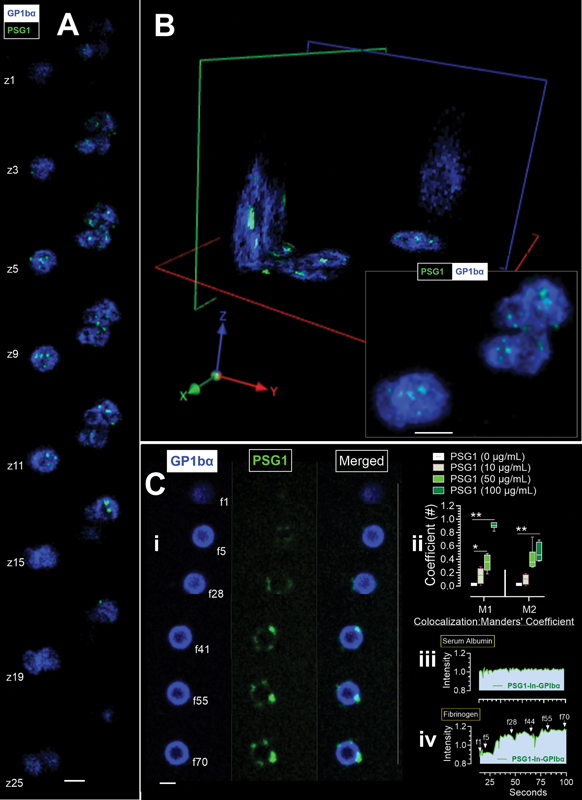 Fig. 1
Peer Reviews
No public reviews on file for this paper yet. If you reviewed it on a platform where reviews are public (OpenReview, ICLR, NeurIPS, ICML), you can paste yours below so the community can read it here.
Videos
No videos yet. Explain this paper in a talk, walkthrough, or lecture? Add one.
Taxonomy
TopicsPlatelet Disorders and Treatments · Renal Diseases and Glomerulopathies · Myeloproliferative Neoplasms: Diagnosis and Treatment
Pregnancy is associated with changes in platelet ultrastructure and function, 1 and it has been suggested that the placenta “educates” maternal platelets to contribute to a healthy pregnancy. 2 The members of the pregnancy-specific glycoprotein (PSG) family are secreted from the syncytiotrophoblast layer of the placenta to the maternal circulation and are one of the few proteins found in the plasma of pregnant females that are absent in non-pregnant females and males. 3 There are 10 protein-coding human PSG genes (PSG1–PSG9, PSG11) 4 and all have been shown to activate latent TGF-β. 5 Previous studies by our group and others have detected PSGs in platelet lysates 3 and releasates, 6 which was unexpected considering their placental origin. Furthermore, PSG1 has been reported to bind platelet integrin α IIb β 3 and inhibit fibrinogen binding. 7 Here, we provide visual evidence which suggests platelets can interact, bind, and internalize plasma PSGs using recombinant PSG1, a highly expressed and well characterized of all human PSGs. 8 PSG1 was generated from the supernatant of stably transfected CHO-K1 single-cell clone established in our laboratory and grown in hollow fiber cartridge bioreactors (Fiber Cell Systems, Frederick, MD, USA), as previously described. 9 10 To fluorescently label PSG1, we used the Alexa Fluor 647 labeling kit (Molecular Probes, Thermo Fisher Scientific), following the manufacturer's instructions. We utilized a high-resolution fluorescence imaging approach to examine the interactions and sub-cellular localization of PSG1-labeled Alexa-Fluor 647 with non-permeabilized platelets derived from non-pregnant females and participants with a healthy pregnancy. Alexa-Fluor 405-conjugated CD42b/GP1b α antibody (Bio-Techne Canada, GP1bα, Blue ) was used as a platelet marker in combination with size discrimination. In Fig. 1 , the images in Panel A are selected z-plane images from z-stack images of platelets separated by 0.25 µm. Panel B of Fig. 1 shows platelets in panel A in an XYZ orientation, and the insert shows extended focus (2D projection) images of the same platelets. In Panel C ( Fig. 1 ), we show in Ci , images of the spatiotemporal interaction of labeled PSG1 with GPIbα marked platelets. The time points for Ci (f1–f70) correspond to 15 to 100 seconds. Cii shows quantification of Manders' colocalization coefficient of PSG1 with GPIbα labeled platelets, and the kinetics of PSG1 interaction with GPIbα labeled platelets adhering to serum albumin ( Ciii ) and fibrinogen 200 µg/mL coating ( Civ ). The data in Cii and Ciii are from eight donors. Manders' coefficients, M1 and M2, indicate the extent of PSG1 and GP1b α colocalization. M1 represents the proportion of the PSG1 signal that colocalizes with the platelet marker GP1b α signal, and M2 indicates the colocalization of GP1b α with PSG1. In parallel experiments using an anti-PSG antibody (BAP3; sc-59348, Santa Cruz), we observed PSG on the membrane and inside the platelets of all pregnant women examined ( n = 8; not shown). Platelets were derived from pregnant women during the 3rd trimester (gestational age 224–272 days), and 2 to 14 days before delivery. Furthermore, labeled recombinant PSG1 ( Green ) was internalized by platelets from non-pregnant females ( Panels A–C ) and localized within the cytosol and on the plasma membrane ( Panels A–C ). PSG1 internalization occurred in platelets in quiescent states adhering to serum albumin ( Ciii ), and the uptake was enhanced in the presence of fibrinogen ( Civ ). The associated supplementary data ( Videos 1 and 2 , available in the online version only) show the spatial distribution of labeled PSG1 as the platelet XY planes images are examined over Z heights ( Video 1 , available in the online version only). Video 2 (available in the online version only) captures the interaction of labeled PSG1 with platelets over time. Images were captured at Nyquist using a Nikon A1R laser scanning confocal microscope via Nikon NIS-Elements imaging software and an oil immersion Plan Apo Lambda objective lens (60x; Numerical Aperture: 1.4; Working Distance: 0.13 mm). Image resolution was improved by the restoration complement of the Volocity® imaging Software and analyzed using the same software (Quorum Technologies Inc. Canada). Scale bars: 3 μm ( A, B ).
Human Platelets Internalise Pregnancy-Specific Glycoprotein-1 (PSG1).
Video 1 Spatial localisation of PSG1 in non-permeabilised human platelets.
Video 2 Kinetics of PSG1 interaction with non-permeabilised human platelets.
The reference list from the paper itself. Each links out to its DOI / PubMed record.
- 1Agbani E O Chow L Nicholas J Overexpression of facilitative glucose transporter-3 and membrane procoagulation in maternal platelets of preeclamptic pregnancy J Thromb Haemost 202321071903191936963633 10.1016/j.jtha.2023.03.014 · doi ↗ · pubmed ↗
- 2Guettler J Forstner D Gauster M Maternal platelets at the first trimester maternal-placental interface—small players with great impact on placenta development Placenta 2022125616734920861 10.1016/j.placenta.2021.12.009 · doi ↗ · pubmed ↗
- 3de Almeida L GN Young D Chow L Proteomics and metabolomics profiling of platelets and plasma mediators of thrombo-inflammation in gestational hypertension and preeclampsia Cells 20221108125635455936 10.3390/cells 11081256 PMC 9027992 · doi ↗ · pubmed ↗
- 4Moore T Dveksler G S Pregnancy-specific glycoproteins: complex gene families regulating maternal-fetal interactions Int J Dev Biol 201458(2-4):27328025023693 10.1387/ijdb.130329 gd · doi ↗ · pubmed ↗
- 5Warren J Im M Ballesteros A Activation of latent transforming growth factor-β1, a conserved function for pregnancy-specific beta 1-glycoproteins Mol Hum Reprod 2018241260261230371828 10.1093/molehr/gay 044PMC 6262632 · doi ↗ · pubmed ↗
- 6Szklanna P B Parsons M E Wynne K The platelet releasate is altered in human pregnancy Proteomics Clin Appl 20191303 e 180016230318839 10.1002/prca.201800162 · doi ↗ · pubmed ↗
- 7Shanley D K Kiely P A Golla K Pregnancy-specific glycoproteins bind integrin αI Ibβ3 and inhibit the platelet-fibrinogen interaction P Lo S One 2013802 e 5749123469002 10.1371/journal.pone.0057491 PMC 3585349 · doi ↗ · pubmed ↗
- 8Moore T Williams J M Becerra-Rodriguez M A Dunne M Kammerer R Dveksler G Pregnancy-specific glycoproteins: evolution, expression, functions and disease associations Reproduction 202216302 R 11R 2335007205 10.1530/REP-21-0390 · doi ↗ · pubmed ↗