Correction to “Targeting Immunoproteasome in Polarized Macrophages Ameliorates Experimental Emphysema via Activating NRF1/2‐P62 Axis and Suppressing IRF4 Transcription”

Abstract
Genes, proteins, chemicals, diseases, species, mutations and cell lines named across the full text — each resolved to its canonical identifier and authoritative record.
Click any figure to enlarge with its caption.
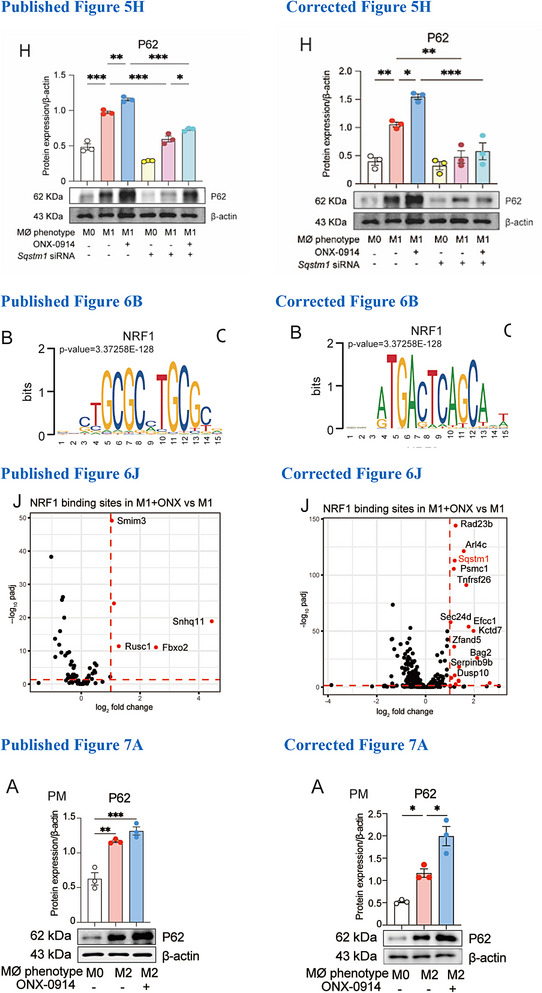 Figure 1
Peer Reviews
No public reviews on file for this paper yet. If you reviewed it on a platform where reviews are public (OpenReview, ICLR, NeurIPS, ICML), you can paste yours below so the community can read it here.
Videos
No videos yet. Explain this paper in a talk, walkthrough, or lecture? Add one.
Taxonomy
TopicsImmune cells in cancer · Inflammasome and immune disorders · Peptidase Inhibition and Analysis
Guo B, Shi X, Jiang Q, et al. Targeting Immunoproteasome in Polarized Macrophages Ameliorates Experimental Emphysema via Activating NRF1/2‐P62 Axis and Suppressing IRF4 Transcription. Adv Sci (Weinh). 2024;11(44):e2405318. https://doi.org/10.1002/advs.202405318.
- In the “Results” section, the text “Interestingly, Nrf2, but not Nrf1, was identified as binding to the P62 gene regulatory site (Figure 6J,K).” was incorrect. This should have read: “As expected, both Nrf1 and Nrf2 were identified as binding to the P62 gene regulatory site (Figure 6J,K).”
- In the “Discussion” section, the sentence “Subsequent analysis predicted that only Nrf2 had the potential to bind to the regulatory site of the P62 gene” has been removed.
- A replacement of the images in Figure 5H, Figures 6B,J, and Figure 7A has been performed with the corresponding final versions.
- Supplement the missing antibody information of commercial source in Table 2 as follows:
NRF1: Anti‐rabbit TCF11/NRF1 (D5B10) (1:1000), Cell Signaling Technology, #8052
NRF2: Anti‐rabbit NRF2 (1:500), Cell Signaling Technology, #12721T
We apologize for this error.
2. Results
2.5 ONX‐0914 Suppresses M1 Polarization via NRF1 and NRF2‐P62 Signaling Pathway
This activation was further supported by increased nuclear localization of NRF2 following ONX‐0194 treatment, as shown by NRF2 antibody‐based fluorescent staining (Figure 6H). RT‐qPCR results also demonstrated that ONX‐0914 enhanced CSE‐stimulated Nrf2 expression in AMs (Figure 6I). Additionally, using Transcription Factor Occupancy By Investigation of ATAC‐seq Signal (TOBIAS) analysis, we predicted the Nrf1 and Nrf2 binding sites in ONX‐0194‐treated M1 macrophages. As expected, both Nrf1 and Nrf2 were identified as binding to the P62 gene regulatory site (Figure 6J,K).
3 Discussion
In our final analysis, we employed ATAC‐seq footprinting analysis to identify the upstream transcription factors (TFs) responsible for the regulation of P62. Our results revealed that ONX‐0914 treatment activated both Nrf1 and Nrf2 in M1‐polarized macrophages. Our RNA interference (RNAi) experiments confirmed the necessity of Nrf2 for ONX‐0914‐induced upregulation of P62.