SHARK: A Specialized Host for Assembling R6K Plasmids
Shivang Hina-Nilesh Joshi, Christopher Jenkins, David Ulaeto, Thomas E. Gorochowski

TL;DR
SHARK is a new type of E. coli strain designed to make it easier and more efficient to work with R6K plasmids for genome engineering.
Contribution
The SHARK strains are engineered for efficient R6K plasmid maintenance and cloning, surpassing commercial alternatives.
Findings
SHARK strains are over 100 times more efficient than commercial Pir strains for transforming large and complex cloning reactions.
SHARK strains are built from the DH10B derivative and include a genome-encoded pir gene for stable R6K plasmid maintenance.
All SHARK strains and genetic tools are publicly available to support genome engineering projects.
Abstract
R6K plasmids are commonly used for a wide range of genome engineering applications due to their ability to support transient delivery of genetic cargos in many hosts. The maintenance of R6K plasmids requires specific strains. Unfortunately, many of these have obscure backgrounds, limited availability and were not built for efficient cloning. To address this issue, we present the construction and characterization of a series of Pir E. coli strains called SHARK that are built from the DH10B derivative, Marionette-Clo. All SHARK strains have a genome encoded pir gene for stable R6K plasmid maintenance and a λCI gene for tight unconditional repression of specific genes on plasmids. We show that SHARK strains are >100-fold more efficient than a commercial Pir strain when transformed with large and complex cloning reactions. SHARK is intended to help facilitate the cloning of R6K plasmids for…
Genes, proteins, chemicals, diseases, species, mutations and cell lines named across the full text — each resolved to its canonical identifier and authoritative record.
Click any figure to enlarge with its caption.
 1
1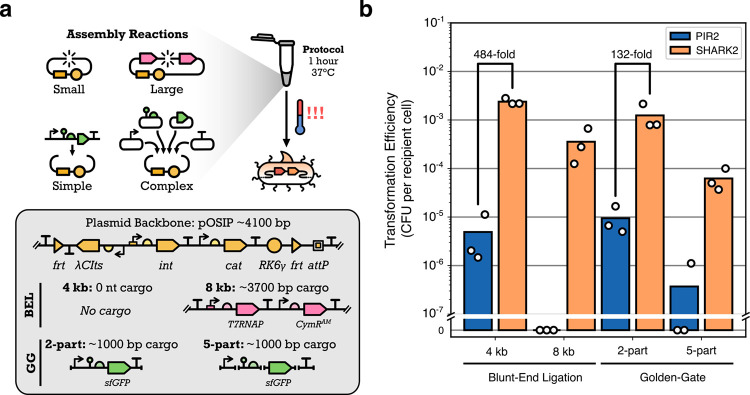 2
2|
| ||||
|---|---|---|---|---|
|
| promoter | RBS | protein |
|
| PIR2 | P
| RBS
| Pir | 13 ± 2 |
| SHARK1 | P
| RBS
| Pir | |
| SHARK2 | P
| B0033 | Pir | 13 ± 1 |
| SHARK3 | P
| B0033 | Pir4150 | 12 ± 1 |
| SHARK4 | P
| B0033 | Pir116 | 14 ± 1 |
| SHARK5 | P
| RiboJ-B0064 | Pir | 7 ± 2 |
| SHARK6 | P
| RiboJ-B0064 | Pir4150 | 59 ± 17 |
| SHARK7 | P
| RiboJ-B0064 | Pir116 | 95 ± 8 |
| SHARK8 | PJ23117 | B0033 | Pir | 15 ± 2 |
| SHARK9 | PJ23114 | B0033 | Pir | 12 ± 2 |
| SHARK10 | PJ23103 | B0033 | Pir | 13 ± 1 |
- —Biotechnology and Biological Sciences Research Council10.13039/501100000268
- —Royal Society10.13039/501100000288
Peer Reviews
No public reviews on file for this paper yet. If you reviewed it on a platform where reviews are public (OpenReview, ICLR, NeurIPS, ICML), you can paste yours below so the community can read it here.
Videos
No videos yet. Explain this paper in a talk, walkthrough, or lecture? Add one.
Taxonomy
TopicsBacterial Genetics and Biotechnology · RNA and protein synthesis mechanisms · CRISPR and Genetic Engineering
Introduction
R6K vectors are widely used for microbial genome engineering and have been employed for homologous recombineering, ?,? phage recombinase integration, ?−? ? and transposon insertions. ?−? ? They have also been instrumental in delivering a variety of DNA cargoes, including genome landing pads, ?,? small molecule sensor arrays,? genetic logic circuits,? recombinase-based memory circuits,? and metabolic pathways. ?,? This widespread use stems from their inability to replicate outside of specific cloning strains, enabling precisely controlled transient delivery of DNA cargo.
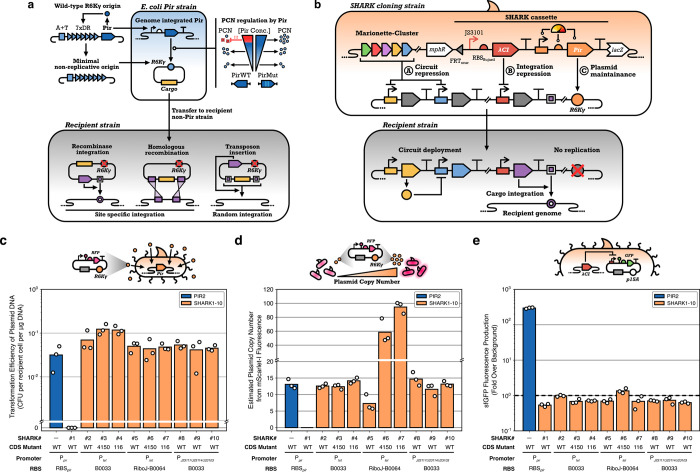
All R6K vectors are derived from the γ-origin of the wild-type R6K plasmid,? where the vegetative region, oriV (A+T rich region with 7 direct repeat sequences), is present on the plasmid and the Pi replication gene, pir, is integrated into the host genome (Figurea). By providing the Pir protein in trans, plasmid replication can initiate at oriV and ensure plasmid maintenance. This wild-type system is autoregulatory with the Pir protein forming homodimers at high concentrations. This causes the protein to become inactive and unable to support plasmid replication. Expression of the Pir protein, therefore, has to be carefully regulated within these strains. To overcome this issue, “copy-up” mutants of the Pir protein have been created that do not display this inhibition and can maintain R6K vectors at elevated copy numbers. ?,?
Overview of the SHARK strain design. (a) Nonreplicative R6K vectors are derived from the γ origin of replication of the wild-type R6K plasmid. This origin consists of a A+T rich region (DNA replication initiation site), 7 direct repeats (7xDR, Pir monomer binding sites), and an autoregulating pir gene. The vegetative components of R6Kγ form the minimal nonreplicative origin, which can only be maintained in E. coli strains with a genomically integrated pir gene. Mutant pir genes have also been used that elevate the plasmid copy number. Genetic circuit schematics shown using Synthetic Biology Open Language (SBOL) Visual symbols. (b) SHARK strains are built on the Marionette-Clo strain, a DH10B derivative with 12 evolved inducible transcription factors in the genome. SHARK strains express a Pir protein to maintain R6K plasmids and a λCI protein to repress plasmid genes (e.g., those involved in plasmid integration into the genome). (c) Transformation efficiency of PIR2 and SHARK strains with purified miniprepped plasmid DNA with a R6Kγ origin. (d) Estimated R6K plasmid copy number in PIR2 and SHARK strains. (e) sfGFP fluorescence from a plasmid where sfGFP protein expression is driven by a λ-promoter from a p15A plasmid. The dashed line denotes the cell autofluorescence level. PIR2 results are shown in blue, and SHARK results are shown in light orange.
Numerous specialized E. coli strains, simply called Pir strains, have been created for R6K plasmid maintenance. These can be purchased commercially (e.g., Invitrogen One Shot PIR series and Lucigen TransforMax EC100D series), are available from culture collections (e.g., BW29427, S17–1λpir,? MFDpir,? HB101−λpir?), or can be directly requested from research groups (e.g., DH5Apir,? CC118/MV1190,? DIAL?). However, many of them were developed several decades ago from base strains with unclear backgrounds, and their performance for typical cloning tasks is not known. For example, we have personally observed low transformation efficiencies and plasmid instability when using a commercial Pir strain (PIR2) for cloning genome engineering plasmids.? In contrast, no such issues were seen for another E. coli strain, DH10B, which we use commonly for complex cloning tasks. ?,?
In this work, we address this issue by developing a set of DH10B derived Pir strains called SHARK (Specialized Hosts for Assembling R6K plasmids). SHARK strains are specifically built from Marionette-Clo,? an E. coli DH10B derivative with 12 inducible transcription factors integrated into its genome. To adapt this strain for working with R6K plasmids, we integrated various Pir expression cassettes into its genome. These cassettes explored different combinations of promoter strength, ribosome binding site (RBS) strength, and Pir protein coding sequences. We find that the vast majority of our strains are able to successfully maintain R6K plasmids, and comparisons of one of our best performing strains (SHARK2) to a commercial variant (PIR2, Invitrogen) showed that transformation efficiencies of plasmid assembly reactions in SHARK2 were at least 132-fold higher. Furthermore, our SHARK strains contain a constitutively expressed λCI protein, thereby providing unconditional and tight repression of genes commonly found on genome engineering plasmids and reducing the chance of activation of these systems during cloning. Overall, our results show that SHARK strains can support the cloning of larger and more complex R6K plasmids for diverse applications requiring the transient delivery of genetic cargoes.
Results
Design
and Construction of SHARK Strains
As a foundation for our SHARK strains, we opted for the widely used E. coli DH10B strain due to its high transformation efficiency and ability to work with large plasmids. ?,? In particular, we built all of our SHARK strains from Marionette-Clo,? a derivative of DH10B that also contains a set of 12 inducible transcription factors integrated into its genome. This allows for repression of a broad range of cargoes and helps to reduce the burden imposed on the host when cloning large plasmids containing complex genetic circuits ?,? (Figureb).
To ensure the stable maintenance of R6K plasmids in our strains, it is essential that the Pir protein is sufficiently expressed. However, Pir cannot simply be overexpressed, as this could result in protein dimerization and a breakdown in plasmid replication. ?,? Optimization of Pir expression was therefore critical for robust R6K plasmid maintenance. As other Pir strains have been made using the wild-type promoter and RBS sequence,? we employed this design for SHARK1 by retrieving these sequences from a previous study.? In addition, we built a number of synthetic designs, SHARK2–7, where we varied features of the Pir transcription unit to systematically alter its expression and reduce our reliance on uncharacterized native regulatory components. We specifically used an inducible P_ tet _ promoter? to enable controlled regulation of transcription (the cognate TetR repressor is provided from the Marionette-Clo genome) and tested a weak B0033 and strong B0064 RBS to regulate translation, with the B0064 RBS also including a RiboJ self-cleaving ribozyme that has been shown to boost translation levels through both stabilization of transcripts and a reduction of structure around the RBS.? We also considered copy-up mutants of the Pir protein coding sequence, including the moderate mutant pir4150 (T108I and P113S)? and the more frequently used pir116 (P106L)? to see if the copy number of R6K plasmids could be controlled.
Each of these different designs for expressing the Pir protein was encoded into SHARK cassettes (Figurec) and placed in pBBR1 plasmids with a FRT-flanked spectinomycin resistance marker to allow for selection and easy removal of the marker using Flp recombinase after genome integration (Supplementary Figure 1). In addition, each cassette also included a λCI coding sequence expressed from a strong constitutive promoter (P_J23101_) and strong ribosome binding sequence (RBS_Bujard_) to provide robust repression of plasmids containing genome integration machinery whose expression is driven by a λ-promoter.?
Once these SHARK cassette plasmids had been built, their cargoes were integrated into the genome of Marrionette-Clo using the λ-RED system.? This system is known to be efficient for small payloads and can be customized to target any site for insertion using short homology arms that are easily added using PCR (Supplementary Figure 1). To simplify this process, we created our own λ-RED plasmid-based system called pREMORAv1 that was used to build every SHARK strain in this study. The pREMORAv1 system consists of a salicylic acid inducible λ-RED operon encoding the β, γ, and exo genes, and a constitutively expressed recA gene, on a low-copy plasmid with a temperature-sensitive pSC101 origin of replication and beta-lactamase selection marker. We targeted the insertion of the SHARK cassettes to the wild-type lacI locus, and post integration, all strains were cured of the spectinomycin selection marker using transient expression of Flp recombinase so that the final SHARK strains were marker-free.
To validate that the SHARK strains were able to maintain R6K plasmids, all designs were made chemically competent and transformed with pR6K-mScarI, an R6Kγ plasmid constitutively expressing the mScarlet-I red fluorescent protein (Figurec). We were initially surprised to find that SHARK1, containing the wild-type promoter, RBS, and pir gene, could not be transformed with pR6K-mScarI. However, upon closer examination of the full sequence of the pir gene from the original study,? we found that the oligo used in later work to create the uidA-pir fusion? was missing 4 nucleotides from the 5*′* of the upper Pir binding inverted repeat (IR) sequence. This may weaken the autoregulation of the pir gene, resulting in low levels of Pir protein expression. In SHARK1, we used the complete P3 Pir promoter sequence from the original study,? which has both intact IR sequences. This may possibly impose a tighter repression of Pir expression.
In our other designs, SHARK2–7, synthetic parts were used to regulate Pir expression, and we further tested different copy-up mutants of the Pir protein coding sequence. We found that all these designs could be transformed with pR6K-mScarI. Interestingly, we also discovered that none required anhydrotetracycline hydrochloride (aTc) induction of Pir expression for plasmid maintenance (Supplementary Figure 3), suggesting that low basal levels of expression from the P_ tet _ promoter were sufficient for R6K plasmid maintenance.
As the inducible function of the P_ tet _ promoter was found to serve no purpose, we decided to create a set of additional strains, SHARK8–10, where P_ tet _ was swapped for one of three weak constitutive promoters (P_J23117_, P_J2314_, and P_J23103_). This would allow the TetR system to be freed for other purposes. We found that all of these new designs could be successfully transformed and were able to maintain the pR6K-mScarI plasmid (Figurec).
Estimating R6K Plasmid Copy Number in SHARK
Strains
To assess the stability of R6K plasmid replication within our strains, we used fluorescence to estimate plasmid copy number ?,? (Figured; Supplementary Figures 3 and 4). Specifically, we compared the relative fluorescence of an mScarlet-I protein from an R6K plasmid (pR6K-mSarI) against a p15A plasmid (p15A-mScarI), which has a well-known copy number of 9 copies per genome ?−? ? (Methods). To improve accuracy, the mScarlet-I protein was designed to be weakly expressed so that the measured signal would be limited by the DNA copy number.
Using this method, we estimated that the commercial PIR2 strain maintains pR6K-mScarI at approximately 13 copies per genome. This closely matches the expected 15 copies per genome reported in the literature.? Even with no addition of aTc, most of the SHARK strains using P_ tet _ to express the Pir protein were able to maintain R6K plasmids at low to medium copy numbers, with SHARK2–4 and SHARK8–10 having estimated copy numbers in the range of 12–15 copies per genome (Table), similar to the PIR2 strain. In contrast, SHARK5 maintained R6K plasmids at a slightly lower copy number of 7 copies per genome, and SHARK6 and SHARK7 maintained plasmids at elevated copy numbers of 59 and 95 copies per genome, respectively. In all cases, we found that R6K plasmids were replicating at a sufficient rate for stable propagation.
1: Strain Designs and Their Estimated R6K Plasmid Copy Numbers
For SHARK strains where the Pir protein was expressed from a P_ tet _ promoter, we also assessed how the R6K plasmid copy number might be affected after P_ tet _ induction with aTc (Supplementary Figure 4). For SHARK2–4, induction with aTc did not affect plasmid copy number, possibly because the B0033 RBS is very weak. In contrast, mixed results were seen for SHARK5–7, which contained a stronger RBS. For SHARK5, which contains the wild-type Pir protein coding sequence, induction with aTc resulted in the loss of the plasmid from the cells. This is expected, as other studies have shown that excessive expression of the wild-type Pir protein causes inhibition of plasmid replication.? For SHARK6 and SHARK7, which contain copy-up mutants of the Pir protein, induction with aTc caused a notable increase in mScarlet-I fluorescence of approximately 1.6-fold for SHARK6 and 1.75-fold for SHARK7 when comparing uninduced and fully induced (100 nM aTc) samples (Supplementary Figure 3). Overall, SHARK7 was the only strain that displayed effective control of the R6K plasmid copy number, allowing it to be varied from approximately 95 to 166 copies per genome.
Genome Integrated
λCI Efficiently Represses Gene Expression from Plasmids
A common use case for R6K plasmids is the transient expression of genetic cargo for genome integration. Many of the plasmids designed for this task make use of temperature-sensitive λCI proteins to enable controlled expression of specific components, e.g., integrase enzymes that integrate the entire plasmid at a target locus. ?,? While working with such systems, like the widely used one-step integration plasmid (OSIP),? we have seen undesired integration of cargoes into cloning strains even though a temperature-sensitive λCI gene is present on the plasmid and cells are cultured at 30 °C. This can be problematic as it makes the plasmid selection marker redundant and destabilizes the plasmid.
To overcome this issue, our SHARK strains include a constitutively expressed λCI protein to ensure a strong repression of λ-promoters. To confirm repression by the genome integrated λCI in our strains, all SHARK strains were transformed with a p15A plasmid containing a λCI regulated promoter driving sfGFP expression, and green fluorescence was measured from cultures. We found that all SHARK strains could successfully repress sfGFP expression to near cell autofluorescence levels (Figuree; Supplementary Figure 5). Of note, despite the pir gene being nonfunctional in SHARK1, the λCI gene functions just as well as in the other SHARK strains. To demonstrate this further, we transformed SHARK1 with a genome integrative plasmid and observed no genome integration, even under conditions where cells were incubated overnight at 37 °C, where the plasmid encoded temperature-sensitive λCI (λCI_ ts _) does not contribute to recombinase inhibition (Supplementary Figure 6). This demonstrates that the genome encoded λCI is sufficiently expressed to fully inhibit even transient expression of the plasmid.
SHARK Is an Efficient Cloning
Strain for Large and Complex DNA Assemblies
The assembly and cloning of plasmids are often bottlenecks in synthetic biology projects. The difficulty of assembling a construct can vary depending on many factors, such as the method of assembly, plasmid size, number of parts, as well as the contents of the assembly itself. To benchmark the performance of our SHARK strains for common cloning tasks, we transformed SHARK2 and the commercially available PIR2 strain with a set of four different assembly reactions: a (i) 4 kb and (ii) 8 kb blunt-end ligation (BEL) reaction, and a (iii) 2-part and (iv) 5-part Golden Gate (GG) assembly reaction (Figurea). These assemblies are representative of the features that typically affect assembly efficiency, i.e., complexity (2-part vs 5-part), plasmid size (4 kb vs 8 kb), and contents of assembly (no cargo vs inducible phage RNA polymerase expression cassette). All of the assemblies tested used the pOSIP-CH plasmid? as a backbone. This is a genome integration vector containing an R6Kγ origin of replication and a recombinase gene whose expression is regulated by a λCI repressor.
Transforming SHARK2 and the commercial PIR2 strain with cloning assembly reactions. (a) SHARK2 and PIR2 were transformed with four cloning assembly reactions testing a combination of assembly sizes (4 and 8 kb) and assembly complexity (2-part and 5-part) for two different types of cloning reactions (Blunt-End Ligation, BEL, and Golden Gate assembly, GG). All the assembly reactions were performed using the pOSIP-CH plasmid backbone, a suicide vector designed for E. coli genome engineering. (b) Transformation efficiencies of SHARK2 and the commercial PIR2 strains were calculated and reported as CFU per recipient cell. PIR2 results are shown in blue, and SHARK2 results are shown in light orange. Each point indicates the transformation of a single aliquot of competent cells from the same respective batch of cell preparation.
Experiments showed that SHARK2 had a higher transformation efficiency than that of PIR2 for all assembly reactions tested (Figureb). For the simpler assembly reactions of 4 kb BEL and 2-part GG, SHARK2 had approximately 484-fold and 132-fold higher transformation efficiencies than PIR2, respectively. For the more difficult assemblies of 8 kb BEL and 5-part GG, PIR2 did not produce any transformants for most of the transformation reactions, while numerous transformants were seen for SHARK2. Comparing the simple and difficult assemblies for SHARK2 alone, there was a notable 6.7-fold drop in transformation efficiency between 4 kb vs 8 kb BEL assemblies, and a 20-fold drop between 2-part GG and 5-part GG, highlighting the increased challenge of working with these larger and more complex assemblies.
Discussion
In this work, we have presented the design and construction of a series of E. coli Pir strains called SHARK that are capable of maintaining and efficiently being transformed with R6K plasmids. Out of the 10 SHARK strains constructed, 9 were capable of robust maintenance of R6K plasmids at either low/medium (SHARK2–5 and SHARK8–10) or high (SHARK6–7) copy numbers (Figure), and we showed that one of our best performing strains (SHARK2) could be effectively transformed with large and complex plasmid assembly reactions that often lead to no colonies in a commercially available Pir strain (Figure). All SHARK strains also included a genome integrated λCI gene, which we showed was capable of effectively silencing plasmid-based gene expression from λ-promoters.
Given our results, we recommend SHARK2 or SHARK8 for routine cloning tasks. Both of these strains have identical designs, except the promoters driving expression of the Pir protein are P_ tet _ and P_J23117_, respectively. SHARK2 and SHARK8 maintain R6K plasmids at medium copy numbers of 13 and 15 copies per genome, respectively, which is useful when cloning large constructs, or if the plasmid expresses burdensome or toxic genes. If higher plasmid yields are required, we recommend SHARK6 or SHARK7, as these strains maintain plasmids at higher copy numbers of 59 and 95 copies per genome, respectively, with copy number also able to be increased by 1.75-fold through further induction with aTc (Supplementary Figure 3). A by product of this work was the finding that very little Pir protein is required for the robust replication of R6K plasmids. Even basal expression from the P_ tet _ promoter and the use of a weak B0033 RBS was sufficient to produce a sufficient concentration of Pir protein within a cell (Figured).
A key benefit of using SHARK over other Pir strains is its ability to handle large and complex plasmid assemblies. We demonstrated this using a variety of plasmid assembly reactions and showed over 2-orders of magnitude higher efficiencies for SHARK2 over the commercially available PIR2 strain (Figure). This efficiency is essential when working with large combinatorial libraries, as well as large multiunit genetic circuits. Furthermore, these types of application are seeing growing interest, with R6K vectors being used for creating cross-species genetic libraries, ?−? ? ? and even cross-kingdom applications. ?,?
Beyond the use of R6K plasmids as a host for transient genetic cargoes, the small size of the R6Kγ origin (∼390 bp) and its lack of any function once delivered to a target cell makes these plasmids an ideal foundation for testing synthetic origins of replication. For example, using LLMs to generate potential sequences,? which can then be tested to create new tools or uncover mechanisms of DNA replication and feedback control.
As interest continues to grow around genome engineering and the integration of large and complex genetic circuits into a wider variety of organisms, our SHARK strains provide a robust and versatile chassis to support these ambitions, overcoming existing plasmid assembly and propagation bottlenecks.
Methods
Strains and Media
Initially, E. coli NEB 10-beta cells (New England Biolabs, C3019H) were used for cloning all non-R6K plasmids, i.e., SHARK cassette plasmids (Supplementary Figure 1a), and One Shot PIR2 cells (Invitrogen, C111110) were used for cloning R6K plasmids, i.e., pR6K-mScarI used in (Figured,e). Once SHARK2 was created and its function was confirmed, it was then used for all subsequent cloning in this work. All SHARK strains are a derivative of Marionette-Clo (strain sAJM.1504), which was a gift from Christopher Voigt (Addgene plasmid No. 108251).? Lysogeny Broth Miller (LB; Sigma-Aldrich L3522) was used for routine culture preparation for plasmid DNA extractions using the Monarch Spin Plasmid Miniprep Kit (New England Biolabs, T1110); LB Miller with agar (Sigma-Aldrich, L3147) was used for all solid media cultures; Super Optimal Broth (SOB; VWR J906-500G) was used for cell cultures when preparing heat-shock chemical competent cells; M9-glucose (1X M9 salts, Sigma-Aldrich M6030; 0.25 mg/mL thiamine hydrochloride, Sigma-Aldrich T4625; 2 mg/mL casamino acid, VWR J851; 4 mg/mL glucose, Sigma-Aldrich G7528; 2 mM magnesium sulfate, Sigma-Aldrich M2643; 100 μM calcium chloride, Sigma-Aldrich C1016) was used for all fluorescence quantification experiments. Antibiotics were used at the following concentrations: Kanamycin (Kan; Sigma-Aldrich, K1637) 50 μg/mL, Chloramphenicol (Cam; Sigma-Aldrich C0378) 34 μg/mL, Spectinomycin (Spec; Sigma-Aldrich S4014) 50 μg/mL, and Carbenicillin (Carb; Sigma-Aldrich C1389) 100 μg/mL. All antibiotics were stored as 1000X working stocks in either 50% glycerol (Kan, Spec, Carb) or 100% ethanol (Cam). Anhydrotetracycline hydrochloride (aTc; Merk 37919) was used to induce SHARK2–7 (Supplementary Figure 3) at the following final concentrations: 0, 1, 2.5, 5, 10, 25, and 100 nM. Salicylic acid (Salicylate; Sigma-Aldrich, 247588) was used to induce the λRED operon at a final concentration of 100 μM.
Heat-Shock Chemical Competent
Cell Preparation
All heat-shock chemical competent (HSCC) cells were prepared in SOB media, and all 37 °C incubation steps were done in a New Brunswick Innova 42 shaking incubator (Eppendorf, M1335-0002). Competent cell batches were prepared in either 5 mL volumes in 14 mL polystyrene culture tubes (StarLabs, I1485-2810) for Figured,e, 50 mL volumes in 250 mL nonbaffled conical flasks for Figureb, or 200 mL cultures split across four 250 mL nonbaffled conical flasks with 50 mL cultures each for Supplementary Figure 1a. For as high an efficiency as possible, it is best to keep tubes and reagents on ice as much as possible throughout the protocol. Specific instructions for λRED competent cell preparation are detailed later.
Regardless of volume size, the HSCC protocol was as follows. Strains to be made competent were streaked out from glycerol stocks onto nonselective LB agar plates and incubated overnight at 37 °C. The following day, a single colony for each strain was inoculated into 2 mL of SOB in 14 mL polystyrene culture tubes and incubated overnight at 37 °C with shaking at 250 rpm. The following day, the overnight cultures were diluted 1:1000 into 5, 50, or 200 mL of fresh SOB media and cultured for 3 h at 37 °C, shaking at 250 rpm. At 3 h, the cultures were placed in a ice bath for 20 min; the large ≥50 mL cultures were aliquoted to 50 mL tubes then placed in the ice bath. The cell cultures were then pelleted in a prechilled centrifuge (Eppendorf, Centrifuge 5910 Ri) by spinning at 4000×g for 10 min. The supernatant was discarded, and the cell pellets were resuspended in refrigerated 100 mM calcium chloride solution; first 1 mL CaCl_2_ was used to resuspend the pellet by gentle pipetting, then the cell suspension from the 5 mL culutre volumes were transferred to prechilled 1.5 mL microfuge tubes. Meanwhile, a further 20 mL of cold 100 mM CaCl_2_ solution was added to each of the 50 mL culture tubes. These cell suspensions were incubated on ice for 20 min. Next, the cell suspensions in the 1.5 mL microfuge tubes were pelleted by centrifugation for 1 min at 6000×g, the supernatant was pipetted out and discarded and the cell pellet was resuspended in 120 μL of cold 100 mM CaCl_2_ with glycerol at 15*%*. Larger cell suspensions were pelleted by centrifugation at 4000×g for 10 min. The supernatant was discarded, and the cell pellets were resuspended in cold 100 mM CaCl_2_ with 15% glycerol. All these cell pellets were pooled into one volume approximately 1/200 of the original culture volume (i.e., 200 mL of cell culture would be concentrated into 1 mL). Regardless of the original culture size, all HSCC cells were split into 20 μL aliquots that were placed in prechilled PCR tubes (StarLab, A10402-3700;), which were then stored in a −80 °C freezer for at least one night before use.
Heat Shock Transformations of E. coli Cells for Colony Forming Unit Counting
All heat shock transformations were performed in a Bio-Rad C1000 Touch Thermal Cycler (Bio-Rad, 1851148) using the following protocol; 20 min at 0 °C, 1 min at 42 °C, 3 min at 0 °C, infinite-hold at 25 °C. For Figured–f, 20 ng of purified pR6K-mScarI minipreped DNA was transformed, and for Figureb 1.66 μL from a 10 μL cloning assembly reaction mix was used for transformations. Post heat-shock, the transformed cells were transferred to 200 μL of SOC (SOB with 0.2% glucose) in a 1.5 mL microfuge tube and then incubated in a Eppendorf ThermoMixer C (Eppendorf, 5382000031) set to 37 °C (Figured–f) or 30 °C (Figureb) for 1 h, shaking at 900 rpm. Post recovery, the cultures were serial diluted through seven 10-fold steps, and 5 μL of each dilution spotted onto selective (Kan or Cam) and nonselective plates. These plates were incubated overnight at 37 or 30 °C, as appropriate, and were imaged using a Bio-Rad GelDoc Go Gel Imaging System (Bio-Rad, 12009077) for colony forming unit (CFU) counting the following morning. CFUs were counted from images taken of the plates (example in Supplementary Figure 3) and the following formula was used to determine transformation efficiency:
Here, d is the dilution factor at which colonies are counted, and m is the DNA mass in ng units, reporting transformation efficiency in units of CFU per recipient cell per μg of transformed DNA. For Figureb, efficiency calculations are not normalized to a specific DNA quantity as this is not known; therefore, transformation efficiency is reported as CFU per recipient cell.
Construction of SHARK Strains with λRED
A custom λRED plasmid was created, called pREMORAv1, by placing the β, γ and exo operon under the regulation of a salicylic acid inducible promoter on a temperature sensitive plasmid, pSC101TS that also contains a beta-lactamase gene for antibiotic selection (ampR). A recA gene with a unregulated P_ lexA _ promoter was also placed on pREMORAv1, enabling in vivo recombination in recA ^–^ strains, such as DH10B. The λRED operon and recA were taken from pREDCas9, a gift from Tao Chen (Addgene plasmid No.71541);? the salicylic acid inducible promoter and transcription factor were from pAJM.771, a gift from Christopher Voigt (Addgene plasmid No.108534),? and the pSC101TS backbone was from pE-FLP, a gift from from Drew Endy and Keith Shearwin (Addgene plasmid No. 45978).? pREMORAv1 was constructed using Golden-Gate cloning and was assembled in two steps; first the λRED operon and P_ lexA _-recA gene were placed under PSalTTC regulation on pAJM.771, this plasmid has a p15A-Kanamycin backbone. Then, the origin and selection marker were changed to that of pSC101TS-ampR for easy curing post recombination.
Each SHARK design was first cloned onto a replicative pBBR1 plasmid with an FRT flanked SpecR resistance marker. This vector was created from various components and the full plasmid sequence can be found in Supplementary Data 1. The λCI transcription unit and SHARK1-Pir transcription unit were first cloned individually into p15A-Kan vectors, and then these were combined onto one pBBR1-SpecR-FRT vector in a second round of Golden-Gate assembly. All the parts for the λCI and pir genes were taken from the CIDAR MoClo Extension Volume I kit, a gift from Richard Murray (Addgene kit No. 1000000161), except the wild-type Pir promoter and RBS, which were ordered as oligos and annealed to use for the Golden-Gate assembly. For SHARK2–7, the promoters and RBSs were modified using Golden-Gate, with oligo annealed parts for P_ tet _ and B0033, and a PCR amplified fragment was used for RiboJ-B0064. The CDSs were modified by using PCR mediated site-directed mutagenesis and BEL. The SHARK8–10 designs were created by PCR mediated site-directed mutagenesis of SHARK2 to swap the P_ tet _ promoter to a weak constitutive promoter (P_J23117_, P_J23114_ and P_J23103_). Fully annotated plasmid sequences can be found in Supplementary Data 1.
For integrating the SHARK cassettes into the E. coli Marionette-Clo genome, cells transformed with pREMORAv1 were made HSCC using the protocol described earlier; however, with 2 key changes; the cells were incubated at 30 °C as the plasmid is temperature sensitive, and the optical density at 600 nm (OD600) was monitored so that the culture could be induced with 100 μM salicylate at and OD600 of 0.5 to activate the λRED operon. The culture was then further incubated shaking at 30 °C for 30 min before proceeding to the incubation on ice step of the protocol.
All SHARK cassettes were PCR amplified using Q5 High-Fidelity 2X Master Mix (New England Biolabs, M0492) in 50 μL reactions with 10 ng of template plasmid DNA. PCRs was performed in a C1000 Touch Thermal Cycler (Bio-Rad, 1851148) for 25 cycles. The DNA template was digested away using Dpni (New England Biolabs, R0176) by adding 1 μL of the enzyme directly to the reaction mix and then incubating at 37 °C for 1 h. The reaction mix was then run on an agarose gel by electrophoresis, and the DNA band extracted using a Monarch Spin DNA Gel Extraction Kit (New England Biolabs, T1120), following manufacturer’s guidelines. After purification, 200 ng of linear DNA was used for heat shock transformation into λRED competent Marionette-Clo cells. Post transformation, the cells were recovered at 37 °C and were plated on spectinomycin selection plates and incubated overnight at 37 °C. The following day, 6–8 single colonies for each SHARK design were passaged onto new spectinomycin selection plates to ensure single clone isolation and further dilution of pREMORAv1 from the population. The following day, colony PCR was conducted to ensure genome integration of the cassette, then a single colony for each SHARK strain was inoculated into 2 mL SOB with spectinomycin and cultured overnight at 37 °C shaking at 250 rpm. The following day, the SHARK strain was made chemical competent in a 5 mL culture volume and the cells transformed with 50 ng of miniprepped pE-FLP DNA. Cells were then incubated at 30 °C to maintain the temperature sensitive plasmid, and carbenicillin used for selection. The following day, a single colony for each SHARK strain was passaged on a new carbenicillin plate to ensure curing of the selection marker from the genome. The following day, a single colony was inoculated into 200 μL of LB media and cultured in a Eppendorf ThermoMixer C (Eppendorf, 5382000031) at 42 °C for 2 h, then 37 °C for 6 h. At the end of the day, the culture was streaked out onto nonselective LB agar plates. The following day, a single colony was picked to be the final SHARK strain used in all subsequent experiments. A final colony PCR was conducted to ensure successful curing of the selection marker (Supplementary Figure 1b).
Cloning Methods
PCR amplicons for cloning purposes and λRED were amplified using Q5 High-Fidelity 2X Master Mix (New England Biolabs, M0492) and run on agarose gels for DNA band separation and extraction using a Monarch Spin DNA Gel Extraction Kit (New England Biolabs, T1120). Colony PCRs were done using OneTaq Quick-Load 2X Master Mix (New England Biolabs, M0486). Plasmids were built using either Golden-Gate assembly or BEL for site-directed mutagenesis. BsaI-HFv2 (New England Biolabs, R3733S, 20,000 units/mL) and T4 DNA ligase (New England Biolabs, M0202S, 400,000 units/mL) were used for all Golden-Gate reactions. Each reaction was set to a total volume of 10 μL containing 40 fmol of DNA for the recipient backbone, 80 fmol of DNA for each insert, 1 μL BsaI-HFv2, 1 μL T4 DNA ligase, 1 μL T4 DNA ligase buffer, and water. The Golden-Gate reactions were incubated for 1 h at 37 °C in a standard incubator. For BEL cloning reactions, each reaction was set to a total volume of 10 μL containing 200 ng of PCR amplified linear DNA, 1 μL T4 DNA ligase, 1 μL T4 polynucleotide kinase (New England Biolabs, M0201L, 10,000 units/mL), 1 μL T4 DNA ligase buffer and water. The BEL reactions were incubated for 1 h at 37 °C in a standard incubator. For regular cloning reactions, 5 μL of the reaction mix was used to transform the chemically competent E. coli cloning strain, but only 1.66 μL was used to transform each competent cell aliquot for experiments presented in Figureb.
Microplate
Reader Experiments
All microplate reader experiments were conducted in a SpectraMax iD5Multimode Microplate Reader (Molecular Devices) in 96-well flat-bottom Sterilin Microtiter Plates (STERLIN, 734-0482). For all experiments, E. coli cells were transformed fresh with the respective plasmids of interest. Untransformed E. coli cells were also streaked out to be used for positive controls for growth and for subtracting cell autofluorescence in the analysis, where relevant. Three colonies from each strain of interest were inoculated into 200 μL of M9-glucose media in 2 mL square-well 96-well deep-well plates (Merck, AXYP2MLSQC); the media contains the relevant antibiotics but no inducers unless relevant. All deep-well 96-well plates were sealed with a breathable membrane (Starlab E2796-3015) and incubated at 37 °C in a plate shaker (Stuart SI505 Microtiter Plate Shaker Incubator) set to 750 rpm for 16–18 h overnight. The following morning, the cultures were diluted 200-fold by transferring 1 μL from the overnight wells to 200 μL of fresh media of the same conditions, also set up in deep-well plates. These diluted cultures (referred to as precultures) were also incubated at 37 °C in a plate shaker set to 750 rpm, but for only 3 h. After 3 h, the precultures were diluted 400-fold by transferring 0.5 μL into 200 μL of fresh media in a 96-well flat-bottom Sterilin Microtiter Plates (STERLIN, 734-0482); this media contained the relevant inducer conditions. For every plate-reader experiment, three “blank” wells were set up of M9-glucose media with no inoculant. The microplate was then loaded into a SpectraMax iD5Multi-Mode Microplate Reader (Molecular Devices). The plate reader was set to take the following measurements every 10 min for a total of 15 h; optical density at 700 nm (OD700), green fluorescence (excitation at 485, emission at 515 nm, with a sensitivity gain of 500 au), and red fluorescence (excitation at 565, emission at 610 nm, with a sensitivity gain of 750 au).
Microplate Reader Data Analysis for Plasmid Copy Number Estimation
and sfGFP Repression
All plate reader data was exported as a text file from the SpectraMax iD5 instrument software and converted to a CSV format for analysis using Python. Raw data was preprocessed by first subtracting the background absorbance and autofluorescence from the designated “blank” wells. Then a “hard” lower-bound threshold was set for all OD700 values (i.e., all OD700 measurements that were below the threshold were set to the threshold value). This was done because the cell density for the first few hours of the experiment was below the detection limit of the plate reader, generating a lot of noise, and subtracting the blanks caused some negative OD700 values, which are problematic for growth rate analysis. Setting a hard lower-bound threshold mitigated these issues for subsequent rate analysis steps. For each experiment, the lower-bound threshold was set to a twenty fifth of the value of the maximum OD700 measured for the designated positive growth control wells. The fluorescence data did not require thresholding like that for OD700. The absorbance and fluorescence values were further processed by running a smoothing function (6-window moving average for each well) to reduce noise and the occurrence of sharp peaks in the subsequent analysis steps. Cell growth rate (h^–1^) and fluorescence production rate per cell (OD700) were calculated for each well using
Fluorescence production rate at maximum growth rate was used to estimate the plasmid copy number (Supplementary Figure 4) and report sfGFP expression (Supplementary Figure 5). Plasmid copy number was estimated by dividing mScarlet-I expression from cells carrying pR6K-mScarI by cells carrying p15A-mScarI, then multiplying that value by 9 ?−? ? to get estimated plasmid copy number per genome. sfGFP fluorescence expression reported in Figuree is normalized to nonfluorescent cells. Representative data for growth and fluorescence curves are presented in Supplementary Figure 7.
Computational Tools
Microsoft Excel 2025 was used to tabulate and calculate all reported values for the CFUs and transformation efficiencies. All microplate reader analysis and graphing of figures were done using custom scripts in Python, version 3.9.7, and using the Jupyter Lab interface, version 3.2.1. All diagrams and figure panels were assembled by using Inkscape version 1.4.2.
Plasmid and
Strain Availability
The following plasmids and strains are available from Addgene: pR6K-mScarI (#248166), pPRO1O2-GFP (#248167), pSHARK2 (#248168), pSHARK6 (#248169), pSHARK7 (#248170), pSHARK8 (#248171), pREMORAv1 (#248172), SHARK2 (#248173), SHARK6 (#248174), SHARK7 (#248175), and SHARK8 (#248176).
Supplementary Material
The reference list from the paper itself. Each links out to its DOI / PubMed record.
- 1Lazarus J. E.Warr A. R.Kuehl C. J.Giorgio R. T.Davis B. M.Waldor M. K.Elkins C. A.Appl. Environ. Microbiol.20198516 e 00990-1910.1128/AEM.00990-1931201277 PMC 6677854 · doi ↗ · pubmed ↗
- 2Lampe G. D.King R. T.Halpin-Healy T. S.Klompe S. E.Hogan M. I.Vo P. L. H.Tang S.Chavez A.Sternberg S. H.Nat. Biotechnol.2024421879810.1038/s 41587-023-01748-136991112 PMC 10620015 · doi ↗ · pubmed ↗
- 3Haldimann A.Wanner B. L.J. Bacteriol.2001183216384639310.1128/JB.183.21.6384-6393.200111591683 PMC 100134 · doi ↗ · pubmed ↗
- 4St-Pierre F.Cui L.Priest D. G.Endy D.Dodd I. B.Shearwin K. E.ACS Synth. Biol.20132953754110.1021/sb 400021 j 24050148 · doi ↗ · pubmed ↗
- 5Wang G.Zhao Z.Ke J.Engel Y.Shi Y.-M.Robinson D.Bingol K.Zhang Z.Bowen B.Louie K.Wang B.Evans R.Miyamoto Y.Cheng K.Kosina S.De Raad M.Silva L.Luhrs A.Lubbe A.Hoyt D. W.Francavilla C.Otani H.Deutsch S.Washton N. M.Rubin E. M.Mouncey N. J.Visel A.Northen T.Cheng J.-F.Bode H. B.Yoshikuni Y.Nature Microbiology 20194122498251010.1038/s 41564-019-0573-831611640 · doi ↗ · pubmed ↗
- 6Martínez-García E.Calles B.Arévalo-Rodríguez M.de Lorenzo V.BMC Microbiol.20111113810.1186/1471-2180-11-3821342504 PMC 3056738 · doi ↗ · pubmed ↗
- 7Crépin S.Harel J.Dozois C. M.Appl. Environ. Microbiol.201278176001600810.1128/AEM.00986-1222706059 PMC 3416591 · doi ↗ · pubmed ↗
- 8Vo P. L. H.Ronda C.Klompe S. E.Chen E. E.Acree C.Wang H. H.Sternberg S. H.Nat. Biotechnol.202139448048910.1038/s 41587-020-00745-y 33230293 PMC 10583764 · doi ↗ · pubmed ↗