Regioselective C2-Sulfonylation of Indoles and Pyrroles via SO2 Insertions
Rekha Bai, Wan-Lin Cheng, Chun-Yu Peng, Yu-Hao Chen, Pin-Han Wang, Chin-Fa Lee

TL;DR
A new chemical method efficiently creates C2-sulfonylated indoles and pyrroles using a cascade reaction under mild conditions.
Contribution
A novel cascade reaction using molecular iodine catalysis and DABSO as an SO2 source for regioselective sulfonylation.
Findings
The reaction provides C2-sulfonylated indoles and pyrroles in good to excellent yields.
The cascade proceeds via an arylsulfonyl radical intermediate under mild conditions.
The method shows a broad substrate scope and sustainability.
Abstract
A molecular iodine-catalyzed three-component cascade reaction of indoles/pyrroles, anilines, and DABSO has been developed, providing C2-sulfonylated indoles/pyrroles in good to excellent yields. The transformation proceeds via the in situ generation of the arylsulfonyl radical from the reaction of anilines, t BuONO, and DABSO, followed by controlled formation of a carbon-centered radical intermediate. In this radical-mediated cascade reaction, DABSO acts as the sulfone (SO2) source while t BuONO facilitates the generation of reactive species. Moreover, this one-pot transformation proceeds under mild conditions, exhibits a broad substrate scope, and offers an efficient and sustainable strategy for the construction of C2-sulfonated indoles and pyrroles.
Genes, proteins, chemicals, diseases, species, mutations and cell lines named across the full text — each resolved to its canonical identifier and authoritative record.
Click any figure to enlarge with its caption.
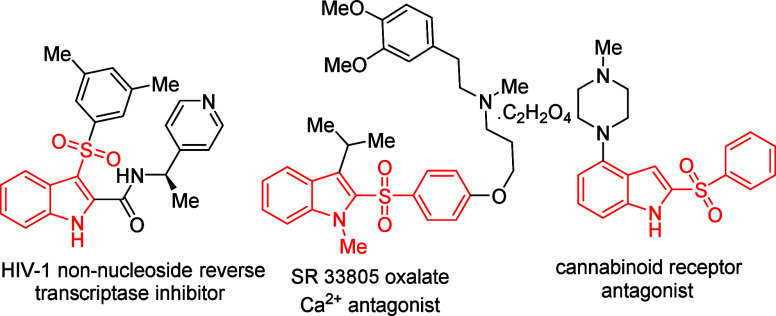 Figure 1
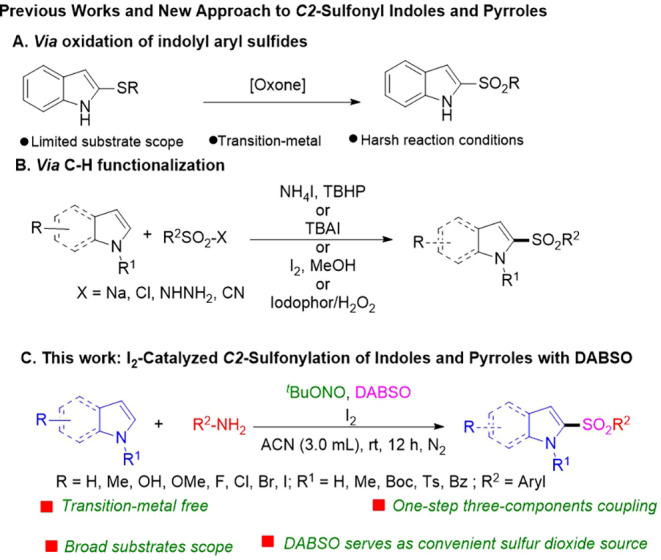 Figure 2
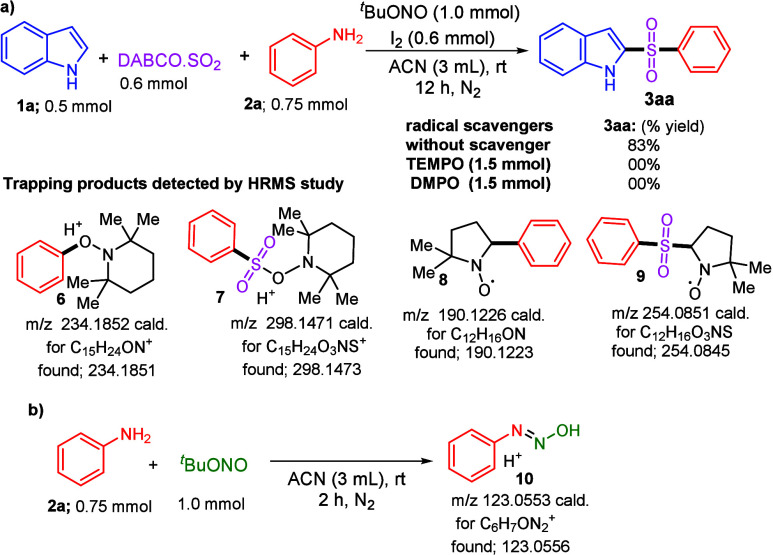 Figure 3
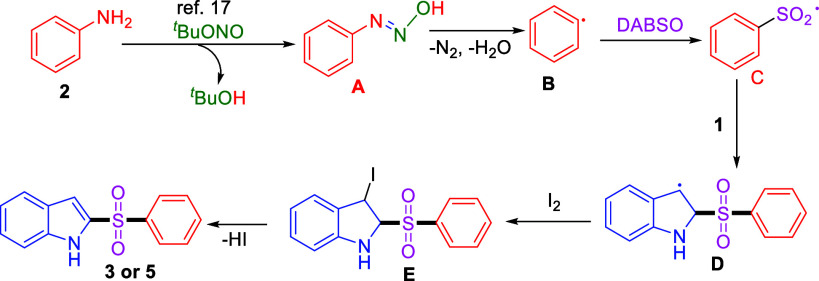 Figure 4
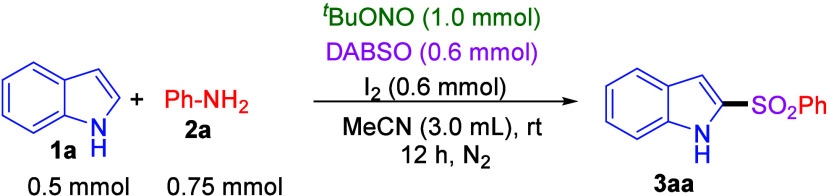 Figure 5
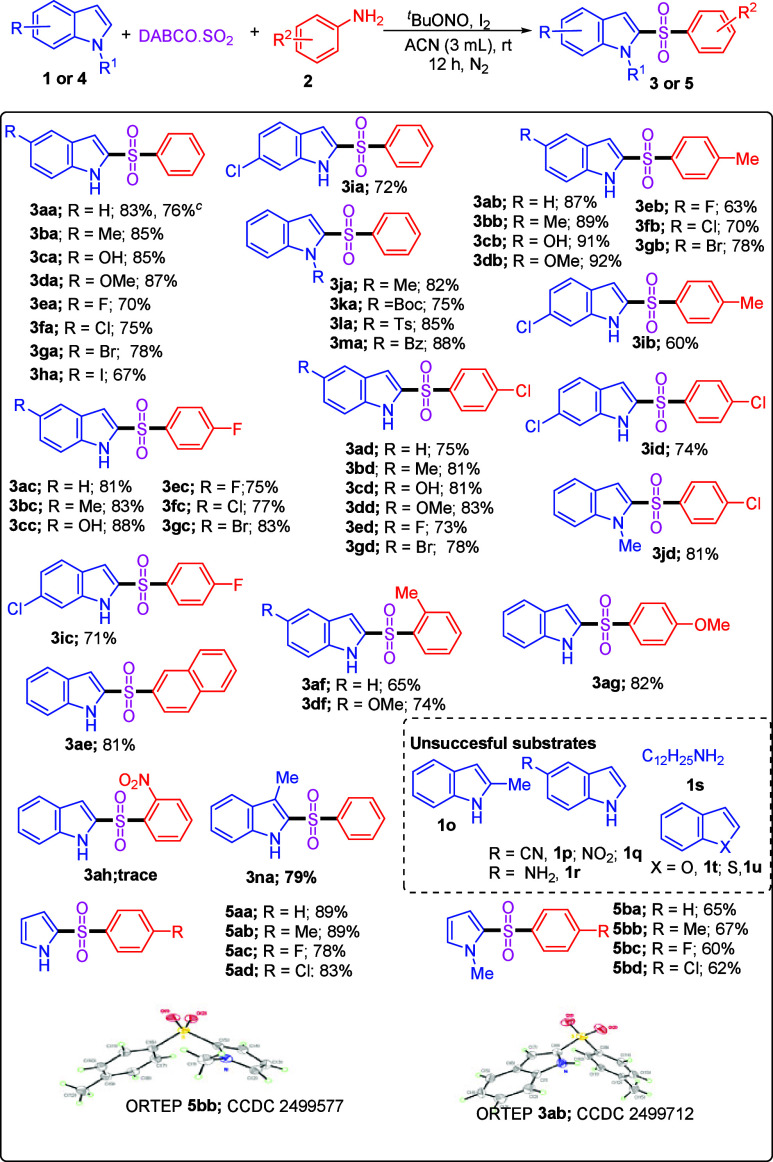 Figure 6
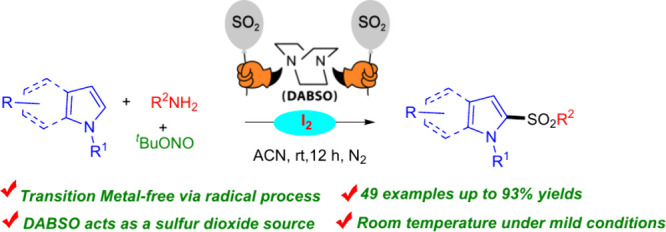 Figure 7
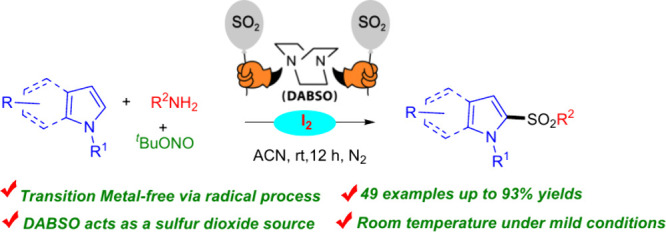 Figure 8
- —Science and Engineering Research Board10.13039/501100001843
- —National Chung-Hsing University10.13039/501100004946
- —National Science and Technology Council10.13039/501100020950
- —Ministry of Education, TaiwanNA
Peer Reviews
No public reviews on file for this paper yet. If you reviewed it on a platform where reviews are public (OpenReview, ICLR, NeurIPS, ICML), you can paste yours below so the community can read it here.
Videos
No videos yet. Explain this paper in a talk, walkthrough, or lecture? Add one.
Taxonomy
TopicsSulfur-Based Synthesis Techniques · Radical Photochemical Reactions · Catalytic C–H Functionalization Methods
Multicomponent reactions (MCRs) involve the combination of three or more starting materials in one pot, efficiently incorporating most atoms from the reactants into the final products.? Recently, sulfur dioxide insertion-based multicomponent reactions have attracted a considerable amount of attention as efficient one-pot strategies for the synthesis of organosulfones.? These transformations are highly appealing due to their straightforward, single-step construction of sulfonyl-containing compounds.? Traditionally, gaseous SO_2_ was commonly used as the sulfur dioxide source; however, its toxic and corrosive nature limits its practical use in academic laboratories.? To overcome this disadvantage, the development of stable and user-friendly sulfur dioxide surrogates has received much attention in recent years. Various SO_2_ surrogates such as DABSO, Na_2_S_2_O_5_, K_2_S_2_O_5_, rongalite, thiourea, and SOgen have been reported over the past decade. ?,? Among them, the 1,4-diazabicyclo[2.2.2]octane bis(sulfur dioxide) adduct (DABSO), which is bench stable, solid, and easy to handle, has emerged as a safer and more convenient alternative, serving as an efficient surrogate for SO_2_.? Owing to these advantageous properties, it is widely employed for the synthesis of sulfur-containing compounds under mild reaction conditions, including sulfones,? sulfonyl halides, ?,? sulfonohydrazides,? sulfonic esters,? and sulfonothioesters, among others.?
Organosulfones represent a valuable class of organic compounds, widely used both as synthetic intermediates and as final bioactive products in pharmaceuticals and agrochemicals.? They were also employed as protecting and activating groups in various synthetic transformations. In particular, heteroaryl (indoles or pyrroles) sulfones have attracted a significant amount of attention because of their broad spectrum of biological activities, including anti-HIV-1, antibacterial, antifungal, and antitumor properties (Figure).?
Indoles have long been a central focus in synthetic organic chemistry due to their widespread occurrence in natural products and pharmaceuticals, along with their notable synthetic versatility.? However, introducing sulfonyl groups, especially at the C2 position of the indole ring, remains challenging, as the C3 position is typically more reactive and thus easily functionalized. While many strategies for sulfonylation at the C3 position exist,? C2-sulfonylation remains less explored and is synthetically demanding. Conventionally, C2-sulfonylindoles have been prepared either by oxidation of indolyl aryl sulfides using Oxone or mCPBA under anhydrous conditions (SchemeA) or through C–H functionalization strategies involving hydrazines, sulfonyl halides, or aryl sulfonic acids as coupling partners (SchemeB). ?,? The groups of Deng,? Kuhakarn,? Zhang,? and Yan? have independently reported the synthesis of C2-sulfonylated indoles using indoles and sodium sulfinates as coupling partners, employing I_2_/TBHP in AcOH, I_2_/MeOH, NH_4_I/TBHP in AcOH, and KI/Oxone as catalyst systems under heating or room-temperature conditions. Additionally, Liu and co-workers? have achieved the synthesis of C2-sulfonylated indoles via the reaction of indoles with hydrazides using an iodophor/H_2_O_2_ system (SchemeB).
The use of molecular iodine and its salt as catalysts in organic transformations has attracted a significant amount of attention due to the growing demand for greener and more sustainable chemical processes. Owing to its ease of handling, commercial availability, mild reactivity, and specifically metal-like behavior, iodine has emerged as a valuable and efficient catalyst for promoting the formation of C–C and C–heteroatom bonds.? Recently, we reported a radical process synthesis of sulfonamides through a reaction of anilines, a nitrite source, and DABSO.? In this transformation, the in situ-generated aryl sulfonyl radical was identified as the key intermediate. Based on these insights, we intended that the indoles and pyrroles might also be utilized as the substrates in the insertion reaction of sulfur dioxide. Herein, we report a novel molecular iodine-catalyzed strategy for the direct C2-sulfonylation of indoles and pyrroles through a three-component C–S coupling reaction involving indoles/pyrroles, anilines, DABSO, and TBN (^ t ^BuONO). In this transformation, the aryl sulfonyl group is introduced through a radical sulfonylation pathway mediated by DABSO (SchemeC). This approach offers several advantages. It is metal-free, employs a stable SO_2_ surrogate, and proceeds in a one-pot manner, making it operationally simple and broadly applicable.
After a series of optimization experiments were performed, the optimal reaction conditions for this multicomponent sulfur dioxide insertion reaction were established as follows: indole (1a, 0.5 mmol), aniline (2a, 0.75 mmol), ^ t ^BuONO (1.0 mmol), DABSO (0.6 mmol), and I_2_ (0.6 mmol) in acetonitrile (3 mL) at room temperature under a nitrogen atmosphere for 12 h. Under these conditions, desired product 2-(phenylsulfonyl)-1H-indole (3aa) was isolated in 83% yield (Table, entry 1). Amendment of the reaction parameters provided the following results. No desired product 3aa was detected in the absence of I_2_ or ^ t ^BuONO (Table, entry 2 or 3, respectively). When KI or NH_4_I was used instead of I_2_, the reaction furnished 3aa in 21% or 58% yield, respectively, (Table, entry 4 or 5, respectively). A trace amount of product 3aa was detected when TBAI was employed instead of iodine (Table, entry 6). The use of inorganic SO_2_ surrogates such as K_2_S_2_O_5_ and Na_2_S_2_O_5_ resulted in no product formation (Table, entries 7 and 8, respectively). Performing the reaction in 1,4-dioxane or DMSO afforded desired product 3aa in only trace or 30% yield, respectively, while DMF and toluene provided 3aa in 63% or 25%, respectively (Table, entries 9–12). Next, other nitrite sources such as isomylONO, ^ n ^BuONO, and NaNO_2_ were examined. IsomylONO and ^ n ^BuONO afforded desired product 3aa in 53% and 49% yields, respectively, whereas NaNO_2_ failed to produce the desired product (Table, entries 13–15). Increasing the amount of iodine to 1.0 mmol or decreasing the reaction time to 8 h did not significantly influence the yield of product 3aa (Table, entry 16 or 17, respectively). Subsequently, when the reaction was conducted using water as the solvent, only a trace amount of product 3aa was detected (Table, entry 18). Furthermore, performing the reaction under an oxygen atmosphere led to the formation of 3aa in only 15% yield (Table, entry 19).
With the optimized reaction conditions established, we next explored the substrate scope of this multicomponent transformation (Table). Initially, the reactivity of various indole derivatives was examined by using aniline 2a, ^ t ^BuONO, and DABSO as coupling partners. Indoles bearing electron-donating substituents at position C5 such as 5-methylindole (1b), 5-hydroxyindole (1c), and 5-methoxyindole (1d) smoothly underwent the transformation with 2a, ^ t ^BuONO, and DABSO, delivering 2-sulfonylindoles 3aa–3da in 83–87% yields. Likewise, indoles, containing electron-withdrawing substituents at positions C5 and C6, i.e., 5-fluoroindole (1e), 5-chloroindole (1f), 5-bromoindole (1g), 5-iodoindole (1h), and 6-chloroindole (1i), were also efficiently reacted with 2a, ^ t ^BuONO, and DABSO under the optimized reaction conditions, affording desired C2-sulfonylated indoles 3ea–3ia, respectively, in 67–78% yields. Additionally, N-methylindole (1j), N-Boc indole (1k), N-tosyl indole (1l), and N-benzyl indole (1m) were also compatible with aniline 2a, providing products 3ja–3ma, respectively, in 75–88% yields. These results clearly demonstrate that the electronic nature and substitution pattern on the indole ring have a minimal influence on the reaction efficiency. Subsequently, the effect of substituents on the aniline moiety was systematically investigated. 4-Methyl aniline 2b smoothly participated in the reaction with various indole derivatives possessing electron-withdrawing and electron-donating groups at position C5 or C6 (i.e., 5-Me, 5-OH, 5-OMe, 5-Cl, 5-Br, 5-F, and 6-Cl). In all of these cases, C2-sulfonylindoles 3ab–3gb and 3ib were obtained in 60–92% isolated yields, highlighting the notable functional group tolerance of this strategy.
Next, we turned our attention toward the electron-deficient anilines like 4-fluoroaniline (2c) and 4-chloroanilines (2d) for this multicomponent reaction. First, 4-fluoroaniline 2c smoothly reacted with electron-rich NH-indole (1a), 5-methylindole (1b), and 5-hydroxyindole (1c) to deliver C2-sulfonylindoles 3ac–3cc, respectively, in 81–88% isolated yields. Indoles bearing electron-withdrawing groups at position C5 or C6 were also smoothly reacted with 2c, ^ t ^BuONO, and DABSO under the standard reaction conditions, delivering 3ec–3gc and 3ic in 71–83% yields. Similarly, 4-chloroaniline (2d) was also compatible with electron-rich and electron-deficient indoles, ^ t ^BuONO, and DABSO, affording desired corresponding C2-sulfonylindoles 3ad–3gd and 3id in 73–83% yields. N-Methylindole (1j) also smoothly reacted with 4-chloroaniline (2d), ^ t ^BuONO, and DABSO, providing 2-((4-chlorophenyl)sulfonyl)-1-methyl-1H-indole (3jd) in 81% yield. Furthermore, we carried out the reaction using NH-indole (1a) and naphthalen-2-amine (2e) under the optimized reaction conditions and successfully afforded desired 2-(naphthalen-2-ylsulfonyl)-1H-indole (3ae) in 81% yield. Similarly, 2-methylaniline (2f) proved to be an effective coupling partner and reacted smoothly with NH-indole (1a) and 5-methoxyindole (1d) in the presence of DABSO and ^ t ^BuONO under the standard reaction conditions, affording products 3af and 3df in 65% and 74% yields, respectively. Subsequently, we tested other aniline derivatives, such as 4-methoxyaniline (2g) and 2-nitroaniline (2h), under the standard reaction conditions. While 3ag was isolated in 82% yield, 3ah was formed only in trace amounts. To further examine the selectivity, reactions of 3-methylindole (1n) and 2-methylindole (1o) with 1a, ^ t ^BuONO, DABSO, and iodine under the standard conditions were carried out. The reaction proceeded smoothly with 3-methylindole, affording desired product 3na in 79% yield, whereas no desired product was obtained from 2-methylindole. Unfortunately, 1o–1u proved to be unsuccessful substrates under these reaction conditions.
Encouraged by this observation, we then extended the scope to pyrrole derivatives. NH-Pyrrole (4a) was efficiently reacted with electron-rich and electron-deficient aniline (2a), p-toluidine (2b), 4-fluoroaniline (2c), and 4-chloroaniline (2d), ^ t ^BuONO, and DABSO, affording products 5aa–5ad, respectively, in 78–89% yields. Similarly, N-methyl pyrrole was also undergoing smooth coupling with aniline (2a), p-toluidine (2b), 4-fluoroaniline (2c), and 4-chloroaniline (2d), efficiently converted into 2-sulfonylated pyrroles 5ba–5bd, respectively, in 60–67% yields under the optimized reaction conditions. Furthermore, to evaluate the efficiency of the reaction on a gram scale, we performed the reaction on a 5.0 mmol scale, which afforded compound 3aa in 76% isolated yield (details in the Supporting Information). The structures of products 3 and 5 were established by ^1^H NMR, ^13^C NMR, and HRMS analysis, while the structures of products 3ab and 5bb ? were further confirmed through single-crystal X-ray diffraction (XRD) analysis (see the Supporting Information).
To gain insight into the reaction mechanism, a series of control experiments were performed using indole (1a, 0.5 mmol), DABSO (0.6 mmol), aniline (2a, 0.75 mmol), and ^ t ^BuONO (1.0 mmol) as model substrates under the optimized reaction conditions in the presence of various radical scavengers (Schemea). The addition of TEMPO (1.5 mmol) to the reaction mixture completely suppressed the formation of desired product 3aa, and instead, TEMPO-trapped radical adducts 6 and 7 were detected by FTMS+ESI, confirming the involvement of radical intermediates. Similarly, when DMPO (1.5 mmol) was added under identical reaction conditions, target product 3aa was not detected; rather, DMPO-trapped adducts 8 and 9 were identified in the FTMS+ESI analysis. In addition, EPR experiments were performed under these conditions, which revealed mixed EPR signals (details in the Supporting Information). Furthermore, a control reaction was conducted to examine the possible interactions between aniline (2a) and ^ t ^BuONO in acetonitrile. FTMS+ESI analysis of this reaction revealed the formation of N-hydroxybenzenediazene (Ph–NN–OH) (10), suggesting the generation of a diazinyl-type radical species (Schemeb). Collectively, these control experiments strongly support that the present multicomponent transformation proceeds via a radical-mediated reaction pathway involving arylsulfonyl radical intermediates.
Based on control experiments and previous literature reports, ? ? ?−?,?,? a possible reaction pathway for this multicomponent SO_2_ insertion reaction is illustrated in Scheme. Initially, ^ t ^BuONO reacts with aniline to form N-hydroxybenzenediazonium A (Ph–NN–OH) and ^ t ^BuOH. This intermediate undergoes homolytic cleavage with release of nitrogen gas and water molecule to generate aryl radical B. The aryl radical then reacts with sulfur dioxide (SO_2_) released from DABSO to give aryl sulfonyl radical C. Instantly, this aryl sulfonyl reacts with indole to produce indolyl radical D. This indolyl radical reacts with iodine and furnishes intermediate E. Subsequent elimination of HI delivers final 2-sulfonylated product 3 or 5.
In summary, we have developed an efficient transition-metal-free, molecular iodine-catalyzed strategy for the regioselective synthesis of C2-sulfonylated indoles and pyrroles via a one-pot three-component reaction of indoles/pyrroles, anilines, ^ t ^BuONO, and DABSO. In this transformation, DABSO serves as the sulfur dioxide source, enabling the in situ formation of the arylsulfonyl radical intermediate through the combination of aryl radical (generated from anilines and ^ t ^BuONO) and sulfur dioxide. Molecular iodine served as an efficient iodide catalyst, while acetonitrile was identified as the optimal solvent. This operationally simple and sustainable protocol features a readily available substrate, mild conditions, a broad substrate scope, and excellent functional group tolerance, affording desired C2-sulfonylated indoles and pyrroles in 60–93% yields. Furthermore, its gram-scale applicability and mechanistic clarity highlight its synthetic utility for constructing biologically relevant sulfonylated heterocycles.
Safety: Caution! All reactions involve the explosive nature of diazo-type intermediates. In our protocol, these intermediates are generated in situ and consumed immediately, preventing their accumulation. All reactions were conducted under dilute conditions behind a safety shield, following standard precautions for handling reactive intermediates.
Supplementary Material
The reference list from the paper itself. Each links out to its DOI / PubMed record.
- 1a Cioc R. C.Ruijter E.Orru R. V. A.Multicomponent reactions: advanced tools for sustainable organic synthesis Green Chem.2014162958297510.1039/C 4GC 00013 G · doi ↗
- 2a Zheng, D. ; Wu, J. Sulfur Dioxide Insertion Reactions for Organic Synthesis; Springer: Singapore, 2017; pp 11–77.
- 3a Blum S. P.Hofman K.Manolikakes G.Waldvogel S. R.Advances in photochemical and electrochemical incorporation of sulfur dioxide for the synthesis of value-added compounds Chem. Commun.2021578236824910.1039/D 1CC 03018 C 34319313 · doi ↗ · pubmed ↗
- 4a Vogel P.Turks M.Bouchez L.Markovic D.Varela Álvarez A.Sordo J. A.New organic chemistry of sulfur dioxide Acc. Chem. Res.20074093194210.1021/ar 700096 h 17685582 · doi ↗ · pubmed ↗
- 5a Seyed Hashtroudi M.Fathi Vavsari V.Balalaie S.DABSO as a SO 2 gas surrogate in the synthesis of organic structures Org. Biomol. Chem.2022202149216310.1039/D 1OB 02199 K 35170616 · doi ↗ · pubmed ↗
- 6a Hoque M. T.Pratihar P.Mandal P. K.Das A.Rahaman R.Maiti D. K.Visible-Light-Sponsored Organophotoredox-Catalyzed Synthesis of Diverse Sulfones from Unsaturated Entities Using DABSO as a SO 2 Source J. Org. Chem.202590147171473110.1021/acs.joc.5c 0188141060263 · doi ↗ · pubmed ↗
- 7a Liu Y.Yu D.Guo Y.Xiao J.-C.Chen Q.-Y.Liu C.Arenesulfonyl fluoride synthesis via copper-catalyzed fluorosulfonylation of arenediazonium salts Org. Lett.2020222281228610.1021/acs.orglett.0c 0048432115957 · doi ↗ · pubmed ↗
- 8a Emmett E. J.Richards-Taylor C. S.Nguyen B.Garcia Rubia A.Hayter B. R.Willis M. C.Palladium-catalysed aminosulfonylation of aryl-, alkenyl-and heteroaryl halides: scope of the three-component synthesis of N-aminosulfonamides Org. Biomol. Chem.2012104007401410.1039/c 2ob 07034 k 22407213 · doi ↗ · pubmed ↗