Safety evaluation of the food enzyme serine endopeptidase from the genetically modified Aspergillus niger strain NZYM‐MG
Holger Zorn, José Manuel Barat Baviera, Claudia Bolognesi, Francesco Catania, Gabriele Gadermaier, Ralf Greiner, Baltasar Mayo, Alicja Mortensen, Yrjö Henrik Roos, Marize L. M. Solano, Henk Van Loveren, Laurence Vernis, Magdalena Andryszkiewicz, Yi Liu

TL;DR
This paper evaluates the safety of a genetically modified enzyme used in alcohol production and concludes it is safe for its intended use.
Contribution
The study provides a safety evaluation of a genetically modified serine endopeptidase enzyme for use in distilled alcohol production.
Findings
The genetic modifications in the enzyme do not pose safety concerns.
The enzyme does not pose a risk of allergic reactions in its intended use.
The enzyme is not expected to remain in the final product due to processing.
Abstract
The food enzyme serine endopeptidase (EC 3.4.21) is produced with the genetically modified Aspergillus niger strain NZYM‐MG by Novozymes A/S. The genetic modifications do not give rise to safety concerns. The food enzyme was considered free from viable cells of the production organism and its DNA. The food enzyme is intended to be used in the processing of cereals and other grains for the production of distilled alcohol. Since residual amounts of food enzyme–total organic solids are removed in this process, toxicological studies were considered unnecessary by the Panel and a dietary exposure was not calculated. A search for the homology of the amino acid sequence of the serine endopeptidase to known allergens was made and a match with one contact allergen was found. The Panel considered that a risk of allergic reactions upon dietary exposure can be excluded for the production of…
Genes, proteins, chemicals, diseases, species, mutations and cell lines named across the full text — each resolved to its canonical identifier and authoritative record.
Click any figure to enlarge with its caption.
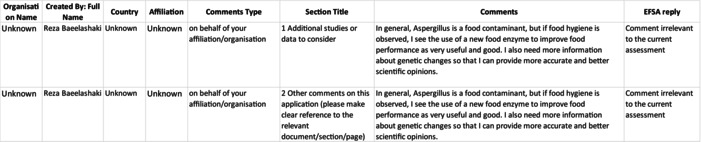 Figure 1
| Parameters | Unit | Batches | ||
|---|---|---|---|---|
| 1 | 2 | 3 | ||
|
| PROT(B)/g | 273 | 287 | 257 |
|
| % | 6.3 | 6.1 | 6.3 |
|
| % | 0.3 | 0.4 | 0.3 |
|
| % | 49.1 | 45.5 | 51.4 |
| ■■■■■ | % | 44.0 | 47.0 | 41.9 |
|
| % | 6.6 | 7.1 | 6.4 |
|
| PROT(B)/mg TOS | 4.1 | 4.0 | 4.0 |
| Food manufacturing process | Raw material (RM) | Recommended use level (mg TOS/kg RM) |
|---|---|---|
|
| ||
|
Production of distilled alcohol | Grain/cereals | 1.61–3.74 |
| Sources of uncertainties | Direction of impact |
|---|---|
|
| |
| Exclusion of one process from the exposure estimation: | – |
| – Production of distilled alcohol | |
Peer Reviews
No public reviews on file for this paper yet. If you reviewed it on a platform where reviews are public (OpenReview, ICLR, NeurIPS, ICML), you can paste yours below so the community can read it here.
Videos
No videos yet. Explain this paper in a talk, walkthrough, or lecture? Add one.
Taxonomy
TopicsAgricultural safety and regulations · Occupational exposure and asthma · Food Allergy and Anaphylaxis Research
INTRODUCTION
1
Article 3 of the Regulation (EC) No 1332/20081 provides definition for ‘food enzyme’ and ‘food enzyme preparation’.
‘Food enzyme’ means a product obtained from plants, animals or microorganisms or products thereof including a product obtained by a fermentation process using microorganisms: (i) containing one or more enzymes capable of catalysing a specific biochemical reaction; and (ii) added to food for a technological purpose at any stage of the manufacturing, processing, preparation, treatment, packaging, transport or storage of foods.
‘Food enzyme preparation’ means a formulation consisting of one or more food enzymes in which substances such as food additives and/or other food ingredients are incorporated to facilitate their storage, sale, standardisation, dilution or dissolution.
Before January 2009, food enzymes other than those used as food additives were not regulated or were regulated as processing aids under the legislation of the Member States. On 20 January 2009, Regulation (EC) No 1332/2008 on food enzymes came into force. This Regulation applies to enzymes that are added to food to perform a technological function in the manufacture, processing, preparation, treatment, packaging, transport or storage of such food, including enzymes used as processing aids. Regulation (EC) No 1331/20082 established the European Union (EU) procedures for the safety assessment and the authorisation procedure of food additives, food enzymes and food flavourings. The use of a food enzyme shall be authorised only if it is demonstrated that:
- it does not pose a safety concern to the health of the consumer at the level of use proposed;
- there is a reasonable technological need;
- its use does not mislead the consumer.
All food enzymes currently on the EU market and intended to remain on that market, as well as all new food enzymes, shall be subjected to a safety evaluation by the European Food Safety Authority (EFSA) and approval via an EU Community list.
Background and Terms of Reference as provided by the requestor
1.1
Background as provided by the European Commission
1.1.1
Only food enzymes included in the Union list may be placed on the market as such and used in foods, in accordance with the specifications and conditions of use provided for in Article 7(2) of Regulation (EC) No 1332/2008 on food enzymes.^1^
On 22 October 2024, a new application was submitted by “Novozymes A/S” seeking authorisation for the food enzyme Serine endopeptidase from genetically modified Aspergillus niger (strain NZYM‐MG).
Terms of Reference
1.1.2
The European Commission requests the European Food Safety Authority to carry out the safety assessment and the assessment of possible confidentiality requests of the following food enzyme: Serine endopeptidase from genetically modified Aspergillus niger (strain NZYM‐MG) in accordance with Regulation (EC) No 1331/2008 establishing a common authorisation procedure for food additives, food enzymes and food flavourings.^2^
DATA AND METHODOLOGIES
2
Data
2.1
The applicant has submitted a dossier in support of the application for authorisation of the food enzyme serine endopeptidase from A. niger strain NZYM‐MG.
Additional information, requested from the applicant during the assessment phase on 19 December 2025, and on 21 January 2026, and they were received on 5 January and on 26 January 2026, respectively (see ‘Documentation provided to EFSA’).
Methodologies
2.2
The assessment was conducted in line with the principles described in the EFSA ‘Guidance on transparency in the scientific aspects of risk assessment’ (EFSA, 2009) and following the relevant guidance documents of the EFSA Scientific Committee.
The ‘Scientific Guidance for the submission of dossiers on food enzymes’ (EFSA CEP Panel, 2021) and the ‘Food manufacturing processes and technical data used in the exposure assessment of food enzymes’ (EFSA CEP Panel, 2023) have been followed for the evaluation.
Public consultation
2.3
According to Article 32c(2) of Regulation (EC) No 178/20023 and to the Decision of EFSA's Executive Director laying down the practical arrangements on pre‐submission phase and public consultations, EFSA carried out a public consultation on the non‐confidential version of the technical dossier from 21 November to 12 December 2025.4 Two entries were registered but the comments submitted deemed as not relevant to the scope of the public consultation, and therefore, were not considered further.
ASSESSMENT
3
IUBMB nomenclatureSerine endopeptidaseSystematic name–Synonyms–IUBMB No3.4.21CAS No–EINECS No–
Serine endopeptidases catalyse the hydrolysis of peptide bonds of proteins with preference for large uncharged residues, releasing peptides and amino acids. This enzyme has broad substrate specificity. The food enzyme under assessment is intended to be used in the processing of cereals and other grains for the production of distilled alcohol, as defined in the EFSA guidance (EFSA CEP Panel, 2023).
Source of the food enzyme
3.1
The serine endopeptidase is produced with the genetically modified filamentous fungus A. niger strain NZYM‐MG, which is deposited ■■■■■ with deposition number ■■■■■.5 The production strain was identified as A. niger by phylogenetic analysis of the concatenated sequences from the calmodulin, β‐tubulin and RPB2 genes and ITS regions.6
Characteristics of the parental and recipient microorganisms
3.1.1
The parental strain is ■■■■■.
The recipient strain ■■■■■.
Characteristics of introduced sequences
3.1.2
The sequence encoding the serine endopeptidase ■■■■■■■■■■ ■■■■■.
Description of the genetic modification
3.1.3
The purpose of the genetic modification was to enable the production strain to synthesise a serine endopeptidase ■■■■■.
■■■■■8
■■■■■.9
Safety aspects of the genetic modification
3.1.4
The technical dossier contains all necessary information on the recipient microorganism, the donor organism and the genetic modification process.
The production strain A. niger NZYM‐MG differs from the recipient strain in its capacity ■■■■■.10
The absence of all antimicrobial resistance genes used during the genetic modification was confirmed by WGS.11
No issues of concern arising from the genetic modifications were identified by the Panel.
Production of the food enzyme
3.2
The food enzyme is manufactured according to the Food Hygiene Regulation (EC) No 852/2004,12 with food safety procedures based on Hazard Analysis and Critical Control Points, and in accordance with Good Manufacturing Practice.13
The production strain is grown as a pure culture using a typical industrial medium in a submerged, fed‐batch fermentation system with conventional process controls in place. After completion of the fermentation, the solid biomass is removed from the fermentation broth by filtration. The filtrate containing the enzyme and then further purified and concentrated, including an ultrafiltration step in which the enzyme protein is retained, while most of the low molecular mass material passes the filtration membrane and is discarded.14 The applicant provided information on the identity of the substances used to control the fermentation and in the subsequent downstream processing of the food enzyme.15
The Panel considered that sufficient information has been provided on the manufacturing process and the quality assurance system implemented by the applicant to exclude issues of concern.
Characteristics of the food enzyme
3.3
Properties of the food enzyme
3.3.1
The serine endopeptidase is a single polypeptide chain of ■■■■■ amino acids.16 The molecular mass of the protein, calculated from the amino acid sequence, is ■■■■■ kDa.17 The food enzyme was analysed by sodium dodecyl sulfate–polyacrylamide gel electrophoresis.18 A consistent protein pattern was observed across all batches. The gel showed a major protein band migrating between protein markers of ■■■■■ kDa in all batches.
No other enzyme activities were reported.19
The applicant's in‐house determination of serine endopeptidase activity is based on the hydrolysis of Succinyl‐Ala‐Ala‐Pro‐Phe 4‐nitroanilide (reaction conditions: pH 4.0, 37°C, ■■■■■). The release of 4‐nitroaniline is measured spectrophotometrically at 405 nm. The enzyme activity is quantified relative to an internal enzyme standard and expressed in PROT(B) units (PROT(B))/g. One PROT(B) is defined as the amount of enzyme that releases 0.25 μmol of 4‐nitroaniline per minute under the assay conditions.20
The food enzyme has a temperature optimum around 50°C (pH 4.0) and a pH optimum around 4.0 (35°C). Thermostability was tested by pre‐incubation of the food enzyme for 10 min at different temperatures (pH 4.0). The enzyme activity decreased above 40°C showing no residual activity at 60°C.21
Chemical parameters
3.3.2
Data on the chemical parameters of the food enzyme preparations were provided for three batches intended for commercialisation.22 The mean total organic solids (TOS) was 6.7% and the mean enzyme activity/TOS ratio was 4 PROT(B)/mg TOS (Table 1).
Purity
3.3.3
The lead content in all batches was below 0.5 mg/kg23 ^,^ 24 which complies with the specification for lead as laid down in the general specifications for enzymes used in food processing (FAO/WHO, 2006).
The food enzyme preparation complies with the microbiological criteria for total coliforms, Escherichia coli and Salmonella, as laid down in the general specifications for enzymes used in food processing (FAO/WHO, 2006).25 No antimicrobial activity was detected in any of the tested batches.26
Strains of the Aspergillus species, in common with most filamentous fungi, have the capacity to produce a range of secondary metabolites (Frisvad et al., 2018). The presence of ochratoxin A and fumonisin B2 was examined in all food enzyme batches and were below the limits of detection (LoDs) of the applied analytical methods.27 ^,^ 28
The Panel considered that the information provided on the purity of the food enzyme was sufficient.
Viable cells and DNA of the production strain
3.3.4
The absence of viable cells of the production strain in the food enzyme was demonstrated in three independent batches analysed in triplicate. ■■■■■.29
The absence of recombinant DNA in the food enzyme was demonstrated by polymerase chain reaction analysis of three batches in triplicate. No DNA was detected with primers that would amplify ■■■■■, with a LoD of 10 ng spiked DNA/g food enzyme.30
Toxicological data
3.4
No toxicological tests were provided by the applicant. In the course of the food manufacturing process, the food enzyme is removed by the applied purification steps (see Section 3.5). Consequently, in the absence of exposure, the Panel considered that no toxicological studies other than the assessment of allergenicity were needed for this food enzyme.
Allergenicity
3.4.1
The allergenicity assessment considered only the food enzyme and not additives, carriers or other excipients that may be used in the final formulation.
The potential allergenicity of the serine endopeptidase produced from A. niger strain NZYM‐MG was assessed by comparing its amino acid sequence with those of known allergens as described in the EFSA GMO Scientific Opinion (EFSA GMO Panel, 2010). Using higher than 35% identity in a sliding window of 80 amino acids as the criterion, a match with one contact allergen was found in the COMPARE database.31
The matching contact allergen was Tri r 2 (35.8% sequence identity), an alkaline serine protease from Trichophyton rubrum.
No reports on oral or respiratory sensitisation or elicitation reactions of the serine endopeptidase under assessment have been published.32
Considering the match with Tri r 2, no reports of allergic reactions after oral exposure to the contact allergens from the Athlete's food fungus Trichophyton have been reported.33
Serine peptidases include trypsin‐like, chymotrypsin‐like and collagenolytic enzymes which have been identified as contact, respiratory and food allergens (Ouyang X et al., 2024; S. Patel, 2017). No homology matches of the serine endopeptidase under assessment with any of those respiratory or food allergens has been identified.
The Panel considered that the results of the sequence homology search and the available literature do not indicate a risk of allergic reactions upon dietary exposure to the serine endopeptidase under assessment.
The production strain belongs to the Aspergillus genus, which is known to cause respiratory allergy (Kurup et al., 2000; Shen & Han, 1998; Vermani et al., 2015). Allergic reactions upon dietary exposure have been observed, but are rare (Xing et al., 2022). The biomass is removed during the production process; however, allergenic proteins of the production strain can be released into the culture medium from which the food enzyme is obtained.
■■■■■ that may cause allergies or intolerances (listed in the Regulation (EU) No 1169/201134), is used as raw material. During the fermentation process, this product will mostly be degraded and utilised by the production strain.
Taken together, concerning the potential allergic reactions due to the production strain and the raw material in the culture medium, the Panel considered that residual amounts of allergenic proteins could be present in the food enzyme. Taking into account the level of dietary exposure (see Section 3.5), this would result in minute amounts in the final foods, from which allergic reactions are usually not expected.
In conclusion, when used for the production of distilled alcohol, the Panel considered that a risk of allergic reactions upon dietary exposure can be excluded.
Dietary exposure
3.5
Intended use of the food enzyme
3.5.1
The food enzyme is intended to be used in one food manufacturing process at the recommended use level summarised in Table 2.
TABLE 2: Intended uses and recommended use level of the food enzyme as provided by the applicant. 35
In the production of distilled alcohol, the food enzyme is added to grain/cereals together with yeast during the fermentation36 to hydrolyse proteins to provide a nitrogen source for the yeast. The food enzyme–TOS are not carried over into the distilled alcohols (EFSA CEP Panel, 2023).
Dietary exposure estimation
3.5.2
The Panel accepted the evidence provided as sufficient to conclude that the residual amount of food enzyme–TOS in the distilled alcohol is negligible (EFSA CEP Panel, 2023). Consequently, a dietary exposure was not calculated.
Uncertainty analysis
3.5.3
In accordance with the guidance provided in the EFSA opinion related to uncertainties in dietary exposure assessment (EFSA, 2006), the following sources of uncertainties have been considered and are summarised in Table 3.
The exclusion of one food manufacturing process from the exposure estimation was based on > 99% of TOS removal.
Margin of exposure
3.6
Since no toxicological assessment was considered necessary by the Panel and a dietary exposure was not calculated, a margin of exposure was not derived.
CONCLUSIONS
4
Based on the data provided and the removal of TOS during the production of distilled alcohol, the Panel concluded that the food enzyme serine endopeptidase produced with the genetically modified A. niger strain NZYM‐MG does not give rise to safety concerns under the intended condition of use.
The Panel considered the food enzyme free from viable cells of the production organism and recombinant DNA.
DOCUMENTATION AS PROVIDED TO EFSA
5
Application for the authorisation of serine endopeptidase from a genetically modified Aspergillus niger strain NZYM‐MG as a new food enzyme. October 2024. Submitted by Novozymes A/S.
Additional information 1. January 2026. Submitted by Novozymes A/S.
Additional information 2. January 2026. Submitted by Novozymes A/S.
ABBREVIATIONSbpbase pairCASChemical Abstracts ServiceCEFEFSA Panel on Food Contact Materials, Enzymes, Flavourings and Processing AidsCEPEFSA Panel on Food Contact Materials, Enzymes and Processing AidsEINECSEuropean Inventory of Existing Commercial Chemical SubstancesFAOFood and Agricultural Organization of the United NationsFEZEFSA Panel on Food EnzymesGMOgenetically modified organismIUBMBInternational Union of Biochemistry and Molecular BiologyJECFAJoint FAO/WHO Expert Committee on Food AdditiveskDakiloDaltonLoDlimit of detectionLoQlimit of quantificationPCRpolymerase chain reactionTOStotal organic solidsWGSwhole genome sequencingWHOWorld Health Organization
REQUESTOR
European Commission
QUESTION NUMBER
EFSA‐Q‐2025‐00017
COPYRIGHT FOR NON‐EFSA CONTENT
EFSA may include images or other content for which it does not hold copyright. In such cases, EFSA indicates the copyright holder and users should seek permission to reproduce the content from the original source.
PANEL MEMBERS
José Manuel Barat Baviera, Claudia Bolognesi, Francesco Catania, Gabriele Gadermaier, Ralf Greiner, Baltasar Mayo, Alicja Mortensen, Yrjö Henrik Roos, Marize de Lourdes Marzo Solano, Henk Van Loveren, Laurence Vernis, Holger Zorn.
LEGAL NOTICE
The scientific output published implements EFSA's decision on the confidentiality requests submitted on specific items. As certain items have been awarded confidential status by EFSA they are consequently withheld from public disclosure by redaction.
The reference list from the paper itself. Each links out to its DOI / PubMed record.
- 1EFSA (European Food Safety Authority) . (2009). Guidance of the Scientific Committee on transparency in the scientific aspects of risk assessments carried out by EFSA. Part 2: General principles. EFSA Journal, 7(5), 1051. 10.2903/j.efsa.2009.1051 · doi ↗
- 2EFSA CEP Panel (EFSA Panel on Food Contact Materials, Enzymes and Processing Aids) , Lambré, C. , Barat Baviera, J. M. , Bolognesi, C. , Cocconcelli, P. S. , Crebelli, R. , Gott, D. M. , Grob, K. , Lampi, E. , Mengelers, M. , Mortensen, A. , Rivière, G. , Steffensen, I.‐L. , Tlustos, C. , Van Loveren, H. , Vernis, L. , Zorn, H. , Glandorf, B. , Herman, L. , … Chesson, A. (2021). Scientific Guidance for the submission of dossiers on food enzymes. EFSA Journal, 19(10), 6851. 10 · doi ↗ · pubmed ↗
- 3EFSA CEP Panel (EFSA Panel on Food Contact Materials, Enzymes and Processing Aids) , Lambré, C. , Barat Baviera, J. M. , Bolognesi, C. , Cocconcelli, P. S. , Crebelli, R. , Gott, D. M. , Grob, K. , Lampi, E. , Mengelers, M. , Mortensen, A. , Rivière, G. , Steffensen, I.‐L. , Tlustos, C. , van Loveren, H. , Vernis, L. , Zorn, H. , Roos, Y. , Apergi, K. , & Chesson, A. (2023). Food manufacturing processes and technical data used in the exposure assessment of food enzymes. EFSA · doi ↗ · pubmed ↗
- 4EFSA (European Food Safety Authority) . (2006). Opinion of the Scientific Committee related to uncertainties in dietary exposure assessment. EFSA Journal, 5(1), 438. 10.2903/j.efsa.2007.438 · doi ↗
- 5EFSA GMO Panel (EFSA Panel on Genetically Modified Organisms) . (2010). Scientific Opinion on the assessment of allergenicity of GM plants and microorganisms and derived food and feed. EFSA Journal, 8(7), 1700. 10.2903/j.efsa.2010.1700 · doi ↗
- 6FAO/WHO (Food and Agriculture Organization of the United Nations/World Health Organization) . (2006). General specifications and considerations for enzyme preparations used in food processing in compendium of food additive specifications. 67th meeting (Vol. 3, pp. 63–67). FAO JECFA Monographs. https://www.fao.org/3/a‐a 0675 e.pdf
- 7Frisvad, J. C. , Møller, L. L. H. , Larsen, T. O. , Kumar, R. , & Arnau, J. (2018). Safety of the fungal work horses of industrial biotechnology: Update on the mycotoxin and secondary metabolite potential of Aspergillus niger, Aspergillus oryzae, and Trichoderma reesei . Applied Microbiology and Biotechnology, 102, 9481–9515. 10.1007/s 00253-018-9354-1 30293194 PMC 6208954 · doi ↗ · pubmed ↗
- 8Kurup, V. P. , Banerjee, B. , Hemmann, S. , Greenberger, P. A. , Blaser, K. , & Crameri, R. (2000). Selected recombinant Aspergillus fumigatus allergens bind specifically to Ig E in ABPA. Clinical and Experimental Allergy, 30(7), 988–993. 10.1046/j.1365-2222.2000.00837.x 10848921 · doi ↗ · pubmed ↗