Airport Malaria Cluster in Certified Malaria-Free Country, Libya, 2024
Ahmed M. Alarbi, Ahmed B. Elhaddad, Nafesa M. Almehdawi, Walid K. Saadawi, Hanan Aqeehal, Mohamed Elalem

TL;DR
A malaria outbreak near a Libyan airport in 2024 was traced to imported mosquitoes, not local transmission.
Contribution
The study identifies airport malaria as a risk in certified malaria-free regions.
Findings
Four Plasmodium falciparum cases, including one death, were found near Benina International Airport.
Epidemiologic and entomologic investigations ruled out local malaria transmission.
The outbreak was attributed to imported malaria vectors, not local mosquitoes.
Abstract
In November 2024, an autochthonous cluster of 4 Plasmodium falciparum cases (1 fatal) was identified near Benina International Airport, Benghazi, Libya. Epidemiologic and entomologic investigation ruled out local transmission, pointing to airport malaria as the cause and highlighting the vulnerability of malaria-free regions to imported vectors.
Genes, proteins, chemicals, diseases, species, mutations and cell lines named across the full text — each resolved to its canonical identifier and authoritative record.
Click any figure to enlarge with its caption.
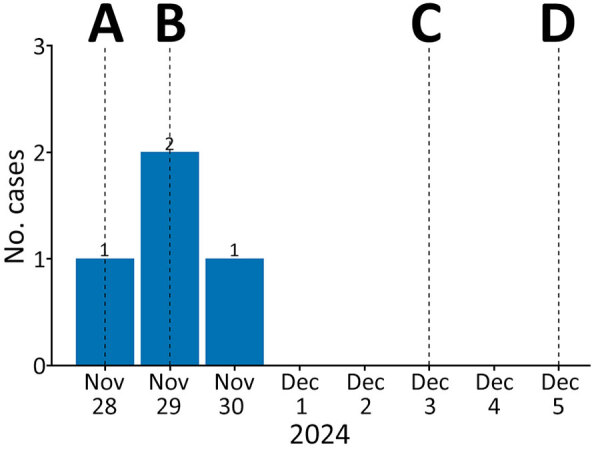 Figure 1
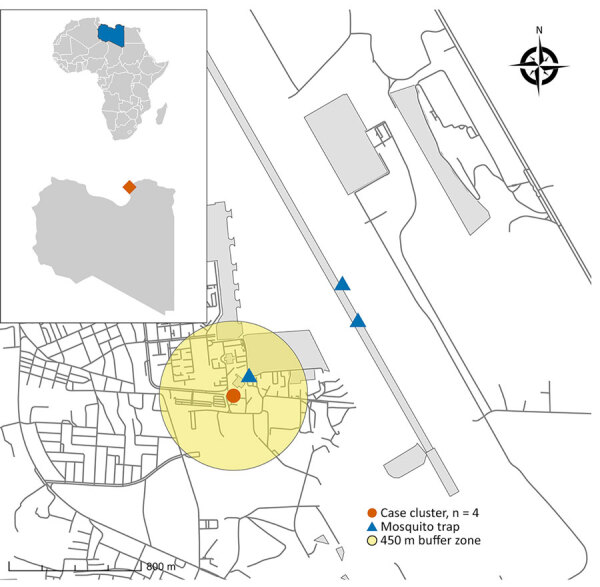 Figure 2
Peer Reviews
No public reviews on file for this paper yet. If you reviewed it on a platform where reviews are public (OpenReview, ICLR, NeurIPS, ICML), you can paste yours below so the community can read it here.
Videos
No videos yet. Explain this paper in a talk, walkthrough, or lecture? Add one.
Taxonomy
TopicsMalaria Research and Control · Mosquito-borne diseases and control · Travel-related health issues
Libya, which was certified malaria-free by the World Health Organization in 1973, faces continuous risk for malaria reintroduction from population movements in malaria-endemic regions (1). Although imported cases are occasionally reported, local transmission has not been documented in eastern Libya for >50 years.
On November 28, 2024, the Libya National Centre for Disease Control was notified of a fatal case of Plasmodium falciparum malaria in a 63-year-old resident of Benghazi, Libya, who had no history of travel. Within 48 hours, infection was confirmed in 3 of his children (ages 12, 16, and 23). This familial cluster was located ≈450 meters from Benina International Airport, prompting an investigation to determine the outbreak’s source. This investigation was considered a public health response to an urgent event by the Libya National Center for Disease Control and, as such, was not subject to institutional review board approval. Oral informed consent was obtained from the family members for interviews and testing.
Our investigation defined a case as malaria-like symptoms in a resident near the airport during from mid-November through mid-December 2024 (Figure 1). Active case finding through local healthcare and community outreach identified 20 other suspected patients; all tested negative. All 4 confirmed case-patients, belonging to a single family of 8, were laboratory-confirmed as positive for P. falciparum. None had traveled internationally or received blood transfusions. We formulated 2 primary hypotheses: local transmission from indigenous Anopheles mosquitoes infected by human carrier or airport malaria from an infected Anopheles mosquito imported by aircraft.
To evaluate those hypotheses, we conducted entomological surveillance during November 29–December 2, 2024, deploying National Centre for Disease Control light traps around the family’s residence and within the airport perimeter (Figure 2). We collected 8 mosquitoes, all of which were identified as Culex pipiens. We found no Anopheles mosquitoes, a finding consistent with recent national surveillance data, which documented certain Anopheles species in specific ecologic niches but confirmed their general absence in coastal urban areas such as Benghazi (H. Aqeehal, unpub. data). The absence of competent local vectors enabled us to eliminate local transmission, making airport malaria the most plausible explanation (2).
This investigation concluded that an infected anopheline mosquito was likely imported by aircraft, probably within cargo given the absence of recent passenger flights from malaria-endemic areas, and subsequently infected members of a family living nearby. Although importation of vectors overland through migrant routes is a theoretical possibility (3,4), the acute, geographically tight cluster in a nonmigrant family points strongly toward a point-source introduction at the airport.
This event is a critical reminder that malaria-free status does not eliminate risk, because points of entry are permeable frontiers for vectorborne diseases (5,6). Our findings prompted immediate recommendations to Libya health authorities to strengthen entomologic surveillance at points of entry and rigorously enforce aircraft and cargo disinsection protocols in accordance with the World Health Organization’s International Health Regulations (2005) (7). We also emphasize the need for clinicians near airports to consider malaria in patients with fever, regardless of travel history. The vulnerability of nonendemic regions requires constant vigilance to prevent the reestablishment of malaria.
The reference list from the paper itself. Each links out to its DOI / PubMed record.
- 1Gebreel AO, Gilles HM, Prescott JE. Studies on the sero-epidemiology of endemic diseases in Libya, IV. Malaria. Ann Trop Med Parasitol. 1985;79:341–7. 10.1080/00034983.1985.118119303907553 · doi ↗ · pubmed ↗
- 2Kessel J, Rosanas-Urgell A, Dingwerth T, Goetsch U, Haller J, Huits R, et al. Investigation of an airport-associated cluster of falciparum malaria in Frankfurt, Germany, 2022. Euro Surveill. 2024;29:2300298. 10.2807/1560-7917.ES.2024.29.5.230029838304950 PMC 10835754 · doi ↗ · pubmed ↗
- 3Tabbabi A, Alkishe AA, Samy AM, Rhim A, Peterson AT. Malaria in North Africa: a review of the status of vectors and parasites. J Entomol Sci. 2020;55:25–37. 10.18474/0749-8004-55.1.25 · doi ↗
- 4Nebbak A, Almeras L, Parola P, Bitam I. Mosquito vectors (Diptera: Culicidae) and mosquito-borne diseases in North Africa. Insects. 2022;13:962. 10.3390/insects 1310096236292910 PMC 9604161 · doi ↗ · pubmed ↗
- 5Schlagenhauf P, D’Acremont V, Buhler S, Hatz C. Airport malaria and odyssean malaria. In: Keystone A, Kozarsky P, Connor B, Nothdurft H, Mendelson M, Cartwright K, editors. Travel medicine. 4th ed. Philadelphia: Elsevier; 2019. p. 64–7.
- 6Ibáñez-Justicia A, Smitz N, den Hartog W, van de Vossenberg B, De Wolf K, Deblauwe I, et al. Detection of exotic mosquito species (Diptera: Culicidae) at international airports in Europe. Int J Environ Res Public Health. 2020;17:3450. 10.3390/ijerph 1710345032429218 PMC 7277938 · doi ↗ · pubmed ↗
- 7World Health Organization. International Health Regulations (2005). 3rd ed. Geneva: The Organization; 2016.