A Holistic, Data-Driven Approach to Diversifying Alpha Omega Alpha (AΩA) Honor Society Electees
Seema Baranwal, Carolyn Giordano, Leon McCrea, Jennifer Hamilton, Kathleen Ryan, Bisan Salhi, Roshell Muir, Amy Fuchs

TL;DR
A study shows that using a holistic review platform increased diversity among medical students selected for AΩA honors.
Contribution
The study demonstrates how a standardized platform can diversify AΩA electees through holistic review.
Findings
Holistic review increased URiM student representation from 2.73% to 10.05%.
First-generation student electees rose from 0% to 6.27%.
Students from lower socioeconomic backgrounds increased from 12.73% to 21.77%.
Abstract
Recently, some medical schools eliminated their Alpha Omega Alpha (AΩA) chapters because of concerns that AΩA academic criteria led to bias in student selection. In 2020, the AΩA board changed the constitution to permit individual member schools to determine how their electees would be chosen. Thus, the relative weight of AΩA’s selection criteria could be defined by the individual schools, allowing for a more holistic approach to selection. This study at a single large private medical school examines student AΩA electee rates before and after the implementation of holistic review using an institutional platform, MyPortfolio (MP; Drexel University College of Medicine, Philadelphia, USA), to holistically select electees. A cross-sectional study design was used to assess demographic data of medical students considered for AΩA membership election between 2016 and 2025 and compared pre-MP…
Genes, proteins, chemicals, diseases, species, mutations and cell lines named across the full text — each resolved to its canonical identifier and authoritative record.
Click any figure to enlarge with its caption.
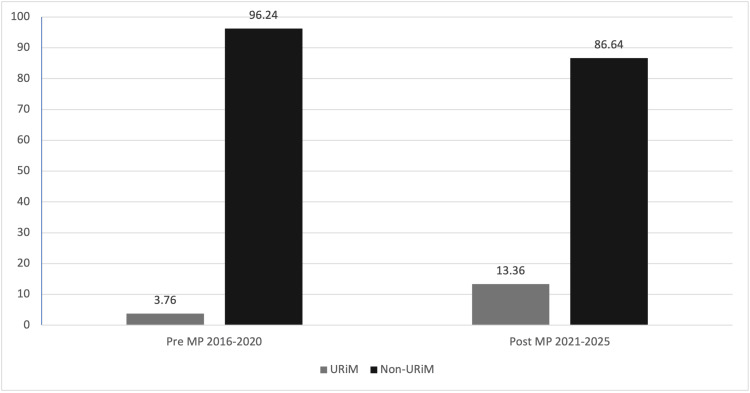 Figure 1
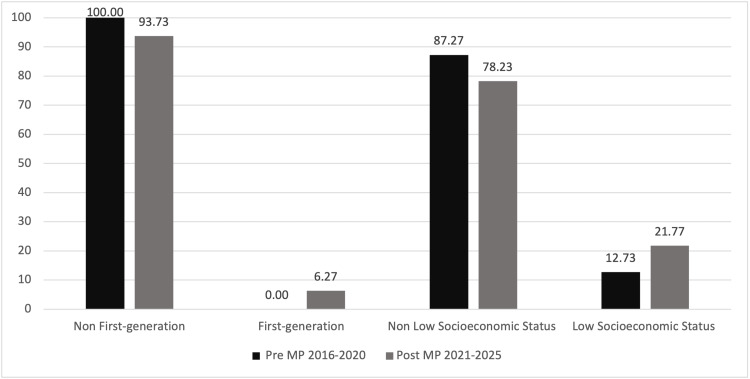 Figure 2
| Race/Ethnicity | Pre-MP 2016–2020 % (n) | Post-MP 2021–2025 % (n) |
| American Indian or Alaska Native | 0.45% (1) | 1.11% (3) |
| Asian | 20.45% (45) | 27.41% (74) |
| Black or African American | 0.45% (1) | 4.81% (13) |
| White | 68.18% (150) | 52.22% (141) |
| Hispanic or Latino | 1.82% (4) | 6.67% (18) |
| More than one race or ethnicity | 4.09% (9) | 4.81% (13) |
| Did Not Answer | 4.55% (10) | 2.96% (8) |
| Total no. electees | 220 | 270 |
Peer Reviews
No public reviews on file for this paper yet. If you reviewed it on a platform where reviews are public (OpenReview, ICLR, NeurIPS, ICML), you can paste yours below so the community can read it here.
Videos
No videos yet. Explain this paper in a talk, walkthrough, or lecture? Add one.
Taxonomy
TopicsDiversity and Career in Medicine · Medical Education and Admissions · Mentoring and Academic Development
Introduction
Membership in the Alpha Omega Alpha (AΩA) Honor Society is a longstanding hallmark of academic achievement of medical students [1]. Although AΩA selection has evolved to include qualities such as leadership and service to the school and community, studies have shown racial, ethnic, and socioeconomic disparities in AΩA membership [2,3]. The literature also highlights how these disparities negatively affect underrepresented students who may aspire to careers in academic medicine [2], as limited access to this prestigious membership could hinder their pursuit of advanced educational and professional opportunities.
In 2020, AΩA changed their charter to permit individual member schools to “identify students who, based on merit, demonstrate the characteristics of becoming excellent physicians and are aligned with AΩA’s mission and values and the school’s determination” [4]. This change allowed for a holistic review of students’ achievements.
Considering the AΩA charter revision, we began utilizing MyPortfolio (MP; Drexel University College of Medicine, Philadelphia, USA), a centralized institutionally developed platform, to measure and prioritize academic, research, service, and leadership achievements. Unlike the previous selection method that relied heavily on academic metrics, MP facilitates a more holistic evaluation of student achievement. This study hypothesized that the utilization of MP to holistically evaluate medical students would yield a difference in the demographic representation of AΩA electees at our medical school.
Research question
The research question we sought to answer was: Does a holistic review of medical school Alpha Omega Alpha (AΩA) honor society candidates better reflect the broader demographics of the class compared to traditional academic metrics?
Materials and methods
MyPortfolio (MP)
MyPortfolio (MP) was developed in 2013 to centralize the tracking of medical students’ extracurricular involvement and to improve the accuracy and efficiency of preparation of the Medical Student Performance Evaluation (MSPE). Our students are required to enter their data into MP annually, along with relevant descriptors (e.g., type of activity, leadership involvement, time commitment).
Since its inception, MP has gone through iterative improvements to ensure ease of engagement and accuracy of data collection. Beginning with the class of 2021, MP has served as the primary mechanism to collect and utilize data for the AΩA selection process.
Participants and demographics
Our institution is a very large private allopathic medical school in the United States (US) with over 1,200 medical students enrolled. Our student body is diverse in background and professional interests, a critical strength of our institution and a pillar of our educational mission. Nevertheless, tracking our students’ achievements and rewarding them accordingly is challenging and a primary driver of the comprehensive MP processes.
Study design
In this cross-sectional study, we used the admissions database to obtain de-identified demographic data of students considered for AΩA election between 2016 and 2024. We compared AΩA election in the pre-MP (classes of 2016-2020) and post-MP (classes of 2021-2025) periods based on the Association of American Medical Colleges (AAMC) self-reported characteristics, gender, race, ethnicity, first-generation, and socioeconomic status (SES), with SES 1 and 2 designated as having lower socioeconomic status [5]. We employed the Strengthening the Reporting of Observational Studies in Epidemiology (STROBE) reporting guidelines [6]. The Institutional Review Board of Drexel University approved this study.
AΩA candidate selection
Students are elected to AΩA by a committee comprised of faculty members of AΩA. In the pre-MP period, students were elected based on a weighted average of grades (20% year 1, 20% year 2, and 60% year 3 grades). The committee was blinded to student names.
In the post-MP period, the committee selected four overarching selection criteria that would be utilized to guide our Chapter’s AΩA selection, each of which could be accurately quantified through curricular assessment or the MyPortfolio platform: Academics, Service, Leadership, and Scholarship. All of the identifying demographic data was blinded, and the octiles made it so that individual student contributions were not identified. This was all done to mitigate bias, so formal training was not done.
The selection criteria were defined across four domains. Leadership was characterized by holding positions in institutionally recognized student organizations. Scholarship was assessed through presentations and publications at local, regional, or national meetings, as well as peer-reviewed abstracts and manuscripts. Academic achievement was determined by class rank, with eligibility limited to students in the top 50% of the class and additional weight assigned to higher octiles. Service was quantified by the number of documented hours in service-related activities (e.g., civic organizations). Based on our review of internal data, these four categories capture the range of our students’ efforts and involvement. Moreover, these criteria were intentionally selected because our experience demonstrates there is a significant degree of participation across a variety of domains that help to equalize this effort.
Students’ grades from courses and clerkships in the first three years were used to generate a performance ranking, which was then divided into octiles. Only students in the top four octiles (i.e., the top half of the class) were included for further consideration. Scholarship octiles were assigned based on presentations and publications reported in MyPortfolio. Leadership and service were combined and used to produce a third octile. These three metrics (academics, 40%; scholarship, 20%; combined leadership and service, 40%) were weighted to generate a single value used to select the top 20% of the class for AΩA nomination.
Statistical analysis
Differences between AΩA members and nonmembers were compared using the χ2 test. Statistical analyses were performed using SPSS, Version 29.0.2.0 (IBM Corp., Armonk, USA). A 2-sided P < .05 defined statistical significance.
Results
Table 1 compares the demographic characteristics of 490 AΩA electees during the pre- (N = 220) and post-MP (N = 270) implementation periods. URiM students elected to AΩA increased from 3.76% to 13.36% from the pre- to post-MP period (χ²(1, N = 491) = 12.02, p < .01, v = 0.166) (Fig. 1). AΩA electees who identified as first-generation also increased from no representation (0%) in the pre-MP period to 6.27% in the post-MP period (χ² (1, N = 491) = 14.296 , p < .001, v = 0.171) (Fig. 2). There was an increase in students from lower SES backgrounds (SES1 and SES2) elected to AΩA (12.73% to 21.77%) from the pre- to post-MP period (χ² (1, N = 491) = 6.81, p < .001, v = 0.118) (Fig. 2).
Percentage of Medical Student AΩA Electees Pre- and Post-MyPortfolio (MP) Implementation by Race and EthnicityURiM: underrepresented in medicine
Percentage of Medical Student AΩA Electees Pre- and Post-MyPortfolio (MP) Implementation by First-Generation and Socioeconomic Status
Discussion
Recent multi-institutional studies have documented persistent disparities in AΩA elections between students from non-URiM and URiM backgrounds, despite comparable academic performance [7-11]. These studies show the limitations of the traditional academic (GPA)-driven selection processes [11-14], and scholars have called for more nuanced, holistic approaches to reduce inequities [11] and broaden access to AΩA. Building on this work, our institution implemented a centralized, rubric-based review process within a standardized platform, My Portfolio (MP), to assess learner accomplishments, inclusive of academic achievement, depth of scholarly pursuits, and leadership and service to the community. To further mitigate bias, all individuals involved in the selection process were blinded reviewers. This model demonstrates a feasible alternative to the traditional academic approach.
The findings indicate an increase in the election of students from historically disadvantaged backgrounds after a re-imagined holistic review of their achievements for AΩA election. With the changes to the AΩA charter [4], our institution used the opportunity to expand the selection criteria and emphasize leadership, service, scholarship, and academic excellence. The study’s main finding demonstrates that a more equitable and inclusive AΩA election can be achieved utilizing a centralized, standardized medical school platform (e.g., MP) to perform a holistic review. The results demonstrate an increase in student AΩA electees from URiM backgrounds [2], in addition to those from first-generation and lower SES backgrounds. First-generation students face specific challenges in medical school, including insufficient institutional support in navigating the hidden curriculum of medical education [15]. Students from lower SES backgrounds continue to face personal and educational-related challenges related to their familial income, which compounds the difficulties overcome in the admissions process [7].
Our results are therefore encouraging and highlight the importance of inclusive practices in medical education [8].
This study does have limitations. First, self-reported racial, ethnic, and socioeconomic status may not fully reflect the complexity of students’ backgrounds and experiences [9,10]. Second, our study involved a pre- and post-implementation analysis and may not completely reflect historical trends in AΩA membership. Another limitation is that this is a single-institution study, and our findings may not be replicable in other settings, particularly when considering possible reviewer subjectivity despite efforts (e.g., annual trainings) to address this issue. Recognizing that institutional culture and structure shape the student experience, the next phase of this work aims to expand its reach to include a multi-institution investigation. The goal would be to engage medical schools across the spectrum of size, type, and structure. The inclusion of public and private institutions will provide a more representative picture of the factors influencing student selection.
Finally, while there were correlations between the new, holistic evaluation and representation of students, these findings cannot establish causality, as it is plausible that other institutional or demographic changes at our medical school could have acted as confounding variables, and may partly explain observed differences. The observed changes in student outcomes may reflect our expansion of engagement opportunities and emphasis on academic priorities through the evolution of the curriculum. Additionally, some of the patterns may simply reflect the random variability of year-to-year demographic shifts in the composition of the student body, which can impact the learning environment, academic performance, and participation patterns. However, the findings demonstrate an implementable process change aligned with AΩA’s charter that yields measurable shifts in recognition for students across multiple demographic domains (URiM, first-generation status, and SES). Furthermore, while it is clear that changes in demographics are supported by our holistic process selection, this study acknowledges that these changes can also be multifactorial in nature due to the dynamic interplay between evolving student composition and emerging academic priorities.
Conclusions
Our findings demonstrate that implementing a centralized holistic review process for evaluating medical student achievement across leadership, scholarship, academic achievement, and service was effective in diversifying AΩA membership at our institution. By moving beyond grading metrics to a more holistic definition of academic excellence, we have successfully fostered a more inclusive recognition of talent and achievement. Moreover, the historically close linkage between AΩA membership and professional opportunities within medicine makes holistic review an important step towards diversifying the physician workforce and academic medicine. As we noted previously, the ability to access AΩA membership presents greater opportunities for career advancement. As such, it becomes imperative that holistic approaches are employed to align with the broader goals of academic medicine to cultivate a diverse, equitable, and dynamic physician workforce. Future research should explore the use of holistic evaluation methodologies in a multi-institutional and longitudinal context as further validity evidence.
The reference list from the paper itself. Each links out to its DOI / PubMed record.
- 1Early predictors of career achievement in academic medicine JAMA Brancati FL Mead LA Levine DM Martin D Margolis S Klag MJ 137213762671992 https://jamanetwork.com/journals/jama/article-abstract/3956801740860 · pubmed ↗
- 2Racial privilege and medical student awards: addressing racial disparities in Alpha Omega Alpha honor society membership J Gen Intern Med Boatright D O'Connor PG E Miller J 334833513520203286920310.1007/s 11606-020-06161-x PMC 7661606 · doi ↗ · pubmed ↗
- 3Association of socioeconomic status with Alpha Omega Alpha honor society membership among medical students JAMA Netw Open Nguyen M Mason HR O'Connor PG Nunez-Smith M Mc Dade WA Latimore D Boatright D 04202110.1001/jamanetworkopen.2021.10730 PMC 817337634076702 · doi ↗ · pubmed ↗
- 4Constitution - Alpha Omega Alpha 12 2024 Alpha Omega Alpha Honor Medical Society Aurora (CO)Alpha Omega Alpha Honor Medical Society, Board of Directors 2025 https://www.alphaomegaalpha.org/about/constitution/
- 5Socioeconomic Status (SES) Disadvantaged Indicator | Students & Residents 12 2024 Association of American Medical Colleges(AAMC) Washington (DC)Association of American Medical Colleges 2025 https://students-residents.aamc.org/applying-medical-school-amcas/publication-chapters/socioeconomic-status-ses-disadvantaged-indicator
- 6Strengthening the Reporting of Observational Studies in Epidemiology (STROBE) statement: guidelines for reporting observational studies BMJ von Elm E Altman DG Egger M Pocock SJ Gøtzsche PC Vandenbroucke JP 80680833520071794778610.1136/bmj.39335.541782.ADPMC 2034723 · doi ↗ · pubmed ↗
- 7Challenges facing first-generation college graduates in medical school: a qualitative analysis JAMA Netw Open Havemann C Mason HR Russell RG 06202310.1001/jamanetworkopen.2023.47528 PMC 1071975538091039 · doi ↗ · pubmed ↗
- 8Underrepresented in medicine students' perspectives on impactful medical education BMC Med Educ Bazargan-Hejazi S Negrete Manriquez JA Mc Dermoth-Grimes M Parra EA Prothrow-Stith D 9042220223658570610.1186/s 12909-022-03983-7PMC 9805279 · doi ↗ · pubmed ↗