Enhancing medical students comprehension through active learning: implementing the jigsaw method to improve engagement
Gulam Begum, B. K. M. Goud, Vijaya Marakala, Nasir A. Hamad, Smitha Elizabeth, Farida H. Khan, Anshoo Agarwal, Osama Khattak, Muhammad Amber Fareed, Khalid F. Alshammari, Vijay Bhavrao Desai, Farooq A. Chaudhary

TL;DR
This study shows that the Jigsaw method, a collaborative learning technique, improves medical students' understanding of complex biochemistry topics like vitamins.
Contribution
The study demonstrates the effectiveness of the Jigsaw method in enhancing medical students' comprehension and engagement in biochemistry education.
Findings
ANOVA showed significant differences in Expert Group and Assignment scores but not in Presentation scores.
Pearson correlation revealed strong positive associations between assignment, presentation, and total scores.
The Jigsaw method improved student engagement, comprehension, and collaborative skills in biochemistry topics.
Abstract
The Jigsaw method is an excellent collaborative learning strategy that actively involves students, improves their problem-solving abilities, and promotes individual accountability. This study investigated the effectiveness of the Jigsaw teaching and learning technique in enhancing medical students’ knowledge of nutrition, specifically focusing on fat-soluble vitamins and B complex vitamins in medical students. A descriptive, cross-sectional, and prospective study was conducted with 176 Biochemistry students (10 males, 166 females) pursuing a Doctor of Medicine (MD) degree. Participants were conveniently sampled. The Jigsaw activity centered on “Nutrition,” with subtopics including Vitamin A, Vitamin K, B complex (B1, B2, B6), and Biotin and Niacin. The results showed across all four teams, mean scores for assignment, presentation, and expert-group activities were comparable, with…
Genes, proteins, chemicals, diseases, species, mutations and cell lines named across the full text — each resolved to its canonical identifier and authoritative record.
Click any figure to enlarge with its caption.
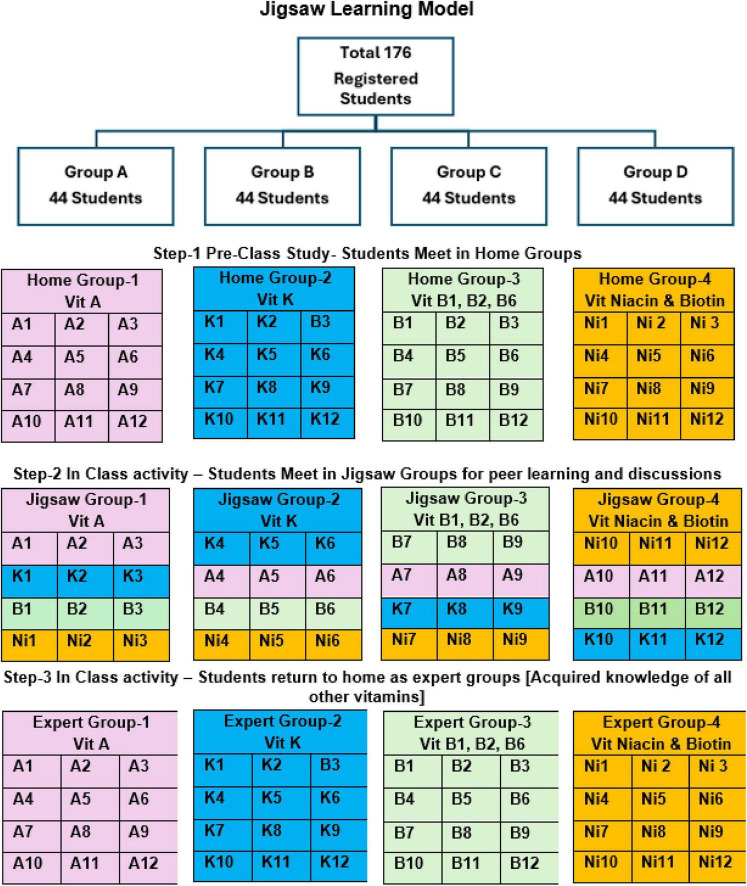 FIGURE 1
| Groups | Process | Time | Weightage |
|---|---|---|---|
| Home group | 15 min | 1.5 % | |
| Jigsaw group | Teaching and learning from peer groups (Faculty Assessment with the Rubric) | 45 min | 1.5% |
| Expert group | 30 min | 2.0% |
| Criteria | 4 marks | 3 marks | 2 marks | 1 mark |
|---|---|---|---|---|
| Demonstrates understanding of specific learning objectives relevant to the case/topic | Thorough understanding of specific learning objectives | Has good understanding of learning objectives | Has some understanding of specific learning objectives | Superficial learning of the specific learning objectives |
| Demonstrates the ability to present accurate information in an organized and effective manner | Excellent ability to present accurate and organized content | Presents effectively with accurate content | Not Presents effectively but content is inaccurate | Presents with inaccurate content, and/ or unorganized, ineffective manner |
| Demonstrates ability to clearly answer any questions raised relevant to the case/topic | Excellent ability to answer questions with accurate information | Good ability to answer questions | Unclear explanations of the doubts raised | Evasive in answering questions |
| Variables | Groups | Category | N | Mean | SD |
|---|---|---|---|---|---|
| 1 | A | Assignment | 44 | 10.09 | 1.43 |
| 2 | A | Presentation | 44 | 10.02 | 1.17 |
| 3 | A | Expert group | 44 | 13.5 | 0.88 |
| 4 | A | Total | 44 | 33.57 | 2.32 |
| 5 | B | Assignment | 44 | 9.98 | 1.58 |
| 6 | B | Presentation | 44 | 9.77 | 1.4 |
| 7 | B | Expert group | 44 | 13.75 | 0.21 |
| 8 | B | Total | 44 | 33.75 | 2.43 |
| 9 | C | Assignment | 41 | 10.17 | 0.86 |
| 10 | C | Presentation | 41 | 9.63 | 1.24 |
| 11 | C | Expert group | 41 | 13.85 | 0.15 |
| 12 | C | Total | 41 | 33.88 | 1.55 |
| 13 | D | Assignment | 42 | 10.9 | 1.27 |
| 14 | D | Presentation | 42 | 10.05 | 1.21 |
| 15 | D | Expert group | 42 | 13.26 | 0.45 |
| 16 | D | Total | 42 | 34.17 | 1.78 |
| Measure | Group means (A/B/C/D) | |||
|---|---|---|---|---|
| Expert group | 13.50 / 13.75 / 13.85 / 13.26 |
|
| C > A, C > D, B > D |
| Assignment | 10.09 / 9.98 / 10.17 / 10.90 |
|
| D > B, D > C |
| Presentation | 10.02 / 9.77 / 9.63 / 10.05 |
| 0.358 | No significant differences |
| Team | Variable pair | r (Pearson) | Interpretation | |
|---|---|---|---|---|
| A | Assignment—presentation | 0.333 | 0.027 | Weak positive |
| Assignment—total | 0.757 | 0.000 | Strong positive | |
| Presentation—total | 0.715 | 0.000 | Strong positive | |
| Expert group—total | 0.441 | 0.003 | Moderate positive | |
| B | Assignment—presentation | 0.336 | 0.026 | Weak positive |
| Assignment—total | 0.841 | 0.000 | Strong positive | |
| Presentation—total | 0.792 | 0.000 | Strong positive | |
| C | Assignment—presentation | 0.130 | 0.418 | Not significant |
| Assignment—total | 0.650 | 0.000 | Moderate positive | |
| Presentation—total | 0.820 | 0.000 | Strong positive | |
| D | Assignment—presentation | –0.013 | 0.935 | No correlation |
| Assignment—total | 0.646 | 0.000 | Strong positive | |
| Presentation—total | 0.711 | 0.000 | Strong positive | |
| Expert group—total | –0.026 | 0.872 | Not significant |
| Teams compared | r (Pearson) | Interpretation | |
|---|---|---|---|
| A–B | –0.226 | 0.140 | No correlation |
| A–C | 0.467 | 0.002 | Significant positive |
| A–D | 0.096 | 0.547 | No correlation |
| B–C | –0.250 | 0.116 | No correlation |
| B–D | –0.034 | 0.830 | No correlation |
| C–D | 0.088 | 0.584 | No correlation |
- —Ajman University10.13039/501100019286
Peer Reviews
No public reviews on file for this paper yet. If you reviewed it on a platform where reviews are public (OpenReview, ICLR, NeurIPS, ICML), you can paste yours below so the community can read it here.
Videos
No videos yet. Explain this paper in a talk, walkthrough, or lecture? Add one.
Taxonomy
TopicsProblem and Project Based Learning · Innovative Teaching Methods · Innovations in Medical Education
Introduction
Enhancing medical students’ comprehension through active learning and implementing the Jigsaw method to improve engagement is well documented in educational pedagogy (1). Moreover, cooperative learning strategies, such as the Jigsaw approach, have been recognized as among the most effective methods for promoting inclusion and fostering collaborative learning environments (2). Medical education (ME) curriculum is vast and involves multiple subjects. Students pursuing undergraduate ME encounter learning challenges owing to the complexity of the medical subjects. Moreover, medical students are expected to learn extensively about the subjects and apply them in practical and during real-life scenarios like patient treatment and management (3). Many teaching and learning (TL) methodologies have been gaining attention of ME faculties. Numerous teaching and learning (TL) approaches have drawn the attention of ME faculty members. It has been acknowledged that medical education technologies (METs), such as the traditional classroom, may not be adequate to produce competent medical graduates. Hence advanced METs like as problem-based learning, flipped classrooms, personalized learning classrooms, formative classroom evaluations methods, and others gained significance (4–7).
Jigsaw is a group based cooperative learning approach that was favored by students increasing their interest in learning (8). The jigsaw methodology was noted to be suitable for both online and offline TL activities (9). Jigsaw learning approach was first introduced in the 1970s. This TL methodology involves group learning wherein the students are further categorized into sub-groups. Further, in this approach, the students engage in learning different topics and sub-topics under the guidance of peer groups and experts (10).
Despite its student friendly approach, the jigsaw methodology was found to have mixed effects on the educational outcomes of the students that included aspects like academic achievement, motivation, self-esteem, and social wellbeing. However, it was demonstrated that the jigsaw approach had positive effects on students’ social self-esteem (11). Jigsaw method was applied among nursing students and the results demonstrated that this approach improved student’s academic achievement, skills, and attitudes (12). Conversely, Riant et al. (2) raise concerns about the conditions under which the Jigsaw method is implemented for low-achieving students. While further research is needed to consider students’ actual performance instructions, quized tests, these limitations underscore the need for teachers to ensure that the Jigsaw approach is accompanied by guided and structured instructions a factor repeatedly shown to be critical for its success.
Moreover student and teachers’ perception of jigsaw approach revealed this method was instrumental in improving the student’s communication skills and helped them overcome shyness. Teachers also reported that this method enhanced their teaching effectiveness (13).
Considering the existing literature, wherein jigsaw appeared to be a favorable TL method to accomplish the student learning outcomes (SLO’s), we implemented it in the undergraduate medical education at the College of Medical and Health sciences (COMHS), National University of Science and Technology, Sohar, Oman. The topic on Vitamins was chosen because it makes them interesting for collaborative and student-centered learning. The topic also connects metabolism, enzymology, and clinical relevance, providing a strong model for applying the Jigsaw technique. Based on this rationale, our study aimed to evaluate the effectiveness of the Jigsaw method in enhancing knowledge acquisition, improving student engagement, and exploring its integration into routine medical education as an active teaching-learning strategy.
Materials and methods
First preclinical Doctor of Medicine (MD) students enrolled in the Biochemistry course at the College of Medicine and Health Sciences, National University of Science and Technology Sohar, Oman, participated in this descriptive, cross-sectional, and prospective study.
Ethical approval was obtained (NU/COMHS/EBC0011/2023), and participants were recruited using a convenient sampling method. A total of 176 students (10 males and 166 female students) were included representing the first preclinical year (MD2) students enrolled in MD program.
The details of the student groups, process, time, and weightage are presented in Table 1.
The jigsaw model implemented in this study
The educational philosophy underlying this strategy is a cooperative learning approach in which students actively engage in structured learning activities, enhance comprehension through peer interaction, and develop collaborative skills by working together in groups. This approach was invented by Elliot Aronson and allows each group member to focus on a single topic or specific learning outcome. The jigsaw technique follows a predetermined, sequential, linear process of student engagement, comprehension and collaboration to accomplish learning outcomes. The original Jigsaw model was used as designed, however, the implementation was contextualized to align with our curriculum structure and class size (14–16).
An orientation program on jigsaw methodology was provided to the study participants before the initiation of the study. The college follows an outcome-based education framework that incorporates active learning strategies such as Problem-Based Learning (PBL), Case-Based Learning (CBL), and Team-Based Learning (TBL) within the curriculum. Students had prior exposure to these approaches; however, the Jigsaw methodology was newly introduced to this cohort. This technique thus represented an innovative extension of the existing strategies, allowing students to build knowledge together and experience a more collaborative, peer-led form of active engagement.
The selected topic for Jigsaw activity was Vitamins—Fat soluble and B complex. The sub-topics assigned were vitamin A (VA), vitamin K (VK), B complex- B1, B2, B6 (VB), and vitamins biotin and niacin (VBiNi). The rationale for selecting this topic was that each vitamin follows a specific sequence, dietary sources, active coenzyme forms, recommended daily allowances (RDA), clinical manifestations, and deficiency disorders, which makes it easier for students to understand, master, and share with peers. This structure makes vitamins an ideal choice for self-directed, collaborative, and student-centered learning. Furthermore, the topic bridges concepts of metabolism, enzymology, and clinical relevance, making it an effective model for integrative Biochemistry learning through the Jigsaw technique.
Students’ division
A total of 176 students were divided into 4 groups A, B, C, and D, each comprised 40–44 students. The students were routinely divided into four practical groups (A–D) of about 41–44 students in each group. These groups rotate simultaneously across Anatomy, Physiology, and Biochemistry practical sessions. This existing organizational structure provided manageable group sizes, enabling active participation, close faculty facilitation, and effective peer interaction. Thus, the 4-day schedule reflected a practical adaptation of the regular timetable slots designated to Biochemistry practical or tutorial using our existing faculty without additional workload (Figure 1).
Pictorial representation of the jigsaw model.
Step 1: Within each day, students were further subdivided into four home groups (VA, VK, VB, VBiNi) of approximately 10–12 members each. Individual handwritten assignments were submitted by each participant. These were narrative in format, addressing multiple levels of Bloom’s taxonomy. The questions were directly aligned with the session learning outcomes (SLOs). Student engagement was reflected in this Step (Figure 1).
Step 2: Three students from the different home groups VA, VK, VB, VBiNi came together to form the “jigsaw groups.” Thus, 4 jigsaw groups named 1–4 were formed. The students in the jigsaw groups included members from different home groups with different topics. The jigsaw group works together with each other discussing all the aspects of the given sub-topics, for an hour. Peer teaching among the groups enables the participants to learn other vitamins. During the process facilitators were present for each group (4 in number), who assessed the peer teaching through a rubric which was content validated and ensured internal consistency across the four groups. Cronbach’s alpha was calculated for the rubric items (α = 0.78), demonstrating satisfactory reliability for use in this context. This step reflected students’ level of comprehension.
Step 3: The Jigsaw group members return back to their respective home groups as an “expert group.” Each Expert group will have members who learnt all other vitamins from their peers and do a group activity of comprehending knowledge and submitting a collective assignment for all vitamin topics. Student collaborative skills were reflected during this Step.
The initial individual assignment and the final collective expert-group assignment were structured activities aligned with the session learning outcomes (SLOs) and mapped to Bloom’s taxonomy. Model answers were used for both assessments to ensure uniformity, objectivity, and consistency in scoring across all groups.
Following the procedure, the students were evaluated based on the COMHS rubric for jigsaw presentation session as shown in Table 2.
Results
The data analyzed using SPSS version 26 (p ≤ 0.05, the result was considered statistically significant). The data presents (Table 3) the mean and standard deviation values for four groups (A, B, C, and D) across three assessment categories: Assignment, Presentation, and Expert Group, along with the total scores.
Across all four groups (A–D), mean scores for Assignment, Presentation, and Expert Group activities were comparable, with overall totals ranging from 33.57 ± 2.32 (Team A) to 34.17 ± 1.78 (Team D). The Expert Group scores showed high consistency across teams (means ≈ 13.3–13.9; SD < 1.0), indicating uniform peer-teaching performance. Slight variations in Assignment and Presentation scores reflect normal group dynamics and individual engagement differences. As shown in Table 4. One-way ANOVA and post-hoc interpretation showed significant differences between groups for Expert Group scores (F = 11.07, p < 0.001) and Assignment scores (F = 4.24, p = 0.006). Presentation scores did not differ significantly among the four groups (F = 1.08, p = 0.358).
Pearson correlation coefficients were used as inferential statistics to evaluate relationships between assessment components. The Pearson correlation coefficients among different performance categories for Group A are presented in Table 5. We found that there was a strong positive correlation of presentation, assignments with total scores, whereas there was a weak positive correlation of assignment with presentation in Group A group.
The Pearson correlation coefficients among different performance categories for Group B are presented in Table 5. We found a significant positive correlation of total scores with assignment and presentation variables. The Pearson correlation coefficients among different performance categories for Group C are presented in Table 5. We found again a significant positive correlation of Group total with assignment and presentation. The Pearson correlation coefficients among different performance categories for Group D are presented in Table 5. This showed again a significant positive correlation of total scores with assignment and presentation. But there was negative correlation of assignment scores with presentation, expert group but was not significant. This also seen with Group total with expert group scores and again it was not significant.
The Pearson correlation coefficients for the total scores of Groups A, B, C, and D are shown in Table 6. This showed there was moderate but significant positive correlation between scores of team C with Team A and a non-significant negative correlation between Group B total with Group A, C and D. Pearson correlation coefficients were used because all variables were continuous and met the assumptions of normality, enabling the evaluation of linear relationships between assignment, presentation, expert-group scores, and total scores.
Discussion
Educational impact of the jigsaw method
Cooperative learning is widely recognized as an effective educational strategy that enhances student engagement, comprehension, and overall academic performance. The Jigsaw method, a form of cooperative learning, actively involves students in the TL process, where learners not only take responsibility for their learning but also contribute to their peers’ understanding (14–17). The SPICES model (student-centered, problem-based learning, integrated teaching, community-based, electives, and systematic) strongly advocates for student-centered learning approaches (18). Research suggests that active engagement strategies improve long-term knowledge retention (19, 20) and enhance academic performance when incorporated into traditional passive learning methods (21, 22). The Jigsaw technique not only fosters comprehension but also promotes cooperation, effective communication, and listening skills among students (23–26). One-way ANOVA results and post hoc interpretation showed significant differences between groups for Expert Group scores (F = 11.07, p < 0.001) and Assignment scores (F = 4.24, p = 0.006). Presentation scores did not differ significantly among the four groups (F = 1.08, p = 0.358). These findings suggest that some teams performed significantly better than others in expert group discussions and assignments, likely due to variations in student engagement, participation levels, and group dynamics. These results align with Puppalwar et al. (27), who found that cooperative learning significantly improved student scores compared to traditional methods. Similarly, Nusrath et al. (28) suggested that the Jigsaw method enhances academic engagement and comprehension in Biochemistry education.
The correlation analysis highlights key relationships among performance categories across different Groups. In Group A, strong positive correlations were observed between total scores and both assignments (r = 0.757, p < 0.01) and presentations (r = 0.715, p < 0.01). However, a weak correlation was noted between assignment and presentation scores (r = 0.333, p < 0.05), suggesting that performance in one category may not necessarily predict performance in another. This is consistent with findings from Goolsarran et al. (29) who reported that structured cooperative learning interventions improved overall student scores but had varying impacts on individual assessment components. A similar trend was seen in Group B, where total scores had significant positive correlations with assignments (r = 0.841, p < 0.01) and presentations (r = 0.792, p < 0.01), reinforcing prior studies that emphasize the role of teamwork in academic success.
For Group C, significant positive correlations were also found between total scores and assignments (r = 0.650, p < 0.01) as well as presentations (r = 0.820, p < 0.01). This aligns with research by Bogam et al. (30), who found that cooperative learning methods helped students retain subject knowledge effectively, particularly in complex topics like Type 2 diabetes mellitus. In contrast, Group D exhibited a different pattern, with total scores significantly correlating with assignments (r = 0.646, p < 0.01) and presentations (r = 0.711, p < 0.01), but negative and non-significant, correlations between assignments and expert group scores (r = −0.301) and between total scores and expert group scores (r = −0.026). This suggests that although teamwork and engagement play a crucial role, the effectiveness of expert group discussions may depend on individual group dynamics and instructional structure, similar to observations by Dollard et al. (31) on classroom cooperation.
Student engagement and collaborative skills
When examining total score correlations among teams, Group A and Group C exhibited a moderate yet significant positive correlation (r = 0.467, p < 0.01), suggesting some consistency in performance trends. However, Group B’s total score had a negative, though non-significant, correlation with the scores of Groups A, C, and D, implying a different performance pattern compared to the other groups. This variation supports the findings of Goolsarran et al. (29) who noted that while cooperative learning generally improves academic outcomes, individual team performance may be influenced by multiple external factors such as peer collaboration, motivation, and prior knowledge.
Studies have shown that cooperative learning strategies such as the Jigsaw method improve student comprehension, problem-solving abilities, and engagement. Research in medical and pharmaceutical education has demonstrated that the Jigsaw method enhances abstract thinking, clinical reasoning, and long-term patient care skills (32–36). Puppalwar et al. reported that students using cooperative learning performed better than those in traditional lecture-based learning and found Biochemistry more engaging through this approach (27). Similarly, Nusrath et al. recommended implementing the Jigsaw method for teaching clinical Biochemistry topics (28). Goolsarran et al. applied this method to medical postgraduate education in patient safety and found it to be both feasible and effective (29). Likewise, Bogam et al. used the Jigsaw method to teach Type 2 diabetes mellitus to first-year medical students and observed significant knowledge gains, recommending a shift from traditional lectures to cooperative learning (30).
The cooperative learning model, as observed by Dollard et al. (31) eliminates classroom competition and fosters collaboration. However, despite its numerous benefits, implementing the Jigsaw method in medical education presents logistical challenges, including time constraints and structural limitations (13, 36–39). More research is needed to explore its feasibility in diverse educational settings, particularly in Biochemistry education in regions like Oman, where studies remain limited (31–34). Our study underscores the value of cooperative learning strategies in enhancing student performance. While the Jigsaw method has proven to be effective, its implementation requires careful planning to overcome challenges associated with medical education curricula.
Strengths
This study demonstrates the feasible integration of the Jigsaw method into routine MD2 Biochemistry practical sessions without increasing faculty workload or requiring additional resources.Implementation across a large cohort (n = 176), supported by structured rubrics, model answers, and acceptable internal reliability (Cronbach’s α = 0.78), strengthens the robustness of the findings.The intervention promoted key competencies central to outcome-based medical education, including self-directed learning, peer teaching, communication, and collaboration.
Limitations
The study did not include a pre–post or comparator group design, as the primary focus was on feasibility and implementation within existing curricular constraints.Conducted at a single institution and using a foundational topic (vitamins) for first-time exposure to Jigsaw, the findings may vary in other contexts or with more complex topics.These aspects will be addressed in planned future multicenter and controlled studies.
Conclusion
The results of this study indicate that cooperative learning through the Jigsaw method enhances student engagement and comprehension of Biochemistry topics. This approach fosters teamwork, communication skills, and active participation, encouraging students to take responsibility for their own learning while supporting their peers.
Well-structured teaching–learning strategies, such as the Jigsaw model, when implemented with appropriate planning and resource alignment, can positively impact student performance and knowledge retention. Integrating collaborative learning into routine teaching enables educators to achieve session learning outcomes more effectively and supports outcome-based medical education.
Future research should explore strategies to further optimize Jigsaw implementation, to facilitate its broader adoption within Biochemistry, medical, and allied health care curricula.
The reference list from the paper itself. Each links out to its DOI / PubMed record.
- 1Soriano-Sánchez JG Quijano-López R Saavedra Regalado MS. Methodological strategies to enhance motivation and academic performance in natural sciences didactics: a systematic and meta-analytic review. Educ Sci. (2025) 15:1289. 10.3390/educsci 15101289 · doi ↗
- 2Riant M de Place AL Bressoux P Batruch A Bouet M Bressan M Does the Jigsaw method improve motivation and self-regulation in vocational high schools? Contemp Educ Psychol. (2024) 77:102278. 10.1016/j.cedpsych.2024.102278 · doi ↗
- 3Kandi V. Medical education and research in India: a teacher’s perspective. Cureus. (2022) 14:e 24680. 10.7759/cureus.24680 35663700 PMC 9160500 · doi ↗ · pubmed ↗
- 4Vadakedath S Kandi V. Modified conventional teaching: an assessment of clinical biochemistry learning process among medical undergraduate students using the traditional teaching in combination with group discussion. Cureus. (2019) 11:e 5396. 10.7759/cureus.5396 31620321 PMC 6793614 · doi ↗ · pubmed ↗
- 5Nichat A Gajbe U Bankar NJ Singh BR Badge AK. Flipped classrooms in medical education: improving learning outcomes and engaging students in critical thinking skills. Cureus. (2023) 15:e 48199. 10.7759/cureus.48199 38054140 PMC 10694389 · doi ↗ · pubmed ↗
- 6Kandi V Basireddy PR. Creating a student-centered learning environment: implementation of problem-based learning to teach microbiology to undergraduate medical students. Cureus. (2018) 10:e 2029. 10.7759/cureus.2029 29531882 PMC 5837329 · doi ↗ · pubmed ↗
- 7Bose S Bade JD Naidu MBR Roy P Kandi V. Application of classroom assessment techniques in medical education: results from the community medicine teaching and learning experience. Cureus. (2024) 16:e 58930. 10.7759/cureus.58930 38800209 PMC 11116747 · doi ↗ · pubmed ↗
- 8Goreshnik A Corey MT Rhodes Kropf J Schwartz AW. Learning about sites of care for older adults: a Jigsaw educational session for medical students. Age Ageing. (2022) 51:afac 032. 10.1093/ageing/afac 032 35231089 PMC 9383527 · doi ↗ · pubmed ↗