Lactylation as a metabolic–epigenetic switch: Mechanisms and roles in cancer, sepsis, trauma, inflammation, and tissue repair
David Bar-Or, Kaysie Banton, David Acuna, Jason Williams, Carlos H. Palacio, Christopher Zaw-mon, Raymond Garrett, Tyler Crawley, Daniel Paredes

TL;DR
Lactate, once seen as a waste product, is now understood to act as a signaling molecule that modifies proteins and influences gene activity, impacting cancer, inflammation, and tissue healing.
Contribution
This paper reviews how lactylation connects metabolism to epigenetics and immune function, offering new insights into disease mechanisms and potential therapies.
Findings
Lactylation modifies histones and non-histone proteins, linking metabolism to gene regulation.
Lactylation affects immune cell function, tumor progression, and tissue repair processes.
Targeting lactylation pathways could lead to new treatments for cancer and inflammatory diseases.
Abstract
Lactylation, a recently discovered post-translational modification, links cellular metabolism to epigenetic regulation and immune function. Once considered a mere glycolytic byproduct, lactate is now recognized as a signaling metabolite that can shape gene expression and protein activity via histone and non-histone lactylation. This review synthesizes evidence on enzymatic and non-enzymatic mechanisms of lactylation, including lactoyl-CoA-dependent pathways, glyoxalase-mediated routes, and emerging functions of aminoacyl-tRNA synthetases. We highlight lactylation “writers” and “erasers,” stereochemical considerations, and integration with other acyl modifications while explicitly distinguishing well-supported mechanisms from hypothesis-generating findings. Functionally, lactylation influences inflammatory signaling, metabolic reprogramming, and immune cell polarization, providing a…
Genes, proteins, chemicals, diseases, species, mutations and cell lines named across the full text — each resolved to its canonical identifier and authoritative record.
Click any figure to enlarge with its caption.
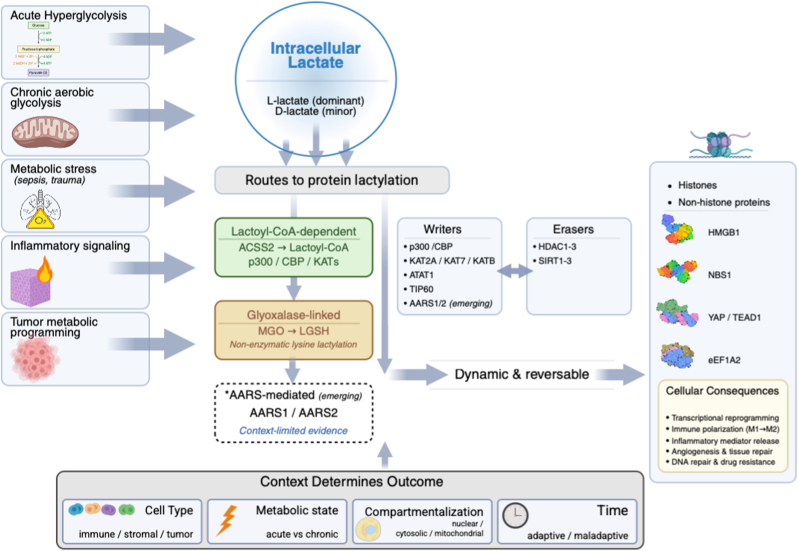 Figure 1
Peer Reviews
No public reviews on file for this paper yet. If you reviewed it on a platform where reviews are public (OpenReview, ICLR, NeurIPS, ICML), you can paste yours below so the community can read it here.
Videos
No videos yet. Explain this paper in a talk, walkthrough, or lecture? Add one.
Taxonomy
TopicsCancer, Hypoxia, and Metabolism · Immune cells in cancer · Advanced Glycation End Products research