Structured light 3D scanner simulation dataset
Michał Własiuk, Robert Sitnik

TL;DR
This paper introduces a simulated 3D scanner dataset to help test and improve 3D imaging algorithms without real-world complications.
Contribution
The novelty is a simulated 3D structured light scanner dataset with controlled conditions for algorithm testing.
Findings
The simulated scanner can project sinusoidal and Gray code patterns onto 3D objects.
Surface materials and lighting can be controlled to test algorithms systematically.
The dataset removes real-world errors for reliable algorithm evaluation.
Abstract
Computer simulation of optical measurement systems plays a crucial role in the design, analysis, and optimization of real-world measurement solutions. However, acquiring real measurement data often involves challenges such as a complex experimental setup, sensitivity to environmental conditions, and the presence of noise and calibration errors, which can hinder controlled algorithm evaluation. To address this issue, in this data article, we introduce datasets generated using a simulated 3D structured light scanner. These samples are produced by projecting a series of sinusoidal and Gray code patterns onto various 3D objects using a simulated projector. The simulated environment also provides the flexibility to apply different surface materials and controlled illumination conditions, enabling systematic testing of algorithms under diverse yet precisely defined scenarios. This approach…
Genes, proteins, chemicals, diseases, species, mutations and cell lines named across the full text — each resolved to its canonical identifier and authoritative record.
Click any figure to enlarge with its caption.
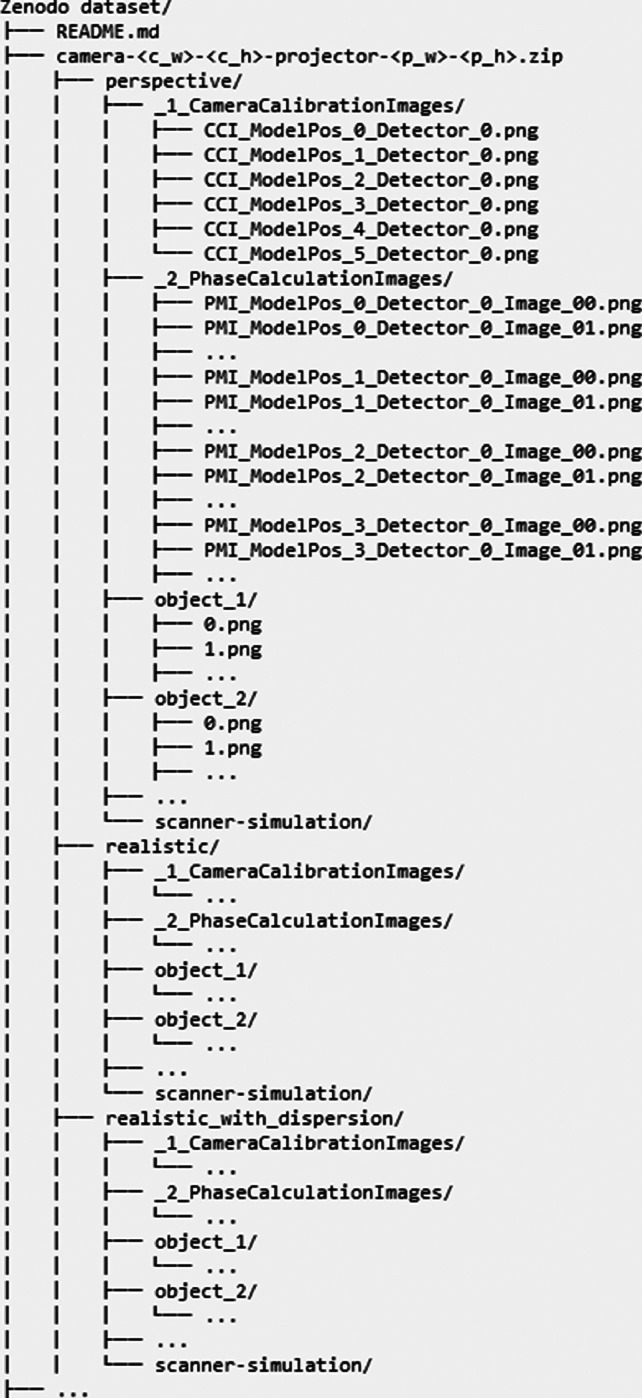 Figure 1
Peer Reviews
No public reviews on file for this paper yet. If you reviewed it on a platform where reviews are public (OpenReview, ICLR, NeurIPS, ICML), you can paste yours below so the community can read it here.
Videos
No videos yet. Explain this paper in a talk, walkthrough, or lecture? Add one.
Taxonomy
TopicsOptical measurement and interference techniques · Computer Graphics and Visualization Techniques · Advanced optical system design