The complete genome sequencing data of Priestia aryabhattai SPCL1 isolated from a heavy metal leachate-contaminated soil in Queretaro, México
Mario Eduardo Clemente Albores, María De Los Ángeles Hernández Tépach, Paola Itzel Herrera de la Torre, Mayra Paola Mena Navarro, María Carlota García Gutiérrez, Karla Isabel Lira De León, David Gustavo García Gutiérrez, Aldo Amaro Reyes, Miguel Angel Ramos López

TL;DR
This paper presents the complete genome sequence of a bacterial strain from contaminated soil in Mexico, offering insights into its potential biological functions.
Contribution
The study provides the first complete genome sequence of Priestia aryabhattai SPCL1 from a heavy metal-contaminated site.
Findings
The genome consists of 41 contigs and approximately 5.6 million base pairs with a GC content of 37.58 mol%.
Six plasmid contigs were identified with varying lengths and GC content.
The genome data is publicly available for further research and potential biotechnological applications.
Abstract
We are providing the genome sequence of Priestia aryabhattai SPCL1, a bacterial strain isolated from a heavy metal leachate-contaminated soil in Querétaro, México. The Illumina NovaSeq platform was used to sequence the whole genome and the sequencing data obtained, including assembly and annotation, were analyzed on the BV-BRC platform. The genome, comprising 41 contigs and approximately 5.6 million base pairs with a GC content of 37.58 mol % and 6131 protein-coding sequences. In addition, 6 contigs of 146,177 bp (36.77 mol % G + C), 126,627 bp (33.27 mol % G + C), 16,881 bp (34.13 mol % G + C), 9835 bp (34.67 mol % G + C), 7402 bp (36.54 mol % G + C) and 4590 bp (35.38 mol % G + C) were assembled as plasmids. This analysis of genomic data represents a valuable resource for increasing knowledge of this bacterial specie and for possible applications in its biological functions. The…
Genes, proteins, chemicals, diseases, species, mutations and cell lines named across the full text — each resolved to its canonical identifier and authoritative record.
Click any figure to enlarge with its caption.
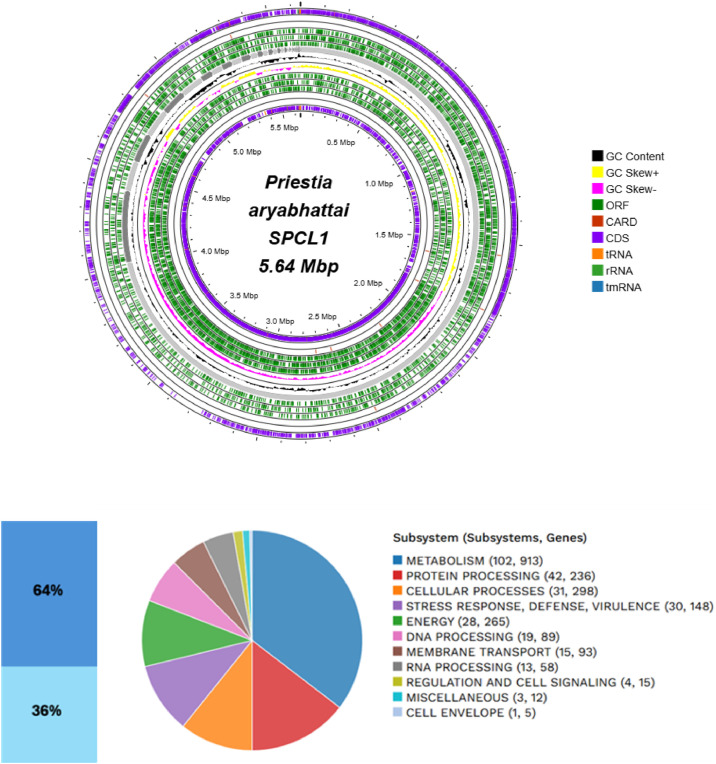 Figure 1
 Figure 2
 Figure 3
 Figure 4
Peer Reviews
No public reviews on file for this paper yet. If you reviewed it on a platform where reviews are public (OpenReview, ICLR, NeurIPS, ICML), you can paste yours below so the community can read it here.
Videos
No videos yet. Explain this paper in a talk, walkthrough, or lecture? Add one.
Taxonomy
TopicsChromium effects and bioremediation · Heavy metals in environment · Aluminum toxicity and tolerance in plants and animals