Shoulder arthroplasty following a previous Latarjet procedure
Matthias Biner, Bettina Hochreiter, Philipp Kriechling, Karl Wieser

TL;DR
This study compares shoulder replacement outcomes in patients who had a prior Latarjet procedure, finding that reverse total shoulder arthroplasty (rTSA) performs best in terms of survival and complications.
Contribution
The study provides a comparative analysis of implant survival and outcomes for different shoulder arthroplasty types in patients with prior Latarjet surgery.
Findings
Reverse total shoulder arthroplasty (rTSA) showed significantly better reintervention-free survival compared to hemiarthroplasty (HA) in post-Latarjet patients.
Post-Latarjet patients undergoing hemiarthroplasty (HA) had significantly worse improvements in shoulder motion and functional scores compared to matched controls.
Complication rates were highest for HA in post-Latarjet patients (75%) compared to matched controls (25%).
Abstract
Shoulder arthroplasty in patients with prior Latarjet procedures is technically challenging due to altered anatomy and soft tissue changes. This study aimed to compare clinical outcome measures, complications, and implant survival in primary hemiarthroplasty (HA), anatomic total shoulder arthroplasty (aTSA), and reverse total shoulder arthroplasty (rTSA) in patients with previous Latarjet surgery vs. matched cohorts. A retrospective analysis was conducted including a total of 69 patients, comparing 23 post-Latarjet patients (4 HA, 6 aTSA, 13 rTSA) with a 2:1 matched control group. Outcomes included range of motion, functional scores (absolute and relative Constant-Murley Score [aCS and rCS], Subjective Shoulder Value), complications, revisions, and radiographic findings. Kaplan–Meier survival analysis evaluated reintervention-free survival. Demographics were not significantly…
Genes, proteins, chemicals, diseases, species, mutations and cell lines named across the full text — each resolved to its canonical identifier and authoritative record.
Click any figure to enlarge with its caption.
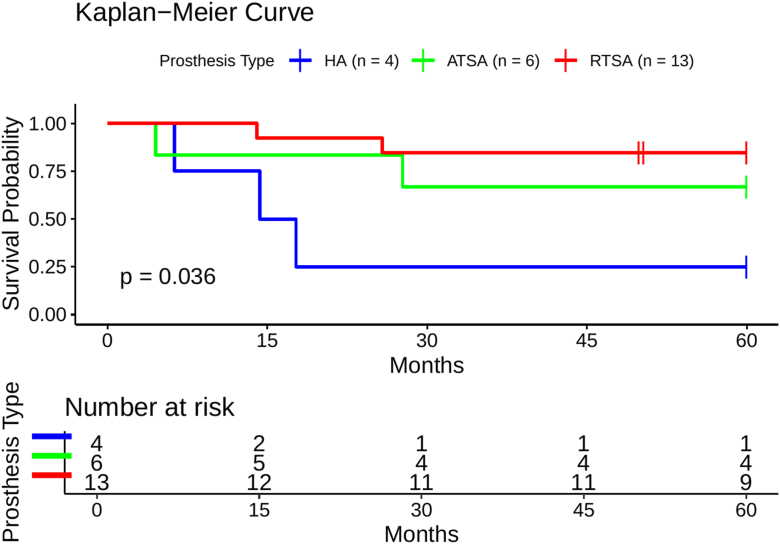 Figure 1
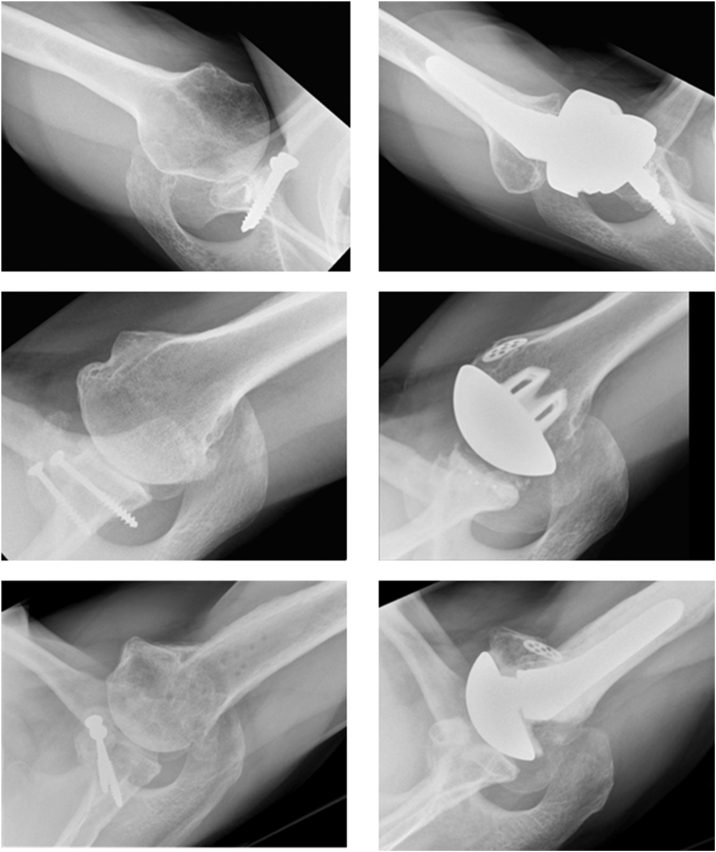 Figure 2
Peer Reviews
No public reviews on file for this paper yet. If you reviewed it on a platform where reviews are public (OpenReview, ICLR, NeurIPS, ICML), you can paste yours below so the community can read it here.
Videos
No videos yet. Explain this paper in a talk, walkthrough, or lecture? Add one.
Taxonomy
TopicsShoulder Injury and Treatment · Shoulder and Clavicle Injuries · Orthopedic Surgery and Rehabilitation