SpecFlu-Net: A frequency-aware neural architecture with temporal-dependency optimization for long-term seasonal influenza transmission forecasting
Tianyi Feng, Yu Huang, Chunyan Luo

TL;DR
SpecFlu-Net is a new AI model that improves long-term predictions of seasonal influenza outbreaks by addressing data challenges like phase drift and peak asymmetry.
Contribution
SpecFlu-Net introduces a frequency-aware neural architecture with a novel TDT loss to enhance long-term influenza forecasting accuracy and stability.
Findings
SpecFlu-Net outperforms state-of-the-art models on three CDC datasets for up to 24 weeks ahead.
The model's frequency-aware encoding and TDT loss improve peak timing and epidemic trajectory coherence.
The framework is parameter-efficient and interpretable, suitable for public health applications.
Abstract
•Influenza Burden Requires Long-Term Forecasts: Seasonal influenza causes millions of severe cases and up to 650,000 deaths annually, demanding reliable 3–6 month predictions for proactive interventions.•Four Data Challenges Identified: Quasi-periodicity with drifting phase, sharp asymmetric peaks, collinear seasonal drivers, and temporal inconsistency under NAR decoding hinder forecasting accuracy.•Frequency-Aware Spectral Encoding: SpecFlu-Net employs a learnable Fourier transform to preserve phase, compact energy, and denoise signals for improved epidemic peak timing.•Temporal-Dependency Optimised Loss: A novel TDT loss anchors first differences, balancing absolute accuracy with epidemic trajectory coherence in non-autoregressive decoding.•Consistent Outperformance Across Datasets: On three CDC datasets and horizons up to 24 weeks, SpecFlu-Net surpasses state-of-the-art baselines,…
Genes, proteins, chemicals, diseases, species, mutations and cell lines named across the full text — each resolved to its canonical identifier and authoritative record.
Click any figure to enlarge with its caption.
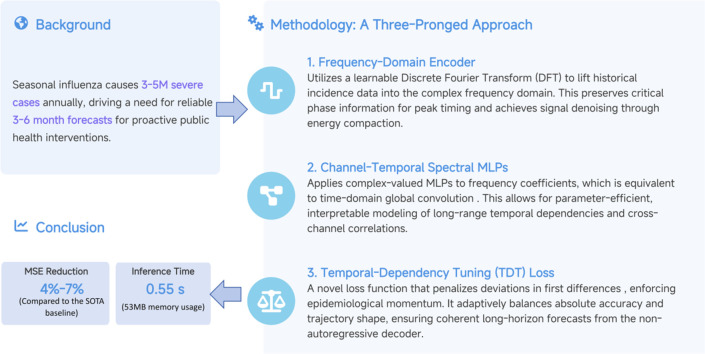 Figure 1
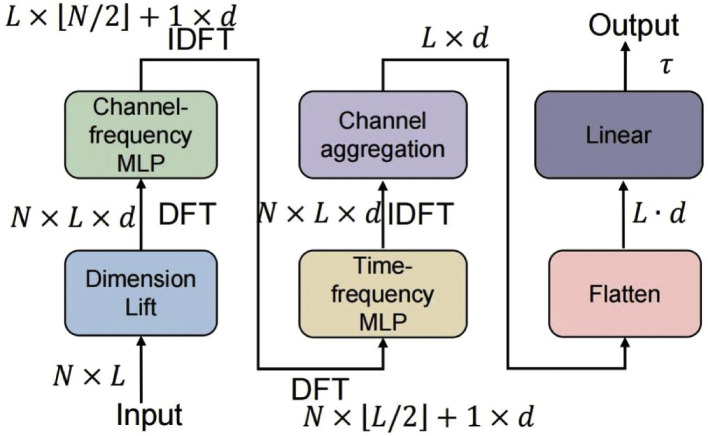 Figure 2
 Figure 3
 Figure 4
Peer Reviews
No public reviews on file for this paper yet. If you reviewed it on a platform where reviews are public (OpenReview, ICLR, NeurIPS, ICML), you can paste yours below so the community can read it here.
Videos
No videos yet. Explain this paper in a talk, walkthrough, or lecture? Add one.
Taxonomy
TopicsInfluenza Virus Research Studies · Neural Networks and Reservoir Computing · Hydrological Forecasting Using AI