Speech under stress: Affective and cognitive reactivity in schizophrenia and their functional correlates
Kyle S. Minor, Madisen T. Russell, Evan J. Myers, Audrey T. Satchivi, Maya E. Brown-Hughston, Erica L. Whiting, Deborah Daluga, Rachel C. Marks, Michaela M. Di Palmo, Basma O. Aly

TL;DR
This study explores how emotional and cognitive stress affects speech disorganization in schizophrenia, finding that speech issues are more pronounced and linked to cognitive impairment.
Contribution
The study identifies affective and cognitive reactivity as factors influencing speech disorganization in schizophrenia, using novel regression-based analyses.
Findings
The schizophrenia group exhibited significantly greater disorganized speech across all conditions.
Affective reactivity was detected only through regression analyses, not repeated-measures ANOVA.
Both affective and cognitive reactivity showed inverse correlations with neurocognitive functioning.
Abstract
Disorganized speech is a core diagnostic criterion of schizophrenia, yet mechanisms driving its variability remain unclear. Building on evidence from schizotypy and first-episode psychosis literature, we examined whether affective and cognitive systems influence speech disorganization in schizophrenia. Thirty-five individuals with schizophrenia (n = 35) and 37 healthy controls completed a validated speech paradigm across three conditions: neutral, affective, and cognitive load. Trained raters assessed disorganized speech using the Communication Disturbances Index (CDI). Reactivity was quantified using standardized residual change scores. The schizophrenia group exhibited significantly greater disorganized speech across all conditions (d = 0.58–0.89). Of note, affective reactivity emerged only when using regression-based analyses controlling for neutral condition disorganization, not…
Genes, proteins, chemicals, diseases, species, mutations and cell lines named across the full text — each resolved to its canonical identifier and authoritative record.
Click any figure to enlarge with its caption.
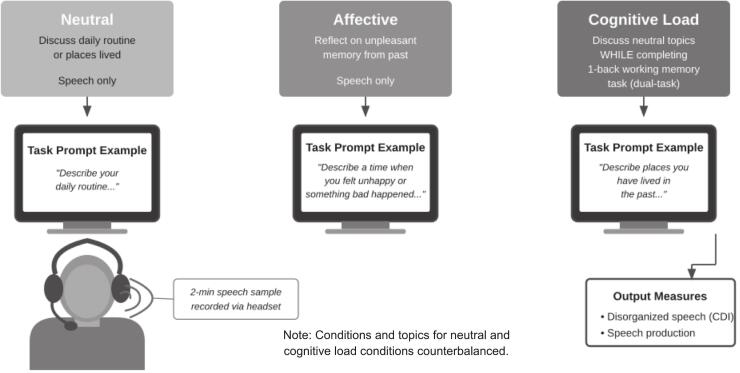 Figure 1
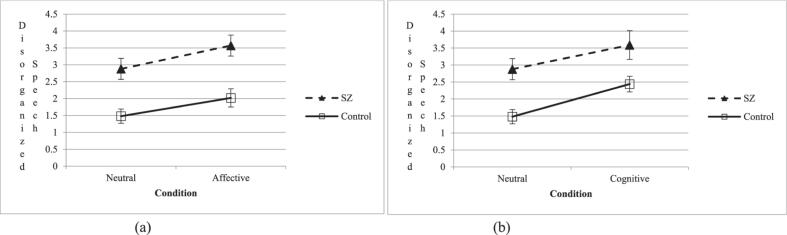 Figure 2
Peer Reviews
No public reviews on file for this paper yet. If you reviewed it on a platform where reviews are public (OpenReview, ICLR, NeurIPS, ICML), you can paste yours below so the community can read it here.
Videos
No videos yet. Explain this paper in a talk, walkthrough, or lecture? Add one.
Taxonomy
TopicsSchizophrenia research and treatment · Neuroscience and Music Perception · Emotion and Mood Recognition