Effects of low-load blood flow restriction vs. high-load resistance training on upper-body strength in male collegiate gymnasts: A randomized controlled trial
Aojie Li, Jing Tang, Kaiqi Zheng, Jingyi Chen, Guangshun Wang, Daoguang Feng

TL;DR
This study found that low-load blood flow restriction training works as well as high-load training for improving upper-body strength in male gymnasts.
Contribution
The study demonstrates comparable efficacy of BFR-LRT and HRT in elite athletes, with distinct adaptation pathways.
Findings
Both BFR-LRT and HRT improved upper-body strength and endurance more than control training.
BFR-LRT and HRT showed no significant differences in outcomes, supported by Bayesian analysis.
Mediation analysis revealed modality-specific pathways for endurance gains in handstand push-ups.
Abstract
High-load resistance training (HRT) is the standard for developing strength, characterized by high mechanical loads. Low-load training with blood flow restriction (BFR-LRT) has emerged as an alternative that uses lower mechanical loads but greater repetition volume to induce metabolic stress. While these training modalities impose differing physiological demands, the extent to which they produce comparable adaptations in highly trained athletes remains unclear. This study aimed to compare the effects of a 6-week BFR-LRT program versus a traditional HRT program on upper-body maximal strength and strength endurance in male collegiate gymnasts. Thirty male collegiate gymnasts completed the experiment in three parallel groups: HRT (3 sets of 10 repetitions at 75% 1-repetition maximum [1RM]), BFR-LRT (1 set of 30 and 3 sets of 15 repetitions at 30% 1RM), or a control group (CG) that…
Genes, proteins, chemicals, diseases, species, mutations and cell lines named across the full text — each resolved to its canonical identifier and authoritative record.
Click any figure to enlarge with its caption.
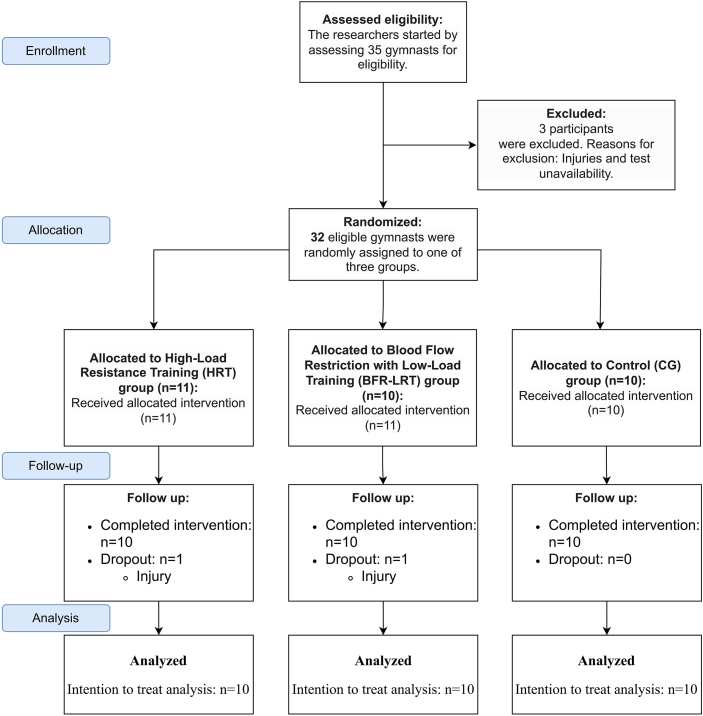 Figure 1
 Figure 2
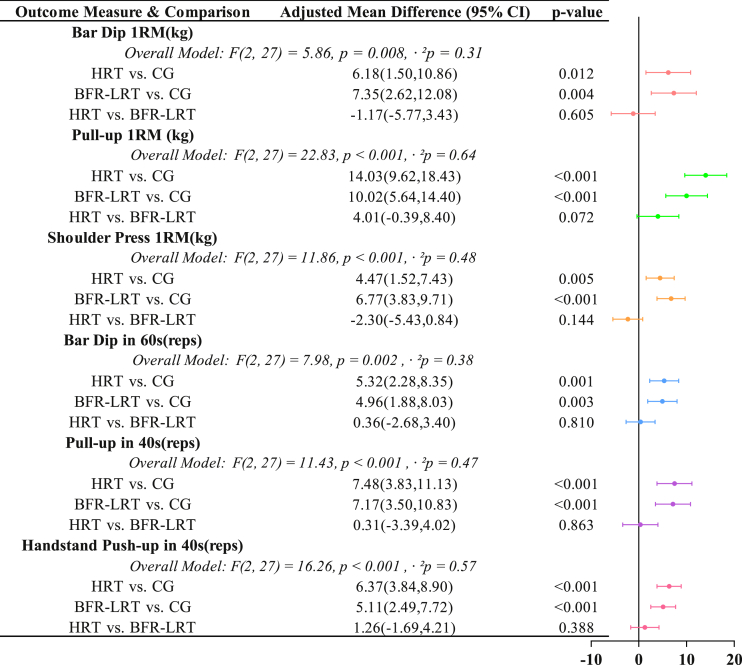 Figure 3
Peer Reviews
No public reviews on file for this paper yet. If you reviewed it on a platform where reviews are public (OpenReview, ICLR, NeurIPS, ICML), you can paste yours below so the community can read it here.
Videos
No videos yet. Explain this paper in a talk, walkthrough, or lecture? Add one.
Taxonomy
TopicsCardiovascular and exercise physiology · Sports Performance and Training · Thermoregulation and physiological responses