Long-term effect of discontinuing anticholinesterase treatment on cognitive decline and mortality in Alzheimer's disease in France: a quasi-experiment and target trial emulation study
Simon Lecerf, Octave Guinebretiere, Raphaël Bentegeac, Victoria Gauthier, Estelle Aymes, Chaymae Mekkaoui, Julien Dumurgier, Philippe Amouyel, Stanley Durrleman, Thomas Nedelec, Thibaud Lebouvier

TL;DR
A study in France found that stopping cholinesterase inhibitors in Alzheimer's patients led to faster cognitive decline over four years, suggesting these drugs may still be beneficial.
Contribution
The study provides real-world evidence of the long-term cognitive benefits of cholinesterase inhibitors in Alzheimer's disease.
Findings
Discontinuing cholinesterase inhibitors led to a 1.81-point greater decline in MMSE scores after four years.
No significant difference in mortality was observed between groups over five years.
The study supports the clinical relevance of cholinesterase inhibitors for mild-to-moderate Alzheimer's.
Abstract
In 2018, France withdrew reimbursement for cholinesterase inhibitors (ChEIs) in Alzheimer's disease, citing modest efficacy, lack of long-term benefit, and safety concerns. This policy shift provided a unique opportunity to assess ChEI effectiveness in real-world settings, by evaluating, among patients treated with ChEI between 01/08/2017 and 01/08/2018, the impact of treatment discontinuation on cognitive decline (MMSE score) and survival. Using the French National Alzheimer's Database (BNA) and Meotis databases, we emulated a pragmatic, intention-to-treat trial comparing patients who discontinued ChEIs after delisting to those who continued treatment, under quasi-experimental conditions. To model cognitive trajectories, we used the inverse probability treatment-weighted (IPTW) cohort and applied mixed-effects models with random intercepts across all follow-up visits. Survival was…
Genes, proteins, chemicals, diseases, species, mutations and cell lines named across the full text — each resolved to its canonical identifier and authoritative record.
Click any figure to enlarge with its caption.
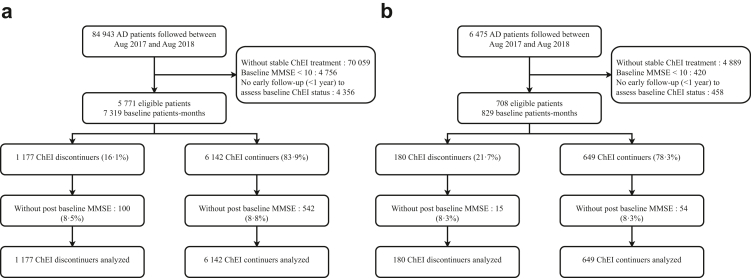 Figure 1
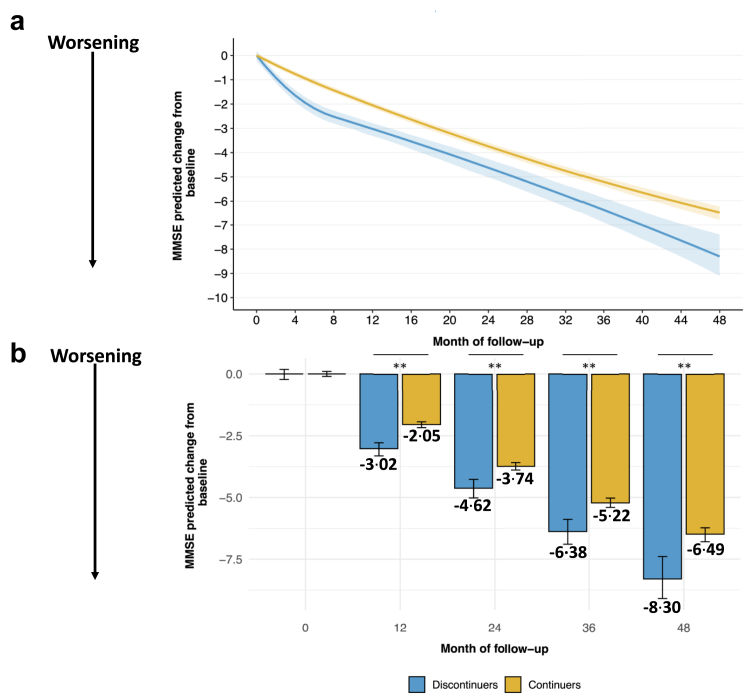 Figure 2
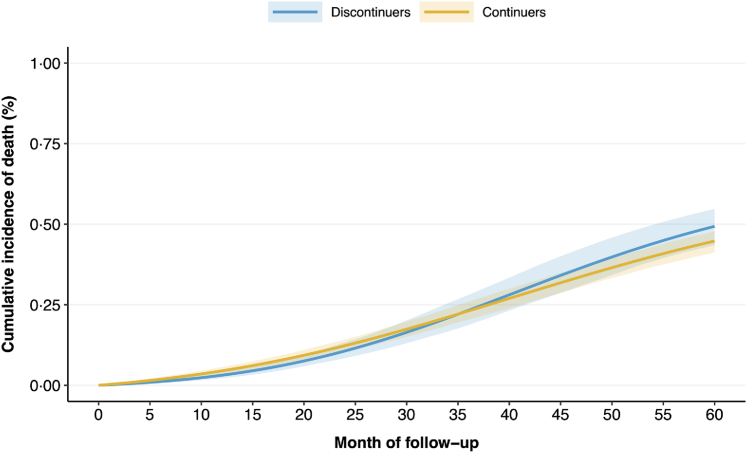 Figure 3
Peer Reviews
No public reviews on file for this paper yet. If you reviewed it on a platform where reviews are public (OpenReview, ICLR, NeurIPS, ICML), you can paste yours below so the community can read it here.
Videos
No videos yet. Explain this paper in a talk, walkthrough, or lecture? Add one.
Taxonomy
TopicsAlzheimer's disease research and treatments · Dementia and Cognitive Impairment Research · Cancer-related cognitive impairment studies