Altered perivascular diffusivity in glioblastoma: integrating DTI-ALPS index with radio-pathomic and histopathologic correlates
Biprojit Nath, Samuel A. Bobholz, Daniel C. Kim, Allison K. Lowman, Savannah R. Duenweg, Aleksandra Winiarz, Benjamin Chao, Fitzgerald Kyereme, Michael Barrett, Hope M. Reecher, Jennifer Connelly, E. Kelly S. Mrachek, Jamie Jacobsohn, Max O. Krucoff, Elaine Tanhehco

TL;DR
This study shows that glioblastoma tumors disrupt brain fluid drainage pathways, as seen through MRI metrics and tissue analysis.
Contribution
The study introduces DTI-ALPS as a novel MRI-based measure to assess glymphatic dysfunction in glioblastoma.
Findings
DTI-ALPS index was significantly lower on the tumor-affected side in glioblastoma patients.
DTI-ALPS metrics inversely correlated with tumor volume and cellularity in affected regions.
Autopsy samples showed tumor cells in perivascular spaces, supporting glymphatic disruption.
Abstract
Glioblastoma is an aggressive primary brain tumor that often exhibits perivascular invasion. This behavior may directly interfere with glymphatic flow, hindering perivascular drainage routes. This study aims to assess glymphatic dysfunction in glioblastoma by evaluating the DTI-ALPS index, an MRI-based surrogate of glymphatic activity. We additionally correlate mpMRI-derived tumor features with radio-pathomic maps of hypercellularity. We included 368 IDH-wildtype GBM patients from the UCSF-PDGM dataset. Preoperative T1, T1C, FLAIR, ADC, and diffusion tensor imaging (DTI) maps were preprocessed using standard co-registration and intensity normalization protocols. Radio-pathomic maps of tumor cellularity were generated using a previously published model which was trained on spatially aligned autopsy samples. The DTI-ALPS index was computed using DTI maps normalized to the JHU-ICMB-FA…
Genes, proteins, chemicals, diseases, species, mutations and cell lines named across the full text — each resolved to its canonical identifier and authoritative record.
Click any figure to enlarge with its caption.
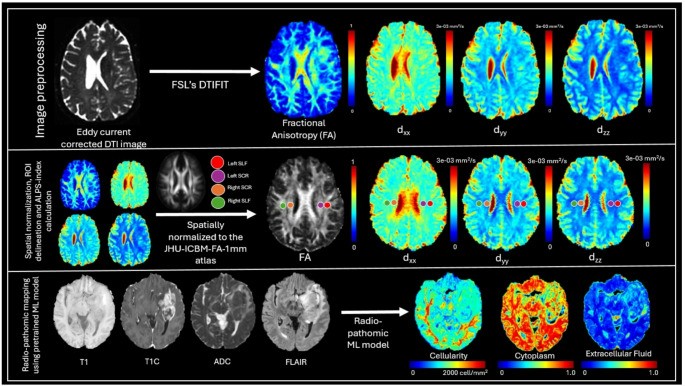 Figure 1
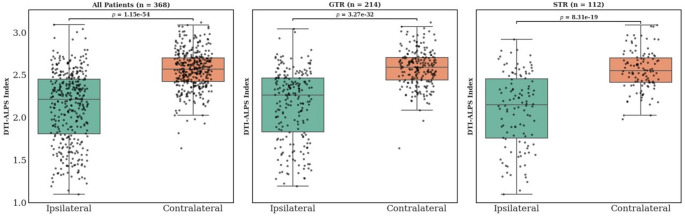 Figure 2
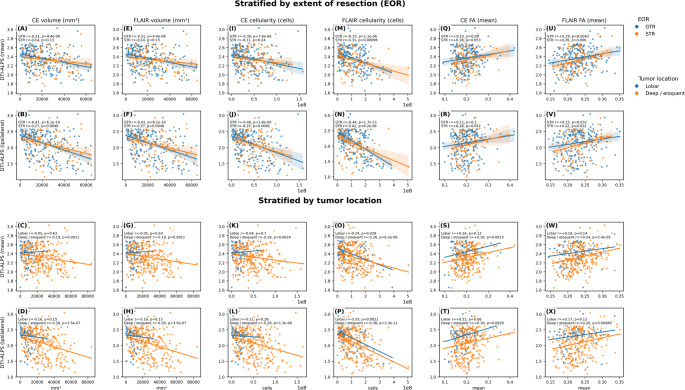 Figure 3
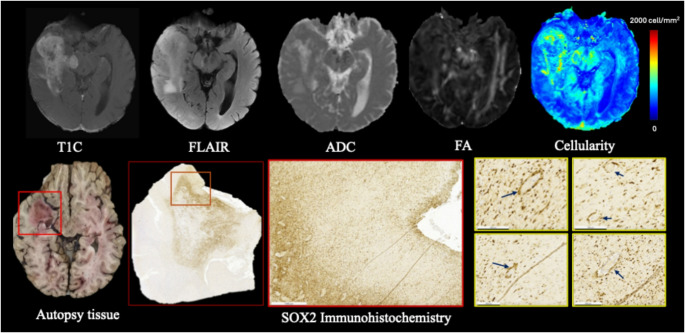 Figure 4
Peer Reviews
No public reviews on file for this paper yet. If you reviewed it on a platform where reviews are public (OpenReview, ICLR, NeurIPS, ICML), you can paste yours below so the community can read it here.
Videos
No videos yet. Explain this paper in a talk, walkthrough, or lecture? Add one.
Taxonomy
TopicsCerebrospinal fluid and hydrocephalus · Glioma Diagnosis and Treatment · Advanced Neuroimaging Techniques and Applications